At my son’s wedding, 500 guests watched my in-laws point a finger at me and laugh. They called me trash. My daughter-in-law, in her $50,000 dress, laughed the hardest of all. She thought she’d won the lottery marrying my son.
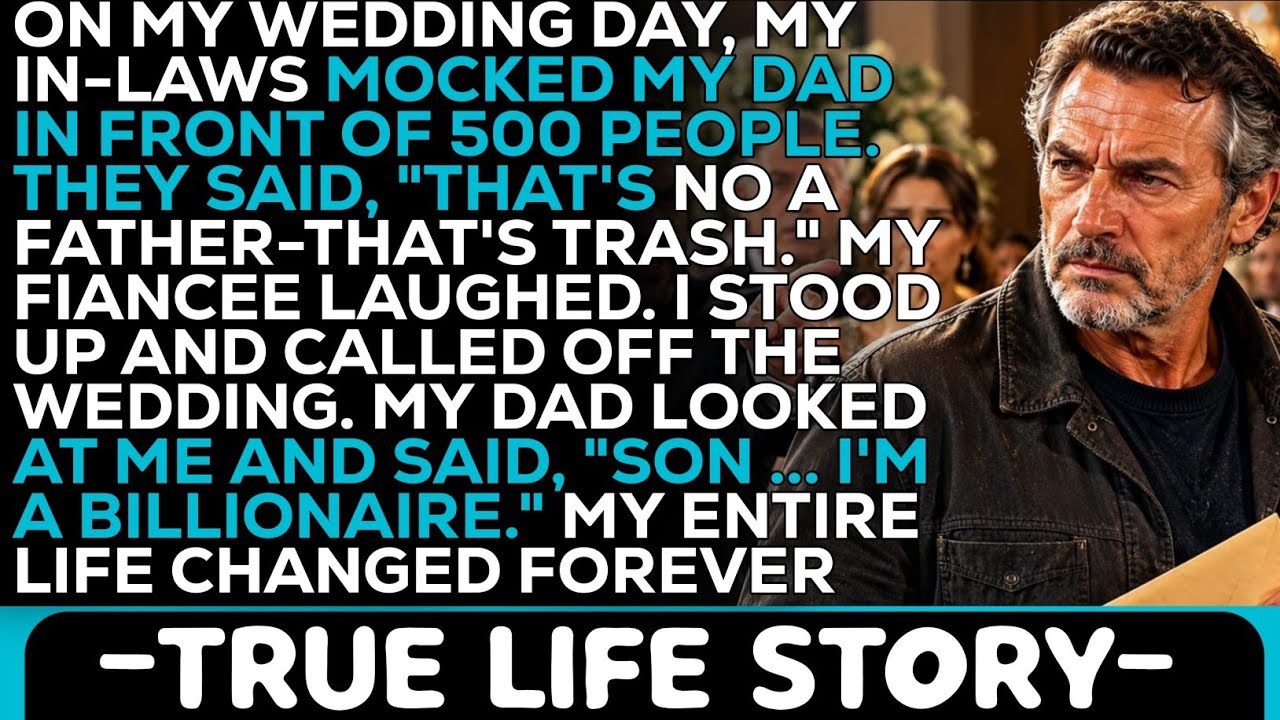
But when I stood up and walked out of that ballroom, I wasn’t leaving in shame. I was leaving to make a phone call that would bankrupt her entire family by sunrise. I sat at table 42 that night, the table for the help, tucked by the kitchen doors, steam and noise hitting me every time a waiter pushed through. My suit was five years old, off the rack, a little tight in the shoulders.
My hands were rough, calloused from fifty years of honest labor. Across the room, the Sterling family held court like royalty. Richard, in his custom Italian tuxedo, Catherine dripping in diamonds — beautiful, polished, and rotten to the core. My son Darius sat beside his bride, Victoria, adoration in his eyes.
She wasn’t looking at him. She was looking at the cameras, at the guests, making sure she was envied. I’d warned Darius that people who judge you by your shoes will never watch your back in a fight. He told me I was bitter.
He was in love. He was wrong about her, and I was about to be proven right in the worst possible way. Richard tapped his microphone, and the room fell silent. His toast turned into a public execution.
He walked the spotlight straight to table 42, pointed a manicured finger at me, and told 500 of the city’s elite that I was the anchor tied to his son-in-law’s ankle — not a father, a cautionary tale. Victoria threw her head back and laughed, genuine and delighted. That laugh was the sound of a guillotine dropping. Darius stood.
His chair screamed against the floor. He walked to the stage, took the microphone, and told the room what his father actually was — a man who worked eighteen-hour days and wore the same boots for a decade so his son could have new sneakers. Then he pulled off his wedding ring, looked at the woman he’d loved for three years, and said, “There is no wedding. ”
He threw the ring.
It hit the floor like a gunshot. Richard grabbed my lapel, hissing threats. I peeled his hand off my jacket with a grip that surprised him. Fifty years of hauling steel doesn’t show on a man’s face, only in his hands.
I told him not to worry about the cost of his ruined night. He had bigger debts to worry about. Then I walked my son out to my rusted-out Ford. And once we were alone on the highway, I pulled a satellite phone from the glove compartment and made a call that ended with the words, “The Sterlings don’t own that hotel anymore.
”
Because here’s what nobody at that wedding knew. The broke old mechanic in the cheap suit was Langston Bennett, founder of Bennett Global Holdings, owner of the cargo ships that brought Richard Sterling’s cheap imported goods into this country. I had let my son marry into that family blind because I needed to know one thing: Did they love Darius, or did they love what they assumed I was worth? Now I had my answer.
The next morning, the Sterlings pounded on my door. Richard, Catherine, and Victoria, reeking of stale champagne and rage. They threw a bill at my chest — $250,000 for their ruined night — and a threat of a lawsuit that would bury Darius. Catherine flung hot coffee across my shirt without blinking.
Victoria told my son he was never good enough for her, that marrying him had been a favor. They gave me twenty-four hours to pay, or they’d take everything Darius had, including the $50,000 predatory loan they’d pressured him into taking out just to afford their idea of a worthy engagement ring. After they left, I told Darius to follow me into the kitchen. I pulled back a rug, pressed my thumb to a hidden panel in the floorboard, and a staircase opened beneath our feet.
My son followed me down into a room lined with monitors — live shipping data, banking feeds, and a framed Forbes cover on the wall. The ghost of logistics. How Langston Bennett built an empire from the shadows. “I fix cars because I like fixing cars,” I told him.
“This is my job. Richard Sterling is rich. I am wealthy. There’s a difference.
Wealth is quiet. Wealth is patient. ”
I’d already bought his predatory loan and forgiven it. He owed those banks nothing.
He owed me nothing but the truth about who really loved him. But the Sterlings weren’t finished. Victoria went live on social media within hours, sobbing on camera, claiming Darius had threatened her, that his father had attacked hers at the wedding. The lie spread like fire.
By morning, Darius’s boss had fired him over the phone, no questions asked. The man played golf with Richard every Sunday. I told my son not to respond. Not yet.
When your enemy is digging their own grave, you don’t take away the shovel. Instead, I opened a Manila folder I’d been sitting on for six months — a private investigator’s file. Victoria was pregnant, and the ultrasound date didn’t line up. The conception window fell during the week Darius had slept in a hospital waiting room while I recovered from heart surgery.
The child wasn’t his. It belonged to her personal trainer, photographed leaving the hotel with her on the exact right week. Two days later came the invitation — cream envelope, wax seal, a summons to dinner at the city’s most exclusive restaurant to make peace. It was a trap, and I knew it.
So I drove Darius there myself in a chauffeur’s cap, playing the invisible help while my son walked in to face them. Richard blocked me from the table. “Drivers wait over there. ” And I let him.
I sat at the wobbly table by the kitchen with a wireless earbud in and a bug sewn into Darius’s jacket, listening to Richard’s real offer. Sign a statement blaming a mental breakdown, let Victoria call the abuse allegations emotional, and in a year or two, maybe they’d toss him a job in a satellite office. “You’re a good dog,” Richard told my son. “Sit.
”
I’d heard enough. I pulled a black titanium card from my jacket, laid it on the table, and told the stunned maître d’ I wanted to pay for every table in the restaurant except the Sterlings’. Champagne for the whole room, courtesy of an anonymous friend, and a napkin delivered to Richard with the bill. One line written in fountain pen: “The last meal is always the best.
”
I watched through the window as the room erupted in celebration around one silent, isolated table, and Richard’s face drained of color as he realized a ghost had been sitting twenty feet away all along. They tried to salt the earth after that. Every firm Darius called went cold overnight. Even his old mentor admitted Richard sat on the university board and had threatened to pull funding.
My son started packing a bag, ready to run to Alaska and disappear. I stopped him at the door. “Grab your good suit,” I said. “We have a meeting in forty-five minutes.
”
We pulled up to a sixty-story glass tower with our name in steel letters over the entrance. Bennett Global Holdings. Darius stood frozen on the sidewalk as security guards bowed their heads to me. I walked him to a corner office overlooking the entire city and told him the truth.
I hadn’t built this empire to make money. I’d built it so no man could ever again tell my son he wasn’t good enough. Then I showed him the play. Richard had leveraged everything — his house, his business, his future — to win the Zenith project, the biggest development contract in the state.
If he lost the bid, his loans would be called, and he’d be bankrupt within ninety days. The client deciding who got that contract was a subsidiary of Bennett Global. I made Darius the anonymous project director, handed him the pen, and told him we were quietly buying up Sterling Development’s debt in the background. “He called you trash,” I said.
“Let’s take out the garbage. ”
Victoria showed up at my door days later, soaked from the rain, playing the desperate pregnant victim, demanding half a million dollars or she’d go to the press and give the baby up for adoption out of spite. I played the broken old man again, offered her the $5,000 in my coffee can, and watched her sneer at my pathetic poverty before storming out — leaving her hairbrush behind. I bagged the hair for a DNA test that night.
By evening, the results confirmed what the timeline already told us: 0% probability of paternity. Then came Catherine’s staged stroke, broadcast live on every local station, collapsing dramatically on courthouse steps the same morning she filed a lawsuit against Darius. I recognized the performance for what it was. A woman bracing her fall to protect her handbag doesn’t have a real stroke.
So I bought the hospital. All of it. I walked into her VIP suite, found her dancing with a wine glass — discharge ready, lying to a camera crew downstairs — and patched the live feed from her room straight onto the twenty-foot screen behind Richard mid-press conference. The whole city watched Richard’s grieving husband act collapse in real time, right alongside a $50,000 bill for the fake hospital stay.
At the country club I’d quietly owned for thirty years, Richard shoved me off a cart path and accused me of stealing a golf club, calling security to drag away the trash. My general manager sprinted over and threw Richard out instead, stripping his membership on the spot in front of the investors he’d been courting for a bailout. Those investors walked. That was the last lifeline gone.
I bought his mansion out from under him next. An insultingly low cash offer he had no choice but to accept, with a leaseback clause buried in the fine print that made him my tenant — paying rent to the man he’d called garbage. Victoria, meanwhile, spotted Darius driving a company Bentley through the city and instantly forgot every insult she’d thrown. She started texting, apologizing, professing love she’d never felt.
We didn’t answer. Days later, she showed up at my door with a suitcase, claiming she’d run from her collapsing family to be with her true love. We let her in and set a trap. A fake, threadbare bank passbook — showing barely $5,000 left — on the counter for her to find.
She tore my kitchen apart in a screaming rage when she found it, called Darius pathetic and poor, smashed a vase, and admitted on hidden camera that she’d only ever wanted her wealth back. She stormed out into the rain with her ultimatum: pay up in forty-eight hours or she’d take the baby and disappear. Then the lawsuit came. $5 million, delivered by a man in a tactical vest, prosecuted by the most feared litigator in the city.
I told Darius we weren’t hiring a legal team. We weren’t calling for backup at all. He would walk into that courtroom alone, and I would let Richard’s own arrogance build the trap around him. In the courtroom, Preston Vain painted Darius as a con artist and me as a leech who’d coached his son into seduction and theft.
Richard took the stand and swore under oath that Darius’s scandal had bled his company of millions and cost him the Zenith deal. That was the sentence I’d been waiting for. My attorney walked in and dropped a stack of documents in front of Richard. Proof that a holding company had quietly bought every one of his loans, triggered a default clause, and called the full $40 million he owed.
Vain, realizing his retainer had been paid with frozen funds, packed his briefcase and walked out. Richard demanded to know who owned the shell company hunting him. I stood up, took off my cheap gray jacket, and told him myself: LB Holdings. Langston Bennett.
The mechanic. The trash from table 42. I told the courtroom exactly what he was — a man drowning in debt who’d used his own daughter’s wedding scandal as a cover story for a company he’d already run into the ground. The judge dismissed the case with prejudice.
Richard collapsed. Victoria made one last desperate play in front of the cameras, begging me to think of my grandson, demanding millions for her unborn child’s sake. My attorney put the paternity results on the courtroom screen for the whole room to read: 0%. Followed by surveillance photos of her and her trainer leaving a hotel the week Darius was at my hospital bedside.
Darius didn’t rage at her. He told her quietly that he pitied her, that she’d traded a dynasty for a gym membership. Then he walked away and never looked back. We evicted the Sterlings from the mansion under police escort while they tried to loot furniture that legally belonged to me.
Richard dropped to his knees on the gravel, begging for $10,000 to get an apartment. I told him he had his health and his freedom, which was more mercy than he’d shown me at that wedding. And I donated the entire mansion to a youth shelter on the spot. Richard was later convicted on federal fraud charges tied to a decade of cooked books at Sterling Development.
Eight years, no parole hearing worth mentioning. Catherine disappeared into a small apartment near his prison, broke and friendless. I saw Victoria myself, months later, waitressing at a highway diner — her hands chapped, her eyes dead, not even recognizing the billionaire she’d once tried to extort for pocket change. I left her a $100 tip and drove home.
A year after the wedding, I stood in the back of a crowd at the ribbon cutting for Zenith Tower, watching my son address the city as CEO of Bennett Development Group. He’d remarried, quietly, in my backyard, to a woman who ran the youth shelter I’d given away. A woman who loved the man, not the balance sheet. People ask why a billionaire still lives in a small house at the edge of town, still drinks instant coffee out of a chipped mug, still drives a truck that rattles at idle.
They don’t understand. This was never a shack. This is where I raised a good man. This is where I planned a war and won it without ever raising my voice.
Money is a tool. You can use it to build a shelter, or you can use it to break a window. The Sterlings used it to break people. I used it to fix my family.
And that coffee — brewed from a $5 jar on my own porch, paid for with fifty years of honest work — tastes better than anything served at any wedding in this city. True power isn’t shouting at a waiter or flashing a black card across the table. It’s the quiet certainty of knowing exactly who you are when nobody’s watching. A tailored suit can hide a monster.
A stained work shirt can hold a king.