My daughter handed me an apron and introduced me to her guests as help. Nineteen times that evening, she and her husband dismissed me, corrected me, or claimed the building I’d owned for over two decades as their own. I didn’t argue. I didn’t make a scene.
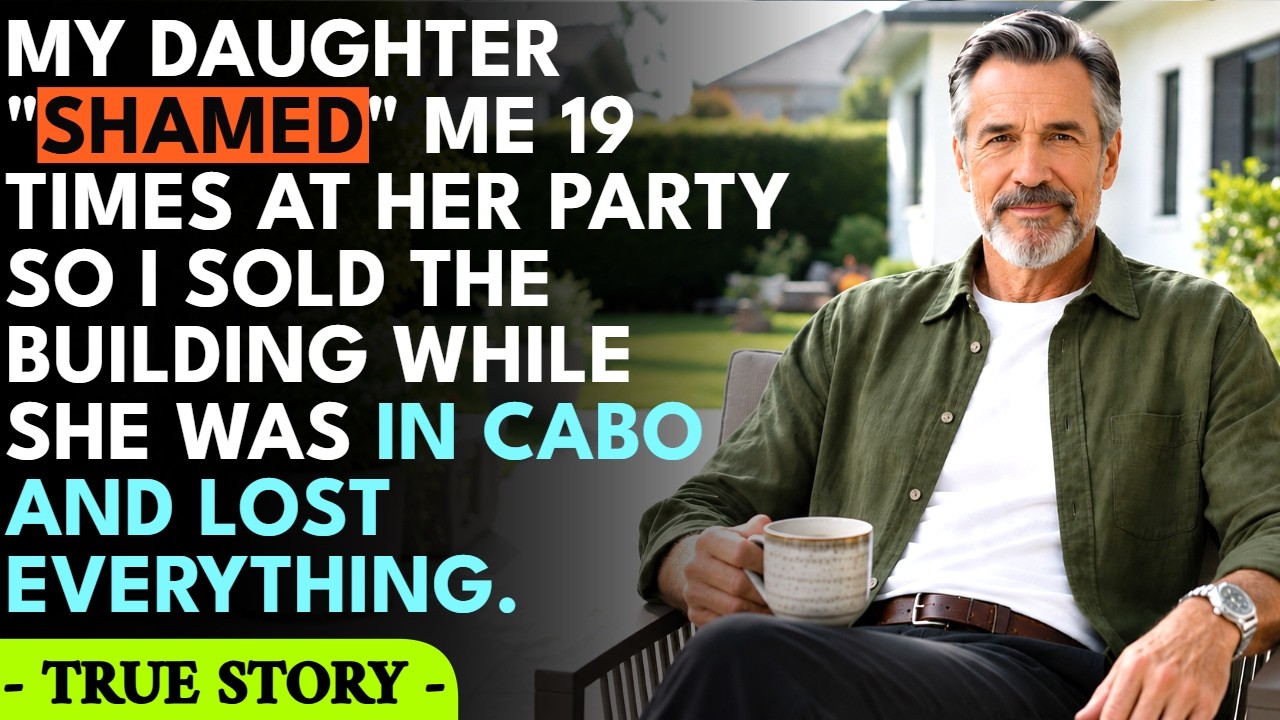
I just kept count. My name is Lou. I’m 65 years old. For 37 years, I worked as a certified iron worker—structural steel, pipelines, refineries.
It’s work that leaves permanent marks on your hands and a particular kind of quiet patience in your chest. I poured my wages into savings, a small retirement fund, and a modest two-bedroom house outside Nashville that my wife Nell and I called home for 28 years. Nell was the architect of everything I valued. She was a grade school art teacher who clipped coupons, grew tomatoes in the backyard, and read three library books a week.
About 12 years into our marriage, she spotted a small commercial building for sale on a busy state road six miles from our house. A squat brick structure with two rental units and a parking lot with weeds pushing through the asphalt. We bought it together for $187,000. We fixed it up on weekends.
We found good tenants. We held on to it. By the time Nell passed from ovarian cancer three years ago, that building was appraised at just over $1 million and generating nearly $7,000 a month in rental income. We held the title through a family trust set up years earlier at our attorney’s recommendation.
Both of us were trustees. Upon her death, sole authority passed to me. Our daughter knew we owned the building, but she never knew that her name appeared nowhere on any document connected to it. That detail would matter enormously later.
My daughter is 38. She married her husband four years ago at a vineyard outside Brentwood, a wedding that cost more than my first year’s wages as an apprentice. Her husband is a commercial real estate broker—charming in the way polished stones are charming: smooth, hard, and reflecting light without generating any of their own. He leased a large house in a gated development north of Nashville and filled it with furniture I’m fairly certain required financing.
He drove a lease vehicle and wore a watch that cost more than some people’s cars. He had a great deal of visible confidence and very little visible humility. When Nell passed, my daughter sat across from me at my kitchen table and held my hand. She told me she was worried about me being alone in that big house.
She said it would make her feel so much better if I was closer. She mentioned the apartment above the commercial building was sitting empty and it was a good, solid space. I could manage the property like I always had while being near family. I believed she meant it with love.
I sold my house. I moved into the 600-square-foot apartment above our building. I collected rent checks, scheduled HVAC inspections, and patched gutters on the east side. I called the plumber when the downstairs tenants’ bathroom backed up.
I recaulked the loading door frame in November when the cold started coming through. I was good at it. I had always been good at working with my hands. What I didn’t realize immediately was that my daughter and her husband had begun referring to the building as theirs.
Not officially, not in legal documents, but in conversation at dinner parties. In the particular tone people use when they speak about assets they expect to inherit. I first heard it at a neighborhood cookout in late summer. My son-in-law was talking to a man from his office, his voice carrying easily across the patio.
“We’ve got a solid commercial asset on the south side,” he said, relaxed and easy, turning a bottle of beer in his hand. “My father-in-law manages it for us. Keeps him busy. He’s getting up there in years, and honestly, giving him something to do has been good for him.
”
I was standing five feet away refilling a bowl of chips. He didn’t lower his voice. He didn’t look at me. I put the bowl down.
I went home. I sat in the apartment above the building I had owned for 20 years and thought about what I had just heard for a long time. Over the following weeks, I paid closer attention. My son-in-law began mentioning the building in client conversations.
My daughter started including it in what she called their portfolio when talking to her friends. Neither of them ever asked me about the trust documents or the actual legal title. They assumed. An assumption I have learned is the most expensive mistake a person can make.
The dinner party happened on a Saturday in October. My daughter and her husband were hosting eight of his top clients—developers and investors from a firm bidding on a large mixed-use project in East Nashville. The catering budget was substantial. The liquor was good.
I was invited, though not as a guest. I understood this within about four minutes of arriving. My daughter met me at the door holding a glass of champagne. She said she was glad I came.
Then she handed me an apron and said the catering staff could use help in the kitchen since one person had called out sick. She said it quietly with a small apologetic smile, as though this were a minor logistical adjustment and not what it actually was. I took the apron. I tied it around my waist.
I went into the kitchen. I’m not a man who has ever been afraid of work. I’ve poured concrete footings in 100-degree heat. I’ve run pipe in crawl spaces so tight I couldn’t fully extend my arms.
So I worked the kitchen that night. I plated appetizers. I refilled serving trays. I washed glasses.
And I paid attention. I counted what I came to call the 19. The same way I used to count weld joints on a pipeline inspection—methodical, precise, with no room for sentiment. The first came early.
A client’s wife asked my daughter who I was, and my daughter said without hesitation, “Oh, that’s just my dad. He helps out when we entertain. He’s very handy. ”
The second came when my son-in-law introduced me to his lead client, a heavyset man named Harrington who controlled more development capital than anyone else in the room, as our property manager.
Not as his wife’s father. As the property manager. The third was when my daughter, gesturing grandly at the kitchen where I was standing three feet away, told a woman in a silver dress that they handle all the domestic details themselves. “We really believe in hands-on hosting.
” I was the domestic detail she was referring to. The fourth came when my son-in-law launched into a presentation about their real estate holdings for a group gathered near the fireplace. He described the commercial building in specific terms: square footage, rental income, current tenant leases, estimated market value. With a fluency that told me he had been studying the documents I kept in my filing cabinet upstairs.
He described it as “an asset we’ve been developing strategically for several years. ” I stood in the kitchen doorway listening to a man explain my property to a room full of strangers as though he had built it himself. I went back to plating bruschetta. The fifth through the ninth came in a rapid cluster during the middle of the evening.
Small dismissals that accumulated like small costs on a job running over budget. My daughter intercepted a conversation I was having with a genuinely kind older gentleman from Memphis who had asked about my background, redirecting him toward her husband mid-sentence. My son-in-law snapped his fingers at me—actually snapped his fingers—to get my attention when he needed more ice. A client asked me a direct question about the building’s location, and my daughter answered for me, telling him I sometimes got confused about the specifics.
A guest thanked me warmly for passing her a glass of water, and my son-in-law joked loudly that “good help is hard to find. ” He laughed. A few people smiled politely. I kept counting.
The one that stopped my breathing came near 11:00. I had gone upstairs to my apartment to retrieve an extra bottle of bitters my daughter had texted me about. It took me four minutes. When I came back down the exterior staircase, I could see through the large window into the dining area before I re-entered the house.
My daughter was standing near the credenza, laughing at something a woman beside her had said. The light caught her wrist. I stopped moving. She was wearing Nell’s watch.
A vintage Omega Constellation. Silver case, cream dial, small diamonds at the hour markers. I had saved three months of overtime wages to buy it for our 25th anniversary. I had presented it to Nell at a restaurant in downtown Nashville with a card I had written and rewritten four times before getting the words right.
She had worn it every day for the last 11 years of her life. When she passed, I had placed it in a velvet box and locked it in the small fireproof safe in the bedroom closet of my apartment. My daughter had not asked to borrow it. She had not mentioned it.
She had found it, opened a safe that did not belong to her, and put my dead wife’s watch on her wrist to accessorize a dinner party outfit. I stood on the landing in the October cold, looking at the cream dial catching the light on my daughter’s wrist. And I felt something shift inside me that I cannot fully describe. It was not anger exactly.
Anger is imprecise and wastes energy. What I felt was more like the moment a structural calculation resolves—when the numbers come out clean and you know exactly what load a beam will carry before it fails. I went back inside. I set down the bitters.
I finished the evening. I counted the remaining incidents with the same detachment. My son-in-law loudly corrected something I said about the building’s rental history in front of four clients, telling them I sometimes misremembered details. My daughter, walking a group of guests toward the front door at the end of the evening, turned to one of the women and said, gesturing in my direction, “We let him stay in the unit above the building.
It keeps him close and it gives him a sense of purpose. ” The woman nodded with the particular expression people make when they are briefly sorry for someone they will never think about again. 19. I had counted 19.
I untied the apron. I folded it and set it on the kitchen counter. I said good night to my daughter, who kissed my cheek and thanked me for helping. I walked up the exterior staircase to my apartment, locked the door behind me, and sat in the dark at the small table by the window for a long while.
Then I opened my laptop. I have a financial portfolio my son-in-law would find astonishing. 37 years of union iron worker wages invested quietly and consistently. Index funds, municipal bonds, a modest position in dividend-paying industrial stocks.
Nell and I lived carefully. We did not spend money on things we did not need. The building was the centerpiece of what we built, but it was not the whole of it. I am not wealthy in the way my son-in-law understands wealth, but I am a man who has never needed to borrow money from anyone in his life.
I sent an email to my attorney that night. His name is Sam. He has handled my legal affairs for 19 years. He is not the type who handles celebrity divorces or hostile corporate raids.
He is a careful, methodical man who drafts airtight documents and does not waste words. I told him what I had heard two weeks earlier in the building’s rear parking lot. A conversation between my son-in-law and a man from his office. They had been talking about a $400,000 business loan my son-in-law was structuring to fund his share of the East Nashville development bid.
He needed collateral. He mentioned the building. He mentioned a power of attorney. He said it was being handled internally.
At the time, I had filed this away without acting on it. After the dinner party, I retrieved it. Sam called me at 7 the following morning. He had pulled the public filings on any recently recorded documents connected to the building’s address or the trust.
My son-in-law had filed a durable financial power of attorney—not a medical proxy, but a financial one, which is the instrument that actually grants asset control. With what appeared to be my notarized signature, he had used it to authorize himself to act on behalf of the trust in all financial matters. He had then submitted a collateral agreement to a lender, listing the building as security for the $400,000 loan. The signature on the collateral agreement was also mine.
I had signed nothing. I had been in this apartment fixing a door hinge and watching a baseball game on the dates those documents were supposedly executed. Sam’s voice was level but precise. “This was not a paperwork error.
This was wire fraud. This was felony forgery. If your son-in-law received the loan funds using those documents, it would compound into federal territory very quickly. ”
I asked him what our options were.
He gave me two. We could file an immediate fraud report, which would trigger a law enforcement investigation and likely result in criminal charges within weeks. My son-in-law would become the subject of a federal inquiry. His career would end publicly and loudly.
Or we could move first. We could execute a rapid, legitimate sale of the building through the trust before any loan funds transferred. The collateral my son-in-law had promised would cease to exist before the deal closed. His lender would discover the fraud independently when they went to verify the asset.
His professional relationships would collapse when his clients learned he had pledged collateral he did not own and could not control. “Which one actually costs him more? ” I asked. Sam was quiet for a moment.
Then he said, “The second one. ”
“Then do the second one,” I said. My son-in-law and my daughter left for Cabo San Lucas four days later. His firm occasionally sent top producers on client entertainment trips.
They would be gone for five nights. He stopped by my apartment the morning they left, dressed for travel, rolling bag in hand, good spirits. He told me to hold off on a few maintenance items until he returned because he wanted to discuss the property direction when he got back. He said it in the particular tone of a man who believes he is managing someone beneath him.
I nodded and said I would be right here. I watched his car pull out of the parking lot. I counted to 60. Then I called Sam.
By 2 that afternoon, Sam had a cash buyer at the table. A regional real estate investment trust that had been quietly circling the property for over a year. They knew the building. They had comped the block.
They were prepared to close fast for a price below full market value, as rapid cash sales always are. But it represented far more money than I needed, and far more than my son-in-law would ever see from it. I signed the sale documents on the hood of Sam’s car in the parking lot of his office building. My handwriting was steady.
My hands did not shake. I have welded pipe joints in February wind at 30 feet off the ground. I know how to hold still when it counts. The wire transfer cleared by 4:00.
Sam filed the deed transfer with the county recorder that same afternoon. He also sent formal written notification to my son-in-law’s lender that the durable financial power of attorney on file was fraudulent, that the building had been sold through a legitimate trust transaction, and that any collateral agreement predicated on that document was void. He copied the Tennessee Secretary of State’s office and the relevant federal authorities. Then he sent a copy of the fraud notification to the managing partner of my son-in-law’s brokerage firm.
That last part was my idea. By the time the sun went down, the building had a new owner. The locks had been changed by a commercial locksmith. A professional moving company had packed and transported my belongings—including my fireproof safe and the velvet box containing Nell’s watch, which I had quietly recovered from my daughter’s jewelry tray before they left for their trip—into temporary storage.
I left their belongings exactly where they were in their leased house. I had no claim on any of that. This was not about possessions. This was about the building, the trust, and the ground they had tried to steal out from under me.
I drove north that evening with my duffel bag on the passenger seat and a thermos of coffee in the cup holder. They returned from Cabo five days later. Sam told me what happened, relayed by the property manager the investment trust had dispatched that week. My son-in-law drove to the building mid-morning, presumably to check in before heading to the office.
He found a new commercial lock on the exterior door, a posted notice of sale, and a laminated sign displaying the investment trust’s contact information. He called the number on the sign and was told the property had changed ownership through a legitimate trust transaction recorded with the county. He was advised that continued presence on the property constituted trespassing. He called my cell phone 17 times between 10:00 in the morning and noon.
I answered on the 18th. I let him say what he had to say. It was loud and it was not measured. When he finally ran out of air, I spoke.
I told him that Nell and I had bought that building with $187,000 we saved over 12 years of careful living. I told him I had re-roofed it myself in 2009 with three friends and a rented scaffold. I told him the trust had held clear title for 22 years and that his name had never appeared on a single document connected to it, and that he had known that or should have known it before he submitted forged paperwork to a lender. Then I told him his managing partner had received the fraud notification the previous Thursday, and that he should probably check his office email.
He went quiet. “The building is gone,” I said. “The loan is void. The forgery has been reported to the appropriate federal authorities.
You should retain an attorney. A good one. ”
I ended the call. My daughter called me that evening.
She was crying. She asked me how I could do this to her. She asked me where they were supposed to go. She said she had trusted me.
I sat with that for a long moment. Then I told her that Nell’s watch was sealed in its velvet box in my storage unit, and she could collect it when she was ready to have a real conversation. Not a conversation about what I had taken from her, but about what she had taken from me. I told her I had loved her her entire life and I would continue to love her, and that love was exactly why I was not going to pretend this had not happened.
I told her that the night of the dinner party, she had handed me an apron and introduced me to her guests as help. She had let her husband tell a room full of people that the building her mother and I had owned for 22 years belonged to them. She had taken her mother’s watch from a locked safe and worn it as jewelry to a party without asking, without mentioning it, as though its history and its weight meant nothing at all. “None of that is small,” I said.
“And I am not small enough to pretend that it is. ”
She did not respond to that. We said goodbye. I do not know what comes after this between us.
That is the part I cannot engineer or calculate in advance. I only know what is true right now. I am in a small house in the hills outside Gatlinburg, Tennessee, where the Smokies rise up gray and solid in the morning fog. I bought it with part of the proceeds from the building sale.
A modest place with a wood-burning fireplace, a covered porch, and a view of a creek I can hear from my bedroom window when I leave it cracked at night. The nearest neighbor is a quarter mile up the road. I wake up early because I always have. I make coffee in a percolator.
I sit on the porch in my flannel shirt and watch the fog lift off the ridgeline, and I think about Nell, who would have loved this place. She would have planted something in the narrow strip of level ground behind the house. She would have found the library in town within the first week. I keep her watch in the top drawer of the nightstand.
Not because I am waiting to return it or deciding what to do with it, but because it belongs where I can see it. Where the person who cared most about it can be remembered correctly. Not as an accessory on someone’s wrist at a dinner party, but as a symbol of a life built from nothing, on purpose, with steady hands and enough patience to wait for the things that were worth having.
That is what I know how to do.