At 3:15 in the morning, while hackers from Romania were trying to break into a bank’s customer accounts, I unplugged my headset and walked away. Not because I was scared. Not because I couldn’t handle it. Because they just told me I was worth $4,500, while my coworker Jason was worth $32,000 for doing half the work.
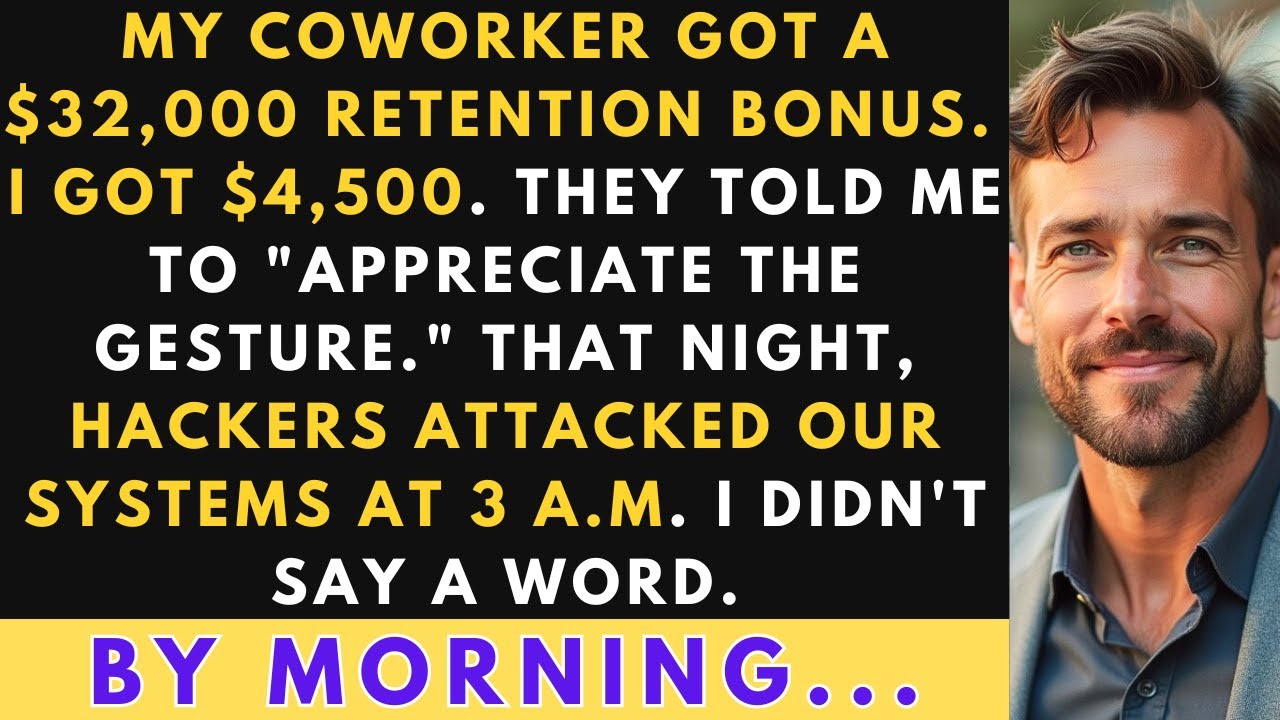
My name is David Thompson. I’m 47. Until three months ago, I spent my nights watching computer screens in Austin, making sure hackers didn’t break into bank accounts while the rest of Texas slept. I didn’t quit in a blaze of glory.
I didn’t slam my laptop shut or flip my desk. I left the way you leave a building that’s been crushing your shoulders for 23 years. Slow, careful, and with a weird kind of relief once the weight wasn’t mine to carry anymore. It started with a retention bonus announcement on a Thursday morning.
The kind of corporate good news that’s really just fear wearing a suit and tie. I worked the overnight cybersecurity shift for Apex Security Solutions, a midsize firm that handled network monitoring for financial institutions. Nothing glamorous about it. When a threat got past our defenses at 2:30 a.
m. , my phone would buzz, and I’d be the one digging through logs, blocking IP addresses, and keeping someone’s retirement fund from disappearing into a server farm in Romania. Dayshift got the credit. Night shift got the blame.
Pretty standard setup. We had a small team covering nights. Five of us rotating across the week. Two were solid guys who knew their stuff.
One was fresh out of college, still learning. One always seemed busy but was never available when things went sideways. And then there was Jason Wilson. Jason was 29, team lead for the day crew, and he had this way of making everything sound easy.
Always relaxed, always smiling, like the job was just following a checklist. He’d say things like, “Don’t stress it, Dave. Management knows we’re the backbone here. ”
Meanwhile, I’m the one who caught the advanced persistent threat that almost took down our biggest client’s trading platform last Christmas Eve, while he was at some holiday party posting pictures on Facebook.
So when Lisa Roberts, our director of engineering, called an all-hands meeting about retention bonuses for critical personnel, I already had a pretty good idea how this would shake out. I’d been around long enough to understand the math. Praise costs nothing. Panic costs everything.
Lisa did the whole warm-voice routine. We’re investing in our people. We want to reward commitment and recognize our most critical contributors. Critical contributors.
I almost laughed out loud. I’d been keeping their systems secure for over two decades, training new hires, updating security protocols that should have been rewritten years ago. If critical meant anything, it meant if this guy leaves, we’re in serious trouble. After the meeting, Lisa called people individually to deliver the numbers privately.
Smart move. Harder to compare notes that way. Jason got his call first. Came back into our team chat with this fake humble attitude.
“Guys, wow. Really didn’t expect this. They really showed some love. ”
Then he sent me a private message with a screenshot, like he’d won the lottery.
$32,000. Cash bonus, with a retention agreement to stay 12 months. He added, “Told you, Dave. They know who matters around here.
”
My stomach did something unpleasant. Not jealousy, exactly. More like recognition, because I already knew what my number was going to be. Lisa called me 20 minutes later.
Video on. Big rehearsed smile. “First off, David, thank you. You’ve been such a stabilizing force on the night shift for so many years.
”
I nodded, because that’s what you do. You nod when people give you compliments, so they can get to the part where they explain why you’re not worth as much as you thought. “We’re offering you a retention bonus, too. We’re really excited about this.
”
She paused, like she expected me to break into applause. $4,500. For a second, I thought she’d made a mistake. Maybe she’d forgotten a zero or read the wrong spreadsheet.
I waited for her to correct herself. The way you wait for someone to realize they just said something completely insane. She didn’t. “$4,500,” she repeated, still with that big smile.
“And it comes with the same 12-month agreement as everyone else. ”
I stared at her through the webcam and felt a dull heat rise up my neck. Not anger yet. More like embarrassment on her behalf.
“Okay,” I said, because I couldn’t trust my voice to do anything else. Lisa’s smile got a little tighter. “I want you to know this reflects budget considerations, not your performance. You’re extremely valued here, David.
”
Right. Valued at about the price of a used pickup truck. When the call ended, I sat there in my home office with the lights off, monitors glowing blue, listening to my daughter upstairs getting ready for her freshman year at UT premed. Smart as hell, works twice as hard as I ever did.
Her tuition alone was going to run me $15,000 this semester, and I’d been counting on something like this bonus to help cover it without touching what little I had saved for retirement. I opened my personal spreadsheet, the one where I track everything from mortgage payments to grocery bills, and typed $4,500 in a cell. Then I typed $32,000 right under it. Not to torture myself.
Just to see it in plain numbers. One week earlier, Jason had missed a critical security alert because he’d stepped away from his desk to grab coffee. I was the one who caught it during handoff, escalated it properly, and kept our client from having their customer data exposed during peak trading hours. Lisa had sent a team email thanking everyone for maintaining our high standards.
Now I was being offered walking-around money to lock myself into another year of watching other people take credit for my work. The worst part? Jason wasn’t even the real problem. He was just the loudest symptom of something I’d been ignoring for way too long.
That Monday night, right around 11:30 p. m. , our monitoring system started throwing alerts. Started small, then got ugly fast.
Some group out of Eastern Europe was probing one of our financial clients’ networks, testing for vulnerabilities in their customer portal. Usually, we’d implement our standard blocking procedures and escalate through normal channels. But our response protocols were outdated. Last time I’d suggested updating them, Lisa told me to focus on execution, not process improvement.
My phone buzzed. Jason, of course. “Hey Dave, seeing some activity on the client dashboard. You got eyes on it?
”
I looked at the attack pattern developing on my screens. Looked at the alert queue filling up faster than I could clear it. Then I opened that retention agreement Lisa had emailed me. 12 months minimum commitment.
Immediate repayment if I left early. Confidentiality clause about bonus amounts. Another clause about at-will employment remaining in effect. They wanted me locked in, but they wanted to keep themselves free to cut me loose whenever it suited them.
The attack was escalating. Three different entry vectors now. Coordinated but subtle. These weren’t script kiddies.
This was professional work, the kind that keeps bank executives awake at night and gets cybersecurity firms sued into bankruptcy. I’d seen this pattern before. Christmas Eve two years ago. Memorial Day weekend last year.
Always during holidays or weekends, when the dayshift was gone and it was just me and maybe one other guy holding down the fort. Always when the people who got the credit weren’t around to handle the consequences. My phone rang. Unknown number, but I recognized the country code.
Romania. I didn’t answer it. That’s not how these things work. The call was just misdirection, trying to get me to think they were amateurs.
Real professionals don’t call to gloat. They work in silence and disappear before you know what hit you. But it told me something important. They knew someone was watching.
They knew someone competent was on the other end of their attack. And they were trying to rattle me. At 1:15 a. m.
, I had a choice to make. I could follow protocol, escalate to Lisa, wake up the incident response team, spend the next four hours walking people through technical details they should have already understood. Or I could handle it myself, like I’d been doing for 23 years. The smart play was to follow protocol.
Cover my ass. Make sure everyone knew I’d done everything by the book. Let the company deal with the consequences of being understaffed and undertrained on nights. Instead, I started documenting everything.
Screenshots of the attack vectors. Network traffic logs. Timestamps showing when alerts fired and when I reported them. Not for the company’s benefit.
For mine. At 2:15 a. m. , the attackers shifted tactics.
Instead of trying to break through the customer portal, they started targeting our internal administrative systems. The ones that controlled access to all our clients’ networks, not just one. That’s when I realized this wasn’t random. They’d been watching us.
Learning our patterns. They knew our night coverage was thin. They knew most of our security team was dayshift only. They knew exactly when to strike for maximum impact with minimum resistance.
My phone buzzed again. “Dave, this is getting pretty hairy. Should we loop in Lisa? ”
I stared at that message for a long time.
Should we loop in Lisa? The same Lisa who just told me I was worth $4,500. The same Lisa who told me to focus on execution instead of improving our defenses. The same Lisa who was sound asleep in her suburban house while hackers tried to steal people’s life savings.
“Your call,” I typed back. “You’re the team lead. ”
Three dots appeared, then disappeared. Appeared again.
Jason was typing something, then deleting it, then trying again. Finally: “I think you should call her. You know this stuff better than anyone. ”
There it was.
The truth that everyone knew but nobody wanted to say out loud. When things got serious, when real expertise was needed, they came to me. The guy worth $4,500. At 2:45 a.
m. , Lisa finally answered my escalation call, voice thick with sleep and irritation. “Is this urgent, David? ”
I watched the attack escalate to the point where it was going to start impacting client operations.
SLA violations. Angry calls to executives. The whole mess. “Yes,” I said, and my voice was calm in a way that surprised me.
“How urgent? ”
I looked at my screens. Looked at the retention agreement still open in another window. Looked at the clock counting down to when this would become someone else’s problem to explain to very angry people with very expensive lawyers.
“They’re inside the admin systems now. If they get root access, they’ll have keys to everything. Every client. Every account.
Every transaction. ”
Silence on her end. Not the good kind of silence where someone’s thinking. The bad kind, where someone’s realizing they’re in over their head.
“What do you need me to do? ” she asked. “Nothing. Just wanted you to know where we stand.
”
“Can you stop them? ”
I could. I’d stopped worse attacks with less warning and fewer resources. I’d been the guy cleaning up messes like this for two decades, while other people slept peacefully in their beds.
“Probably,” I said. “Then do whatever you have to do, David. Just fix it. ”
At 3:10 a.
m. , after 20 minutes of walking her through technical details she should have understood but didn’t, she said it again. “Just do whatever you have to do to fix it, David. ”
At 3:15 a.
m. , I stood up from my desk, unplugged my headset, and took my security badge off the lanyard, like I was removing something that had never really belonged to me in the first place. And I walked away. I didn’t panic afterward.
Didn’t spend the night staring at the ceiling, wondering if I’d made a mistake. My brain just felt quiet, like I’d finally stopped trying to justify things that had never made sense to begin with. The funny thing about walking away from a cyber attack is that the attack doesn’t stop just because you’re not there to fight it. The Romanian hackers didn’t pack up and go home because David Thompson decided he was done being undervalued.
They kept working. Kept probing. Kept trying to break into systems that were now defended by people who didn’t understand how those systems actually worked. I found out later, much later, that it took them three hours to contain what I could have stopped in 30 minutes.
Three hours of financial data at risk. Three hours of SLA violations piling up. Three hours of Lisa and Paul Anderson, our VP of operations, running around like their hair was on fire, trying to figure out why their night coverage had suddenly vanished. By 6 a.
m. , they’d managed to lock down the immediate threat. But the damage was done. Not just to the systems.
To the company’s reputation. When you’re in cybersecurity, word travels fast. Other firms hear about incidents. Clients start asking uncomfortable questions.
Insurance companies start adjusting premiums. By noon the next day, my phone was buzzing like an angry wasp. Slack messages first, then texts, then missed calls from Lisa that she didn’t bother to follow up with voicemails. When managers are confident, they leave detailed messages.
When they’re scared, they just keep calling. I checked my work email once, just to see the damage. Overnight tickets had piled up like autumn leaves. The client in Europe had escalated to their VP of operations.
Another client was threatening to invoke penalty clauses in their contract. Buried in my inbox was a calendar invite titled “emergency coverage discussion. ” No agenda. No apology.
That’s when my irritation sharpened into something cleaner. This wasn’t sudden. It hadn’t been one bad night or a misunderstanding. This was a pattern I’d been working around for 23 years, telling myself it was temporary.
That this is just how night shifts work in corporate America. I started pulling documentation. Not angrily. Methodically.
Performance reviews. Incident reports. Security certifications I’d maintained on my own time and dime. Every major threat I’d neutralized in the past year had timestamps between midnight and 6:00 a.
m. My signature somewhere in the resolution chain. The retention program fine print told its own story. The money came from a discretionary budget Lisa controlled.
Amounts weren’t tied to performance metrics or seniority. They were tied to leadership perception. Which meant who made the executives feel safe during business hours. Jason made them feel safe.
I made problems disappear in the dark, where no one had to think about them. The real kicker was buried on page three of the retention agreement: a clause about performance expectations during the commitment period. Essentially, if you signed the agreement, you were committing to the same workload and responsibilities for 12 months, regardless of any changes in staffing, scope, or incident frequency. They weren’t just buying your loyalty.
They were buying your availability. For Jason, that meant 12 months of dayshift work. Regular hours. Manageable stress levels.
For me, that meant 12 months of being the only thing standing between skilled hackers and other people’s money every night, for the price of a decent used car. By Wednesday afternoon, Paul Anderson, our VP of operations, called me directly. I’d talked to Paul exactly three times in 23 years. Every conversation happened when something was already on fire.
“David,” he said, skipping any pleasantries. “We’re seeing some cascading issues from Monday night. Lisa says you have the most context on our response protocols. ”
Context.
Not authority. Not ownership. Context. “I do,” I said.
“Can you jump on a call with the team? Help us get this sorted out? ”
I thought about that retention agreement sitting unsigned in my inbox. Thought about the repayment clause.
Thought about Jason’s screenshot and that $27,500 difference. “I can,” I said slowly. “But I won’t. ”
Silence on his end.
Long enough to tell me everything I needed to know. “Why not? ” Paul asked. “Because that’s what the retention bonus was for.
You made your decision about who’s worth keeping around. ”
He exhaled hard through his nose, irritated now, but trying to keep it professional. “David, this isn’t the time for that conversation. ”
“It’s exactly the time, Paul.
You wanted to retain me for $4,500. This is what staying looks like. ”
“We’ll sort this out tomorrow,” he said, and hung up. That’s when everything accelerated.
By Thursday morning, our client status page went from green to yellow to orange. Someone made the mistake of posting an update that mentioned “internal resource constraints. ”
“Internal resource constraints” meant people. And clients don’t like hearing that the people who protect their money aren’t available.
By Friday, Jason called me directly. Not a text this time. A real call. “Dave,” he said, and I could hear keyboard clicking in the background.
“Look, I know you’re upset about the bonus thing, but we really need your help here. Lisa is breathing down our necks, and honestly, I’m in over my head with some of this advanced stuff. ”
There it was. Not an apology.
Not acknowledgement of the disparity. Just need. “You got the bonus, Jason. This is what it’s for.
”
He was quiet for a few seconds. “Come on, man. That’s not fair. ”
I almost smiled.
“You’re right. It’s not fair. It’s just not my problem anymore. ”
“Look, I know I don’t know the systems like you do.
All that documentation you wrote, some of it’s outdated and—”
“Good luck figuring it out,” I said, and ended the call. By the following Monday, the company status page was red. That’s when leadership really started to panic. Not because of the money.
Because of the visibility. Red status pages make clients nervous. Nervous clients call executives. Executives don’t like being called at home.
The beautiful irony was that the systems weren’t actually broken. They were just undefended. Like a house with all the locks removed but the doors still standing. Everything looked normal until someone tried to test it.
Tuesday morning, Lisa emailed me directly. No CCs. No corporate speak. “David, we need to talk.
What will it take? ”
I read it twice, then wrote back three sentences. “I’m open to discussing compensation alignment with industry standards, clear advancement path, and transition to dayshift coverage. Until then, I’m not available for emergency support.
This isn’t punitive. It’s professional. ”
Within an hour, HR had joined the email thread. By afternoon, legal was copied.
They weren’t there for me. They were there because someone had finally asked the obvious question. How does one guy walking away bring down our entire night operation? That question doesn’t lead to promotions.
It leads to audits. By Thursday, the story inside the company had shifted. People stopped asking me to come back and started asking who approved what, when, and why. Someone noticed that night shift performance reviews were capped at “meets expectations” regardless of actual performance.
Someone else noticed that retention bonuses weren’t documented against any objective criteria. Someone else noticed that Jason had signed his agreement just hours before an incident he couldn’t handle on his own. Paul scheduled a process improvement review. Lisa stopped responding to emails altogether.
And that’s when it hit me. They’d thought I was gone. But I wasn’t gone. The consequences of how they’d treated me were just arriving, one audit trail at a time.
The audit didn’t come with flashing lights. It arrived as calendar blocks titled “review” and “follow-up,” booked by people who never joined night calls and never asked how outages were fixed. They didn’t need explanations. They had timelines.
Logs. Emails. Signed agreements with different numbers for the same role. Lisa disappeared first.
Officially, she was “pursuing other opportunities. ” Unofficially, her name just stopped appearing in company directories. When someone’s been with a company for eight years and then vanishes without a farewell email, you know the decision wasn’t mutual. Jason lasted longer.
He tried to step into the vacuum, started posting updates, volunteering for calls, speaking louder in meetings. But visibility works both ways. When people started asking detailed questions about security protocols and incident response procedures, his answers got thin fast. He wasn’t incompetent.
He just didn’t know the systems the way he thought he did. And now everyone could see it. Three weeks after I’d walked out, a recruiter I’d spoken to years earlier reached out. Dayshift position at a larger tech company here in Austin.
Same technical scope, but with actual career progression and a team that understood what cybersecurity work actually involved. The conversation was different from any job interview I’d had in years. They didn’t ask me to justify my experience or prove my value. They’d already done their homework.
They knew about the incident at Apex. Knew about the retention program. Knew that companies sometimes make expensive mistakes about who they choose to keep. “We’re not looking for someone to clean up problems in the dark,” the hiring manager said.
“We’re looking for someone to build systems that prevent problems from happening in the first place. ”
The offer came back with an $18,000 base increase over what I’d been making, better health benefits, and no retention agreement required. They wanted me because of what I could do, not because they were afraid I’d leave. I accepted it the same day.
HR at Apex emailed me midweek. Careful wording. No apology. They wanted to close the loop on my employment status.
I replied with a clean resignation letter. Two paragraphs. No accusations. Just facts.
Last day worked. Reason for leaving: “Misalignment of role scope and compensation. ”
Legal signed off within an hour. That told me all I needed to know.
They weren’t trying to keep me anymore. They were trying to reduce their liability. I handed over access the way I always had. Documented.
Complete. Professional. I didn’t sabotage anything. I didn’t delete files.
I didn’t need to. The damage was already done by people who thought expertise was replaceable and loyalty was cheap. Jason lasted the full 12 months, but he never got another bonus. That was the real karma.
Not dramatic. Not cinematic. Just a 29-year-old watching his career plateau while he figured out how much he didn’t actually know. He left six months after his retention period ended.
Last I heard, he was doing desktop support somewhere in Dallas. As for me? The first time my phone rang at 2 a. m.
at the new job, it was a wrong number. I silenced it and went back to sleep without thinking about threat levels or client SLAs or whether someone would blame me if I didn’t fix something before morning. Because walking out at 3:15 a. m.
wasn’t the dramatic part. The dramatic part was realizing I didn’t have to prove my worth by being exhausted anymore. They paid to keep the wrong person. And I just stopped pretending that was my responsibility to fix.
My daughter starts her sophomore year in the fall, premed just like she planned. And for the first time in years, I’m not worried about how we’ll pay for it. The new job’s tuition assistance program covers half, and the salary increase covers the rest with room to spare. But the real victory isn’t financial.
It’s simpler than that. I sleep through the night now. When my phone buzzes at 2 a. m.
, it’s usually just a text from my daughter studying late in the library, asking if I’m proud of her. I always text back the same thing. “More than you know. ”
I spent 23 years believing that if I just worked hard enough, stayed loyal enough, solved enough problems that other people couldn’t, I’d eventually be valued the way I deserved.
It took a $27,500 retention bonus gap to teach me something every 47-year-old man should already know. Your worth isn’t determined by how much punishment you’re willing to absorb. Sometimes the best revenge is just refusing to be undervalued anymore.
Everything else takes care of itself.

:max_bytes(150000):strip_icc():focal(725x436:727x438):format(webp)/Savannah-Guthrie-Nancy-Guthrie-020126-c85b19ac3ad84a1c98bb4871dfbd37ad.jpg)
