In December 1799, George Washington spent hours outside inspecting his plantation at Mount Vernon in freezing rain. He thought little of it at first, but within days he could barely breathe. A team of doctors was called in, and they used a treatment so brutal it would never be considered today—bloodletting. They drained nearly a pint of his blood.
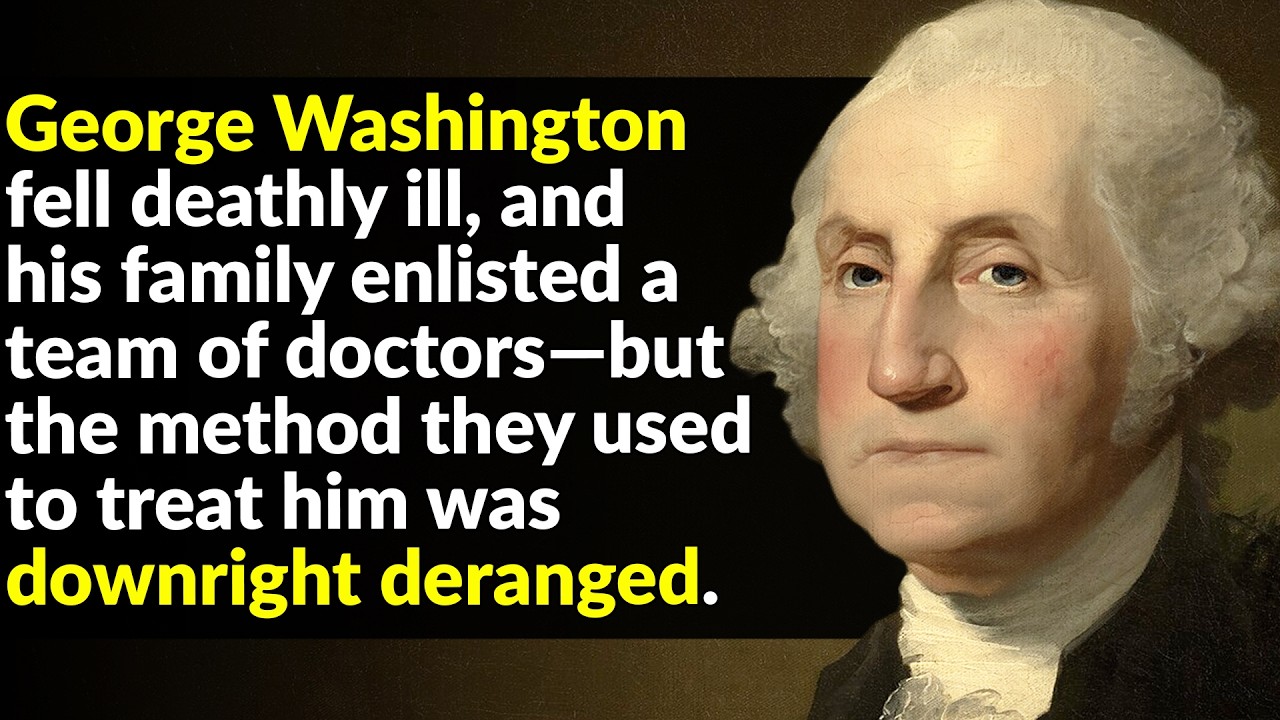
When that didn’t help, they took five more pints. Washington, fading and knowing what was coming, ordered his staff to wait three days before burying him so there was no chance of being buried alive. On December 14th, 1799, the first President of the United States was dead. But long before that sickbed, Washington had been a young man determined to escape failure.
Born on February 22nd, 1732, in Westmoreland County, Virginia, he grew up in one of Britain’s thirteen American colonies. Around the age of twenty, following his older brother’s path, he joined the Virginia militia. The governor quickly promoted him to major, and by 1754, during the French and Indian War, he reached the rank of colonel and led the Virginia regiment. That summer, stationed at Fort Necessity in Pennsylvania, he and his force of roughly three hundred men were trapped by a French regiment of nearly nine hundred.
Washington had no choice but to surrender. Shortly after, his regiment was dissolved, and he was stripped of his colonel title. He could have accepted a lower rank as captain in a newer regiment, but he refused the humiliation of a demotion. His patience paid off when the Virginia regiment reformed a year later, and he took back his position as its leader.
But disappointment followed quickly. In 1758, he set out to capture Fort Duquesne, near modern-day Pittsburgh. When he arrived, the French had already abandoned it. After one too many humiliations, Washington resigned his post.
During this time away from the battlefield, he turned to Martha Custis, a woman he had met at a social gathering and spent as much time with as his leaves would allow. Within a year they knew they were meant for each other. They married on January 6th, 1759, on her family’s property, and by all accounts were deeply in love. They never had biological children together—possibly due to Washington’s sterility or complications from Martha’s last pregnancy—but they raised a family.
Martha had four children from her first husband, who had died, and Washington happily took them in as his own. The marriage also made him a very wealthy man. He inherited all the lands Martha had received from her first husband, which added significantly to his already prominent standing. As the years passed, he grew increasingly outspoken about Britain’s treatment of the colonies.
He was disgusted by how poorly the British underpaid their officers and overtaxed the people. He began training local militias, preparing for a conflict he saw coming, and served as Virginia’s delegate to the First Continental Congress. Washington shared the colonists’ outrage, but he wasn’t initially eager to declare full independence. That changed on April 19th, 1775, when the war began with the battles of Lexington and Concord.
A month later, Washington attended the Second Continental Congress. As delegates debated, the British seized Boston, and American militias locked the city down, forcing a stalemate. Congress realized the war would be long and difficult, and it approved the creation of the Continental Army. Given his military record, Washington was nominated and chosen as its leader.
He and his army set out to take Boston, and crowds lined the roads to cheer him on. As winter closed in, Washington proposed using the frozen river to charge the city, but his men argued against it. Instead, they set up camp on Dorchester Heights. Over the next year, they besieged the British inside Boston.
By March 1776, they had driven out nearly nine thousand British servicemen and more than a thousand loyalists. But the revolution was far from over. Washington anticipated that the British would strike next at New York City, so he ordered his forces to fortify the city. He was right, but American forces were quickly overwhelmed.
Washington cut his losses, retreating to regroup in New Jersey. There he met up with General John Sullivan, who brought two thousand fresh men, a huge boost to morale. Without wasting time, Washington launched a counterattack, making his historic crossing of the Delaware River, then ambushing the enemy and winning major battles at Princeton and Trenton. Despite these victories, the British under General Howe remained a formidable force and kept pushing Washington back.
Other revolutionary leaders weren’t faring much better, and the early admiration Washington had earned began to fade. The revolution’s future looked uncertain until the Americans secured new allies. In 1778, they signed an alliance with the French. There was also a war being fought in the shadows.
Washington ran an intricate network of spies, gathering intelligence that prevented several major attacks on American and French forces. One of his most valued men was Benedict Arnold, a general who had served capably in battle and spent years supplying Washington with valuable secret intelligence. But by the end of the 1770s, Arnold switched sides, delivering intel to the British right under Washington’s nose. Washington discovered the truth when American militia captured British spymaster John André.
Arnold himself escaped to New York. The betrayal shook Washington, and he immediately recalled anyone who might have been in league with the traitor. Circumstances improved when the Marquis de Lafayette returned from France with more men and much-needed supplies. After years of struggle and often being outnumbered, Washington finally felt the colonies had a real chance.
A plan was drawn up to besiege the British in Yorktown, Virginia. Washington led a force of nearly twenty thousand men. When they reached Yorktown, Washington fired the first shot, and the battle began in earnest. The French navy engaged the British in Chesapeake Bay while ground forces encircled the city, locking the British inside.
The fate of the colonies rested on Yorktown. After nearly a month of siege, the Americans gained the upper hand. The British raised the white flag on October 19th, 1781, and Washington spent the next two days negotiating the surrender. Although Yorktown was the last major battle of the American Revolution, full independence didn’t come until two years later with the signing of the Treaty of Paris.
The Continental Army had fulfilled its purpose. Washington gave one last address to his forces before officially resigning and dissolving them. The war was over, but new challenges lay ahead. Congress had to figure out how to govern a sovereign nation, and in 1787, it held the Constitutional Convention.
Washington, though reluctant, attended as Virginia’s delegate. The weight of his presence was felt immediately. Benjamin Franklin nominated him to run the convention, and all the delegates voted him in charge. But that was only a stepping stone.
The question arose of who would lead America as its first president. There was only one option on everyone’s mind. On February 4th, 1789, George Washington became the first and only president to receive a completely unanimous vote. He was very conscious of his power and determined not to be seen as a king like their previous ruler, George III.
He declined titles like “His Highness” or “Majesty,” instead choosing to go by “Mr. President,” setting the standard for all future leaders. He had hoped to guide America in a united fashion, but people disagreed on things, and even his closest advisers were at odds. Thomas Jefferson created the Jeffersonian Republicans, and Alexander Hamilton created the Federalist Party, laying the foundation for America’s two-party system.
Washington was an effective leader, but he wasn’t keen on the role forever. Nearing the end of his first term, he grew weary of the stresses and their effects on his health. His goal was to complete one term and retire. But when news of his plans leaked, a profound outpouring of support followed.
Countless voices urged him to run again. Washington relented and won the 1792 election with another unanimous vote. His second term wasn’t without controversy. When the French Revolution broke out, Washington declined to help their old allies, refusing aid to both the monarchy and the revolutionaries.
The US would remain neutral. His administration also signed the hugely unpopular Jay Treaty with Great Britain in 1794, opening up trade with their former enemies, allowing repayment of pre-war debts to British creditors, and granting Britain “most favored nation” status. Jefferson staunchly opposed it, fearing it would only upset France further. As time went on, Washington’s opponents grew more vocal, criticizing him as an ineffective leader and even accusing him of greed.
Washington was ready to leave, and he decided his second term would be his last, setting the standard of a two-term presidency. He officially retired from office in March 1797 and returned to Mount Vernon to live out his remaining years as a businessman. Less than three years later, he was gone. His death was caused not by battle or betrayal, but by a cold that turned severe and a medical practice that drained the life from him.
Washington knew it was over and tried to protect himself from one final horror—being buried alive. He was the father of a nation, yet in his final days, his greatest concern was whether the doctors might kill him before he was truly dead. History has turned much of George Washington into myth. He was far from flawless, even owning a plantation worked by slaves.
But he was undeniably an excellent military commander, and his actions as leader of the Continental Army and as America’s first president shaped the course of history.