Bradley Cross leaned against my office doorframe like he owned the place. “Half of your $250,000 client bonus is mine,” he said with that rehearsed grin of a man who had never once debugged a mainframe or balanced a budget in his entire life. I didn’t speak. I just sat there behind my desk, watching him.
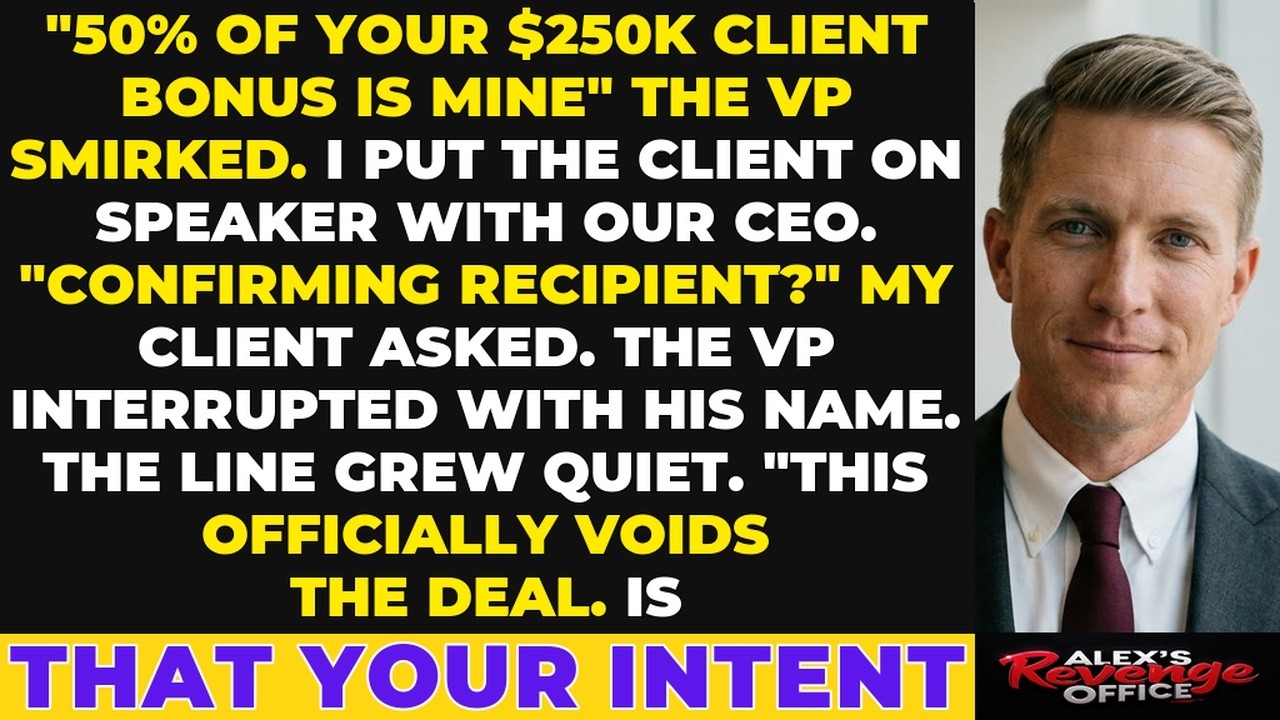
Bradley was the new vice president of business development, a man whose entire career was built on buzzwords and borrowed credit. Before I could even process what he’d said, he turned and strolled out, already tapping on his phone like he was booking a golf trip with my money. Six months. That’s how long I’d spent on the Langston Manufacturing account.
Six months of 6:00 a. m. video calls because Marshall Langston liked to start his day early. Six months of hand-holding stakeholders who needed five rounds of meetings just to pick a color for a dashboard.
I’d earned that bonus. Every penny of it was written into my contract. And now Bradley thought he could just walk in and claim half of it. I’d been in corporate America for twenty-two years.
I’d seen this movie before. The executive who shows up at the finish line, shakes a few hands, and reclassifies your solo effort as a “joint leadership initiative. ” You end up in the background while they take the award. But this time was different.
This time I had documentation. Bradley didn’t know it yet, but every email, every call log, every risk assessment had my signature and timestamp on it. Not his. I’d kept the Langston account together through three executive turnovers and one holiday gala where their head engineer almost walked away from the deal drunk.
I’d smoothed that over quietly. Now this parasite thought he could drain my incentive pay because he’d played golf with the CEO once. I didn’t explode. That’s what he wanted.
An emotional outburst he could spin to HR as me being unstable. I’d learned twenty years ago that anger makes you look volatile. But a paper trail? That makes you untouchable.
So I stayed silent. I kept working. When Bradley took my project tracking document, added his name next to mine as “co-lead,” and sent it to our CEO Conrad Stone, I didn’t fire off an angry email. I just kept logging everything.
Every interaction. Every timestamp. My keyboard sounded like a forensic investigation. The betrayal burned, though.
It wasn’t just about the money, though God knows I needed it. I was still paying off my late father’s medical debts. My truck needed $3,800 in transmission work. My kid was about to tour colleges we could barely afford.
That bonus wasn’t a vacation fund. It was my lifeline. But Bradley wasn’t just stealing dollars. He was trying to erase me.
Claim my work as his own. Fine. I’d let him walk right into the center of the stage. He didn’t realize the floorboards were already loose.
The stories started trickling in. Wade from sales pulled me aside by the break room. “He did the exact same thing to Pete,” he whispered. “Took a third of Pete’s regional commission last year under ‘strategic executive oversight.
‘” Pete didn’t even fight it. HR said it was within guidelines. Then came more. Sandra from project operations had her bonus stripped on a nine-month infrastructure project she’d led.
Another analyst mentioned that Bradley liked to insert “retroactive oversight clauses” into project charters after signatures, diverting payouts into a pool only he touched. Each story landed like a weight in my chest. I wasn’t surprised. I was disgusted at how long the company had enabled him.
I went to HR to test the waters. The senior generalist clicked through her portals and shrugged. “If finance approved the adjustment, it must have gotten executive sign-off. ” When I asked who signed, she confirmed it was Bradley himself.
The VP was authorized to approve his own theft of my bonus. Payroll just followed instructions. The whole system was built on plausible deniability. So I went around the system.
I pulled every calendar invite, every CRM update, every server deployment record from the last eight months. I extracted dozens of email threads where I’d personally walked Langston’s executives through risk assessments and contract language. Across 240 days of communication, Bradley hadn’t appeared once until three weeks ago, when he copied himself on a status report I’d sent at midnight while my kid slept on the couch next to me. His only contribution to the entire project?
A thumbs-up emoji. But I didn’t stop there. I dug through the corporate legal repository until I found the master incentive governance document. Buried in section 4, paragraph 2, was a clause that made my pulse quicken: “Final performance-based disbursements must directly correlate with primary relationship ownership, verified task execution, and uninterrupted client continuity.
”
Client continuity. That was the key. I’d been the sole operational lead on Langston since day one. Bradley didn’t even know their division directors’ names.
I bookmarked everything. Archived the logs. Built an encrypted folder I labeled “Routine System Maintenance Archive. ” Then I started drafting a brief.
No emotion. No complaints. Just dates, timestamps, document numbers, and quotes. Cold, clinical precision.
On Tuesday at 8:14 a. m. , Bradley fired his opening shot. An all-company email titled “Third Quarter Langston Account Milestone Summary.
” It was a victory lap, full of exclamation points and handshake stock photos. Buried in the third paragraph: “I am deeply grateful to have worked alongside Harlan Vance on this critical enterprise win. Our joint executive approach ensured Langston Manufacturing felt supported from both a strategic and operational perspective. ”
In corporate speak, he was staking his claim to half the bonus.
I didn’t reply. That would’ve given him the conflict he wanted. Instead, I played a longer game. Four months ago, during initial negotiations, Langston’s legal team had been nervous about management stability.
They’d been burned by vendor abandonment before. So I’d helped them draft a protective clause in the master service agreement: primary relationship management could not be altered, split, or reassigned during a performance period without express written consent from their board. Any unauthorized alteration would constitute a material breach, voiding all financial obligations and letting them terminate the contract immediately. That clause had been sitting dormant.
Now I used it. I emailed Marshall Langston under the guise of routine contract maintenance. I attached a clarification document stating that performance milestones must align with the designated primary relationship holder. Marshall, a methodical attorney, replied within seven minutes.
“Send over the finalized addendum for signature. ”
When he returned the signed document, the trap was set. If Bradley filed a payout claim as co-lead without written authorization from Langston, he’d trigger a breach condition that would void the entire $4. 7 million contract.
The company would face catastrophic loss, and it would be squarely Bradley’s fault. Meanwhile, Bradley kept strutting. I heard him in the executive lounge telling regional directors that he’d personally closed the confidence gap with Langston’s board while I handled “routine administrative work. ” I said nothing.
Thursday was our bi-weekly review call. I scheduled it at 11:00 a. m. and added one extra name to the invitation: Conrad Stone.
I framed it as a routine visibility touchpoint. Within 45 minutes, Bradley spotted the meeting and added himself, announcing he’d be “delighted to represent corporate leadership. ”
He was walking into his own destruction. On Wednesday afternoon, Bradley marched into the finance suite like a conqueror.
Two hours later, a compensation modification request hit the payroll queue. Sandra from payroll, who remembered his past antics, forwarded it to me with a one-line note: “Are you aware of this? ”
I opened it. “Project Langston Integration Third Quarter Performance Disbursement.
” Primary relationship section: Harlan Vance and Bradley Cross as joint co-leads. A 50/50 split of the $250,000 bonus. The justification box said: “Allocation agreed upon verbally during the third quarter strategy review. ”
Verbal agreement.
His favorite weapon. A shameless lie. Still, I didn’t act internally. No email to Bradley.
No HR complaint. I just prepared for Thursday. At 10:57 a. m.
, I sat at my desk, staring at the Zoom interface. My pulse was steady. Every document was organized. At 11:00 sharp, the tone chimed.
Marshall Langston joined from his headquarters. One second later, Conrad Stone logged in. Then Bradley appeared, camera perfectly framed, teeth gleaming, wearing a tailored navy blazer like he was shooting a promo. “Good morning, everyone,” I said.
Conrad nodded. Marshall smiled. “Good to see you, Harlan. ”
Bradley leaned into his mic, cutting in.
“Marshall, fantastic to connect again. We’re thrilled to align on strategic objectives for phase two. ”
I didn’t engage. I started screen sharing, pulling up a document titled “Langston Manufacturing Third Quarter Performance Closeout and Continuity Protocol.
” I scrolled to the governance section. “Before we review operational milestones,” I said, “I need to formally verify the primary relationship structure listed on our internal compensation filings. Per section 3C of our master service agreement, client continuity must be explicitly verified prior to final bonus authorization. ”
Marshall adjusted his glasses, leaned forward.
“Can you clarify why relationship verification is being raised at this stage, Harlan? ”
Before I could answer, Bradley jumped in. “Allow me to clarify, Marshall. Harlan and I operated as joint co-leads for the third quarter.
I provided executive strategic oversight, while Harlan handled operational execution. Our internal filing reflects a shared co-lead allocation. ”
Silence. I stopped sharing my screen.
Marshall didn’t smile. His face hardened into pure legal coldness. He folded his hands on his desk. “Bradley, what you’ve just described represents a direct violation of section 3C of our signed agreement and a breach of contractual good faith.
”
Bradley’s smile froze. “I beg your pardon? ”
Marshall picked up a printed document and held it to his camera. “Last week, our legal department finalized an addendum reinforcing our continuity requirements.
Section 3C mandates that primary account management cannot be split without prior written authorization from our board. Any unauthorized attempt to alter primary relationship records or reallocate incentives instantly voids all financial provisions. ”
He turned to Conrad. “Conrad, Harlan Vance has been our exclusive primary strategist and sole operational contact for six months.
We have zero record of Bradley Cross participating in strategic management. If Stonebridge is officially asserting that Bradley is a co-lead, our contract terms are automatically nullified and we halt all phase two implementations totaling $4. 7 million. Is it your official position that Bradley Cross is a co-lead?
”
Conrad’s face went pale. He stared at Bradley’s video frame. “Is there any written documentation from Langston authorizing a co-lead structure, Bradley? ”
Bradley’s composure disintegrated.
“Well, Conrad, we discussed cross-functional strategic alignment during informal conversations, and I felt my executive involvement was understood—”
“That’s not what I asked you. Did you submit a formal compensation reallocation form asserting a co-lead relationship without written client approval? ”
Bradley opened his mouth. Nothing came out.
Marshall didn’t hesitate. “Given the clear ambiguity and unauthorized administrative actions, Langston Manufacturing is placing all pending contract disbursements on immediate hold. We will await formal clarification from your legal department. Good day.
”
He disconnected. Conrad stared at the screen. “Get off this call immediately, Bradley. ”
Bradley tried to speak.
“Off. Now. ”
Bradley’s video vanished. Alone with me, Conrad rubbed his temples.
“Harlan, I need a complete digital audit trail on my desk within thirty minutes. Every email, every timestamp, every submission form. ”
“It’s already in your executive inbox, Conrad. I submitted the complete verified record to your private legal folder prior to this meeting.
” I’d categorized it under corporate compliance standards, tortious interference prevention, and fiduciary duty of loyalty documentation. Conrad opened the file. He scanned the evidence. “I’ll handle this internally,” he said quietly, and ended the call.
Within two hours, the machinery moved. Internal audit launched a formal investigation into Bradley for fraudulent misrepresentation, breach of fiduciary duty, and corporate compliance violations. By 3:00 p. m.
, an all-company notice announced he’d been placed on administrative leave pending review. Security escorted him out that afternoon with a cardboard box. Two days later, Conrad summoned me to the boardroom. He presented me with an updated contract designating me as senior director of strategic enterprise accounts, the full $250,000 bonus, and an executive equity package.
“The board recognized that your methodical documentation and legal foresight saved a $4. 7 million account from destruction,” Conrad said, extending his hand. “You proved that real corporate authority comes from competence, preparation, and integrity. Not vanity titles.
”
I signed the paperwork. Justice had prevailed. The audit uncovered a systemic trail of compensation improprieties and unauthorized commission redirections across multiple teams. Bradley was terminated for cause and forfeited all unvested stock options.
His career ended not with a promotion, but with a confidential settlement and permanent reputational damage. The Langston account flourished under my leadership. Phase two finished three weeks early with zero friction. My team got the recognition and resources they deserved.
Every afternoon now, I look across the office floor toward that vacant corner suite. And I’m reminded that strategic patience, legal precision, and unshakable documentation will always beat unearned corporate arrogance.