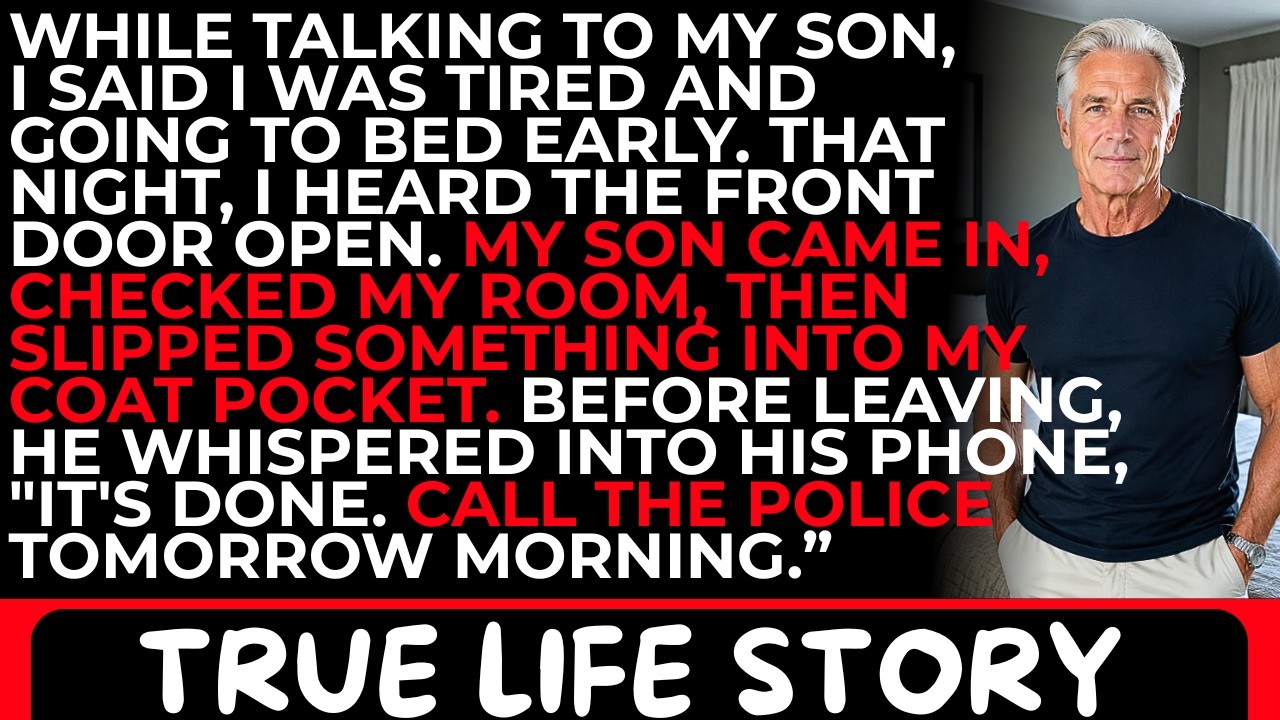
My own son stood in my bedroom doorway at midnight, watching me pretend to sleep. Ten seconds later, he tucked a loaded gun and a fake passport into my coat pocket and whispered into his phone, “It’s done. Call the police tomorrow morning. ”
I didn’t move for eleven minutes.
You need to understand the size of what happened that night. My name is Jeff Steven. I built Steven and Hale Logistics from a folding table in my garage into forty trucks and eighty employees. I had a wife, Nadia, who could silence a room with one raised eyebrow, and a nineteen-year-old son, Kennedy, who I thought still believed his old man hung the moon.
And Raymond. My best friend for twenty-two years. The man I trusted with everything. We met in our twenties, hauling furniture in a rented box truck for eleven dollars an hour.
We split gas money down to the penny and ate gas station burritos for lunch four days a week. Somewhere between carrying a stranger’s piano up three flights of stairs and nearly dropping it on our feet, we became the kind of friends who don’t need explaining. He stood up at my wedding. I stood up at his.
He paced the hospital linoleum with me when Kennedy was born, and hugged me so hard he cracked one of my ribs. He taught my son to fish. He taught him to drive stick in an empty parking lot on a Sunday morning. He was Kennedy’s godfather.
For nineteen years, he was the second most important man in my son’s life. And at some point in the last two years, he decided the easiest path to a comfortable retirement ran straight through my grave. The night it all came apart started ordinary. Nadia made her chicken and rice, the one with too much garlic none of us ever complained about.
Kennedy showed up twenty minutes late, smelling like motor oil, still in his auto parts polo with his name tag crooked. “Traffic,” he said, when Nadia asked why. There’s no traffic between here and the auto parts store. There’s four stop signs and Cynthia’s dog.
But I let it go. He looked tired, carrying something tired, and I chalked it up to community college finals. Then he asked about the Meridian account. My son had never once asked about a specific client account unprompted in his life.
“Numbers don’t add up on Raymond’s side,” I said. “Every time I ask him about it, he tells me not to worry. ”
Kennedy’s jaw did something small and tight. “You trust him that much?
” he asked. “Twenty-two years, Kennedy. I trust that man with your life. ”
I watched something cross my son’s face that I didn’t have a name for yet.
I do now. It was the look of a boy who already knew how dangerous that sentence was, and couldn’t say so without showing his hand. On his way out, he gave me one long look, like he was trying to memorize my face. “Get some sleep, old man,” he said.
“You look tired. ”
Everyone in that house told me to get rest that night. Like they’d all rehearsed it. Raymond came by that evening, like he did every Wednesday, to talk business over whiskey neither of us needed.
He sat across from me in my den, swirling his glass, and told me I looked tired too. “Big week coming,” he said. “You should get some rest. ”
I went to bed early.
Around 11:40, I heard the front door open carefully, like someone didn’t want it to make a sound. Footsteps on the stairs, skipping the third step, the one that groans like a dying man. Only three people in the world knew to skip that step. Me, Nadia, and Kennedy.
The bedroom door cracked open an inch. I kept my breathing slow, eyes closed, playing asleep. I felt him watching me for ten seconds. Then the door eased shut.
I heard the coat closet open. A rustle of fabric. Something small and hard tucked into a pocket. My good wool coat, the one I only wear to church and funerals.
Then, so quiet I almost missed it, “It’s done. Call the police tomorrow morning. ”
My own son. I didn’t move until I heard his car pull out of the driveway.
I walked to that closet like a man walking to his own execution. In the pocket I found a loaded gun, and underneath it, a passport. My photo. Someone else’s name.
Robert Callahan. I’d never heard the name in my life. I sat on the edge of the bed holding a stranger’s identity and a loaded weapon, thinking my son had just tried to frame me for something. I was wrong about the frame part.
I didn’t wake Nadia. I went to my study, unloaded the gun, and stared at that passport until the ink burned into my retinas. Then my phone buzzed. A text from Kennedy.
Dad, you up? My hands were shaking. I’m not a man whose hands shake. I’ve negotiated freight contracts with men who’d sooner stab you than shake your hand.
I rattled that night. Can’t sleep, I typed back. Everything okay with you? Yeah.
Just checking on you. Love you, old man. Old man. He’d called me that since he was twelve.
Hearing it now felt like a knife wrapped in a birthday card. At 4:00 in the morning, headlights swept across my window. Nadia’s sister, Glattis, walked straight to my porch and knocked so soft it was barely a knock at all. “Is Nadia up?
” she asked. She had a thick folder under her arm. The kind of thick that ruins lives. “No.
What is this? ”
She looked at me like a man standing on a ledge. “You need to see this before the police get here. ”
“Glattis.
What in the hell is going on? ”
“Sit down, Jeff. ”
I’m fifty-eight years old. I don’t sit down on command in my own house at 4:00 in the morning.
But something in her face made my legs do it anyway. She opened the folder. Bank statements. Wire transfers.
Six hundred thousand dollars funneled out of Steven and Hale over fourteen months, routed through three shell accounts, landing in an offshore account with my signature on every authorization form. My signature forged so well I had to squint twice to be sure it wasn’t mine. “Raymond,” I said. It wasn’t a question.
“Raymond,” she confirmed. “Kennedy found it three weeks ago. He’s been digging ever since. ”
Three weeks.
Why didn’t anybody tell me? Glattis’s jaw tightened. “Because two days ago, Kennedy overheard something he wasn’t supposed to. Raymond on the phone with a man named Matthew, talking about handling the ‘Jeff situation’ before the embezzlement charges went public.
Talking about it happening quiet. Talking about an accident. ”
The room got very cold very fast. “He’s not just framing you for the money, Jeff.
” Her voice cracked in a way I’d never heard. Not even at our father’s funeral. “He’s planning to have you killed, and let the embezzlement charges explain why you ran. Dead men don’t stand trial.
”
The pieces slammed together so hard I felt it in my chest. The passport. The gun. My own son sneaking into my closet at midnight.
Kennedy didn’t frame me. He was building a paper trail the cops couldn’t ignore. Something that gets me arrested tonight, in a cell surrounded by officers, instead of leaving me alone in this house where Raymond’s people could find me. “He was saving your life the only way a nineteen-year-old with no badge and no power could,” Glattis said.
How long had she known? Kennedy had called her three weeks ago at 1:00 in the morning, scared half to death, and told her he thought Raymond was stealing from me. She’d told him he was being paranoid. He’d sent her three bank statements that proved he wasn’t.
“He needed someone with a legal background who could organize the paperwork the right way,” she said. “Someone the police would take seriously. And he needed it to be someone who wasn’t you. Because the second you knew, Jeff, you’d have marched straight into Raymond’s office and confronted him like a bull walking into traffic.
”
I didn’t have a comeback. Mostly because it was true. “Where is he now? ” I asked.
“Watching Raymond’s place, making sure nothing moves before the police get there. ”
I stood up so fast the folder slid off my lap. I called Kennedy. “Dad, you shouldn’t be calling,” he answered, voice pitched low.
“Get away from that house right now. ”
“I’m fine. I’m three houses down. I’m not doing anything stupid.
”
“You put a gun in my coat, Kennedy. You are already doing something stupid. ”
Silence. Then, quieter, “You weren’t supposed to know it was me.
”
“I know everything. Glattis is here. I’ve seen the statements, the wires, all of it. Now tell me you’re walking to your car and driving straight home.
”
“Not until I know Raymond’s not going anywhere before the cops show up. ”
“Kennedy. He tried to have you killed, Dad. ” His voice broke on the word killed in a way that undid something in my chest.
“I’m not walking away and just hoping the system does its job in time. It’s slow. You don’t have slow. You have hours.
”
“How do you know it’s tonight? ”
“Because I’ve been listening to Raymond for three weeks. Dad, I fix his Wi-Fi router every other week for forty bucks. His office computer sits eight feet from his desk.
People forget teenagers exist in a room. He talks on speaker phone like nobody’s ever listening. Two nights ago, I heard him tell Matthew, ‘It has to look like he ran. Tomorrow night before the filing hits.
’ Tomorrow night was tonight, Dad. ”
I stood in my driveway in pajama pants at 4:30 in the morning. For the first time since he was small enough to carry on my shoulders, I didn’t know what to say to my son. “Fine,” I said.
“Then I’m coming to you. ”
We sat two houses down from Raymond’s colonial in Kennedy’s beat-up sedan. Engine off. Lights off.
Watching a house I’d eaten dinner in a hundred times, owned by a man who’d held Kennedy the day he was born, whose wife used to bring us casseroles when Nadia had the flu. “If the gun charge hadn’t stuck,” I asked, “what was your backup? ”
“You don’t want to know what backup, Dad. ”
“Kennedy.
”
“I was going to call in an anonymous tip that you’d threatened Raymond. Domestic disturbance call. Guarantees a unit shows up. Guarantees you get pulled out of the house for questioning.
Guarantees you’re not alone in a dark bedroom when two men let themselves in through the back. ”
He said it flat, like he was reading off a grocery list. That flatness scared me more than anything else that night. He had four backups, he told me.
The gun and passport were just the cleanest one. I stared at my son, nineteen years old, jaw set, eyes locked on a house that belonged to a man he used to call Uncle Ray. And I felt something I hadn’t expected. Not fear.
Not grief. Pride with teeth. “You should have told me,” I said. “You should have noticed your best friend was stealing from you for over a year,” he shot back.
Honestly, fair. Headlights swung into Raymond’s driveway. A dark SUV, engine still running. Two men got out.
One tall, hood up, moving like he’d done this before. The other shorter, nervous, checking the street twice. “That’s them,” Kennedy whispered. “That’s Matthew, the tall one.
”
We ducked below the dash as they walked up Raymond’s porch. Not to knock. To wait. “Call it in, Dad,” Kennedy said.
Kennedy called it in. Here’s the part that sounds insane if you haven’t lived it. The police arrived at my house first. Glattis had already tipped off a detective friend of hers, a woman named Jones, about a firearm and a fraudulent identification document discovered in a residence.
Standard procedure. At 6:11 in the morning, in my own driveway, in my pajama pants, I was placed under arrest for possession of an unregistered firearm and a fraudulent passport. Nadia came running out in her robe, screaming my name. And I have never in my life felt so relieved to hear handcuffs click shut.
“Jeff, what is happening? What did you do? ”
“Nothing, baby. I promise you, I did nothing.
” I looked past her to Kennedy, standing at the end of the driveway, arms crossed, watching with an expression carved out of granite. “Ask our son. He’ll explain everything. And when he does, you’re going to want to sit down first.
”
Detective Jones walked me to the car with a grip that was firm but not cruel. “Most guilty men don’t thank the officer arresting them,” she said quietly. “I’m not most men,” I said. “And you’re about to have the easiest embezzlement and conspiracy to murder case of your career, detective.
All the paperwork’s already done for you. My son did your job three weeks early. ”
Her radio crackled before she could respond. “Suspects apprehended two blocks from the residence.
One in custody, one running on foot. K9 unit requested. ”
Detective Jones looked at me with something between suspicion and awe. “Get in the car, Mr.
Steven. I think you and I are going to be spending a lot of time together this morning. ”
In the interview room, I told her everything. The embezzlement.
The forged signatures. The plan to make me disappear. The recording Kennedy had captured off Raymond’s own speakerphone. “He planned his father’s arrest to keep him alive,” she said, setting down her pen.
“That’s either the smartest thing I’ve heard all year, or the single most illegal thing a nineteen-year-old has ever done for love. ”
“Can’t it be both? ”
She almost smiled. Almost.
Two hours later, while I sat behind bars drinking government-grade instant coffee, Raymond was arrested at his own front door for embezzlement, wire fraud, and conspiracy to commit murder. Matthew, the tall one, was caught two blocks away. Calm as anything. The shorter one made it four blocks before the K9 unit found him hiding behind a dumpster.
Matthew wasn’t just muscle. He was the one who built the Robert Callahan identity in the first place, a man with a small side business in exactly the kind of paperwork that gets people disappeared. Once Detective Jones laid out what he was facing, his loyalty to Raymond evaporated faster than morning fog. He gave a full statement inside four hours.
Turns out loyalty is expensive. And Raymond, cheap bastard that he apparently always was underneath the golf club charm, had lowballed the payment. I got out on bail that afternoon. My lawyer, a sharp, no-nonsense woman Kennedy had somehow already retained, had the illegal firearm charge dropped within hours.
The serial number traced back to one of Raymond’s storage units. The fake passport charge evaporated the second Detective Jones connected it to Matthew. I walked out of that station into the parking lot, blinking against the sun like a man reborn. Kennedy was leaning against his car, waiting.
He didn’t say anything at first. Just walked up and hugged me so hard I felt something in my back pop. “You scared the hell out of me,” I said into his shoulder. “You scared the hell out of yourself,” he said.
“You’re the one who called Ray your brother from another mother at Thanksgiving. ”
“Please don’t remind me. ”
He pulled back, and for a second he looked exactly like he did the day he lost his first tooth. Trying so hard to be brave about something that clearly terrified him.
“You put a gun in my coat pocket, Kennedy. ”
“I put a gun in your coat pocket that I unloaded myself before I did it. Because I am not an idiot. And because getting my father shot in his sleep by strangers was worse than getting him a possession charge that vanished by lunch.
”
I looked at my son, really looked at him, maybe for the first time as an adult and not as the kid I still pictured on a bike with training wheels. “I’m proud of you,” I said. “And I am never, ever letting you plan a surprise party again. ”
He actually laughed.
First time in twenty-four hours. “Deal. ”
Nadia was waiting at home. She didn’t hug me right away.
She stood in the kitchen with her arms crossed. “Twenty-two years,” she said quietly. “I made that man’s kids’ birthday cakes, Jeff. Mabel and I do book club together.
And he was going to have you killed in our bed. ”
“I know. ”
“Don’t you dare go soft on him. Don’t you dare let twenty-two years of nostalgia talk you into a plea deal or a quiet settlement.
I’ve watched you give people the benefit of the doubt your entire life. It is the thing I love most about you. It’s also the thing that almost got you murdered in your sleep. ”
“Not this time,” I said.
The trial took four months. I sat through every single day. Matthew testified first under a plea agreement, describing the whole plan in a flat, almost bored voice, like he was reading a weather report instead of describing my murder. “Mr.
Raymond told me it needed to look like Mr. Steven ran,” he said. “The embezzlement filing was set to go public the next morning. The idea was that Mr.
Steven would appear to have skipped the country using a fake identity. ”
“And what was your role? ”
“I built the identity. Robert Callahan.
Passport, background, the works. And I coordinated the two men who were supposed to make sure Mr. Steven didn’t make it out of the house that night. ”
The courtroom went dead silent.
I felt Nadia’s hand find mine under the table and grip hard enough to hurt. I made myself look at Raymond. He didn’t look back. He stared at the defense table like it owed him money.
They played the recording for the jury. Raymond’s own voice, tiny through the courtroom speakers. “It has to look like he ran. Tomorrow night before the filing hits.
Clean, no mess, Matthew. I’ve known this man twenty-two years. I’m not asking for a mess. No mess.
”
He’d wanted my death to be tidy. Considerate. Almost like he was doing me some kind of favor. I testified on day eleven.
I told them about the box truck, the piano on the stairs, the wedding speech, the hospital hallway, the fishing trips, the driving lessons in an empty parking lot. I told them about twenty-two years of trust, brick by brick, and how it took one recording, six sentences long, to knock the whole structure down. The prosecutor asked whether I believed Raymond felt any remorse. “I believe,” I said, looking directly at him for the first time in the whole trial, “that Raymond feels sorry he got caught.
I don’t believe he spent one second being sorry about what he tried to do to me. ”
Raymond’s defense tried to argue the recording was ambiguous. That “clean, no mess” could have meant anything. The prosecutor demolished that in her closing argument.
“Is it discreet to route six hundred thousand dollars through three shell accounts over fourteen months? Is it discreet to forge a business partner’s signature twenty-six separate times? Is it discreet to build a false identity complete with a fabricated passport using that same partner’s photograph, a partner who was going to be blamed for the entire scheme once he’d conveniently vanished? ”
She let it sit.
“There is nothing discreet about any of this. There is only quiet. And there is a very important difference between the two. Because quiet is what you do when you’re planning to make sure nobody’s left alive to ask questions.
”
I watched two jurors’ faces change in that exact moment. I knew right then we’d won. Kennedy testified last. He sat in that witness chair in a borrowed suit jacket that didn’t quite fit him in the shoulders, nineteen years old, describing in careful, steady detail how he’d made the decision alone at midnight to put a gun and a fake passport in his father’s coat pocket rather than risk losing him.
“Why didn’t you go to the police first? ” the prosecutor asked. “Because I didn’t have enough yet to make them move fast,” Kennedy said. “And by the time I did have enough, I only had hours, not days.
I made the call I thought would keep him alive. If I was wrong, I was going to have to live with that. But I wasn’t willing to be wrong in a way that meant burying my father instead. ”
The defense didn’t cross-examine him.
Not one question. Raymond got twenty-two years. One for every year he wore a mask around my family. You want to hear that we talked it out?
That two old friends found some bittersweet understanding across a jailhouse visitation glass? That’s not this story. Raymond tried to have me murdered so he could steal six hundred thousand dollars and let my corpse take the fall. He sat in my den drinking my whiskey, telling me to get some rest, while two men were already circling my house on a schedule he’d built himself.
I didn’t visit him in county lockup. I didn’t send a lawyer to negotiate a lighter sentence out of some misplaced nostalgia for the two broke idiots who used to haul furniture together in a rented box truck. I sat in that courtroom front row every single day and made sure he saw my face every time he looked up. I liquidated his remaining stake in the company within the month.
Restructured so his signature meant nothing on any document, past or present. Mabel, his wife, who I do believe never knew a thing, filed for divorce before the verdict even came down. She sent Nadia one letter six months later. I never read it.
Some things don’t survive the fallout, even for the innocent ones standing too close to it. We changed the sign out front. Steven and Hale became just Steven Logistics. No ampersand, no ghost of a partner who never should have gotten his name on the building in the first place.
Kennedy drove out with me the morning the new sign went up. We stood in the parking lot together, coffee in hand, watching the installers peel the old lettering off the brick. “Feels smaller without the extra name,” I said. “Feels honest,” Kennedy said.
“That’s better than big. ”
The last time I saw Raymond was at sentencing. When they let him out in handcuffs past the row where Nadia, Kennedy, and I sat, he stopped just for a second. The bailiff let it happen.
“Jeff,” he said, just my name, in that same easy voice he used to order our gas station burritos with, twenty-two years and a lifetime ago. I looked at him the way you look at a photograph of someone after you’ve found out everything about them you never wanted to know. “You don’t get to say my name anymore,” I said. “You lost that a long time before I ever found that gun in my coat.
”
The bailiff moved him along. He didn’t look back. I didn’t watch him go. He asked for mercy at sentencing.
Stood up in a cheap suit that used to fit him better and talked about twenty-two years of friendship, about a moment of weakness, about a man who’d lost his way. I didn’t stand up for him. I never will. Kennedy works with me now, runs half the dispatch operations, better than Raymond ever did.
And every Wednesday, the day Raymond used to come sit in my den, we sit in that same room and I pour two glasses of whiskey and I tell him again how close I came to losing everything because I trusted the wrong man for twenty-two years, and the right one for only nineteen. I didn’t know it that night, lying in the dark, listening to footsteps on the stairs. That the person sneaking into my life to take something from me wasn’t the threat.
He was the only reason I lived to tell you about it.