The neighbor called me at four in the morning while I was holding a patient’s hand. Ruth Delgado had lived next door to my grandmother for thirty years, and she was crying so hard I could barely understand her. Marlene Woods had died in her sleep before dawn. Then Ruth said the part that froze me.

“Honey, your parents have known since seven this morning. I waited all day for you to come. When you didn’t, I figured nobody told you. ”
My grandmother had been gone nine hours, and my own parents hadn’t thought I needed to know.
Ten years earlier, two weeks after my eighteenth birthday, they had set two suitcases on the front porch and changed the locks while I stood there holding my backpack. Now they were sitting in the front pew at her funeral, my mother squeezing my hand like we’d done this every day for a decade. “We should talk about the estate, sweetheart, as a family. ”
They thought they were coming back for money.
What they walked into was the one room where my grandmother could still speak for herself. And what the judge read out loud on page four, nobody saw coming. Including me. You have to understand the house I grew up in.
In my mother’s kitchen, taped to the refrigerator, there was an invoice. She started it the month I turned sixteen. Room and board, a hundred fifty dollars a month, itemized in blue ink with a running balance at the bottom. My mother had been a loan officer for twenty years, and she ran our family the way she ran her desk.
Every kindness was recorded somewhere, gathering interest. My dad never argued with the system. He sat behind his newspaper like a man waiting out weather. Then there was Nana’s kitchen, six streets over.
Saturday mornings, pancakes on a griddle older than my father, coffee so weak you could read a newspaper through it. I asked her once what I owed her for gas money, and she laughed so hard she had to sit down. “Eat your pancakes. You don’t owe me a thing.
You never will. ”
Same last name, same town, two different countries. In one kitchen I was a daughter. In the other, I was a debt.
In April of 2014, when I was seventeen, Nana had a stroke. A small one, the doctors said. I drove her to physical therapy every afternoon after school. That’s how I got to watch what my parents did next.
My mother showed up to the hospital with a folder. Inside were brochures for Willow Crest Senior Living and a printout from a realtor with an estimate on Nana’s house. Nana was still slurring her R’s, and my mother was already pricing the walls around her. Nana said no.
She said it slowly, but she said it. A few weeks later I came downstairs for water and heard my parents at the kitchen table with the calculator out. My mother was saying words I’d never heard before. Petition.
Power of attorney. Guardianship. My dad was saying, “If you think it’s best, Pam. ” She was planning to ask a court to declare Nana incompetent, take over her money, and sell her house.
Three weeks later, she filed the papers. Here’s what my parents didn’t count on. When somebody files to have a person declared incompetent in Ohio, the court sends someone to look. The court investigator came to Nana’s house on a Thursday in July while I was there after therapy.
She watched Nana make coffee, pay her water bill, and name the current president, the year, and the exact price of ground beef at Hartman’s grocery. Then she asked me questions out on the porch, alone. I told the truth. I told her Nana cooked her own meals and balanced her own checkbook.
I showed her the little school notebook where I’d been keeping our therapy schedule. I told her my grandmother was the most competent person I knew. Dr. Patel, Nana’s doctor for twenty years, told the court the same thing in writing.
In August of 2014, the petition was denied. Nana kept her house, her money, and her name. My mother didn’t scream. She came out of that courthouse with her chin level, drove me home in a silence you could stand a spoon in, and said one quiet thing at a red light without turning her head.
“You’ll learn what loyalty costs, Ansley. ”
Two months later, I found out it was an invoice. I turned eighteen at the end of September. Two weeks later, I came home and my key didn’t work.
On the welcome mat were two suitcases, packed neat, and my backpack from junior year set on top. My mother opened the door with the chain still on. She wasn’t angry. She was composed the way she was at her desk when she declined somebody’s loan.
“You’re eighteen now. You made your choice in that courtroom. Family is a ledger, Ansley, and you are deep in the red. ”
Behind her, I could see my dad’s shadow behind the curtain, not moving.
The door closed. The deadbolt turned. I stood on the porch doing math no eighteen-year-old should do. Then I picked up the suitcases and walked six streets in the October dark and knocked on Nana’s door at eleven at night.
She opened it in her robe. She looked at me and at the suitcases and didn’t ask one question. She just reached past me and flipped a switch, and the porch light came on over my head, warm and yellow. “Love doesn’t keep books, honey.
It keeps a light on. ”
From that night forward, for the rest of her life, that light burned every single evening so I’d always know which house was mine. The next ten years weren’t a training montage. Mostly they were just long.
I lived in Nana’s spare room for a year, then a studio apartment above the hardware store. I waited tables, took out loans, and put myself through nursing school. In November of 2015, when I was nineteen, I broke. It had been thirteen months of double shifts and silence.
One night my hands wouldn’t stop shaking. I drove myself to the county hospital and signed myself in. Seventy-two hours in the behavioral health unit. I signed myself in alone, and three days later I signed myself out alone, and I told exactly one living soul, which was nobody.
I came out of that building with a rule carved somewhere permanent. Need nothing. Owe nothing. If no one holds anything of yours, no one can drop it.
It felt like strength for ten years. That rule comes back later in a courtroom in the worst way. I got my nursing license at twenty-two and found my way to hospice work. Sunday mornings belonged to Nana’s kitchen.
Ten good years. Then, in the fall of 2024, Nana started making appointments she wouldn’t explain, driving herself downtown to see a lawyer named Harriet Cole. The diagnosis came in October of 2024. Congestive heart failure, end stage.
Because life enjoys irony, the case went to the agency I work for, though not to me. I was never her nurse. I was her granddaughter. I cooked.
I sat. I drove. I lost at gin rummy on purpose and got caught doing it. Half the gray-haired women in Maple Glen came through that kitchen like it was a chapel with better snacks.
Twice more that winter, Nana had Harriet Cole over, and the two of them shut the dining room door for an hour. One night in February, near the end, she took my wrist with more grip than she had any business having. “When they come smiling, you let Harriet do the talking first. Promise me.
” I said, “When who comes smiling, Nana? ” She just looked at me, steady. So I promised. Three weeks later, she was gone, and I was standing on her porch reading an index card taped to her door.
“Contents inventoried. Please do not remove items. ” My mother had been dead less than a day, and my parents had already made a list of everything inside that house. They ran the funeral like a campaign event.
My mother wore the correct black and cried at the correct volume. My dad stood at the church door shaking every hand in Maple Glen, accepting condolences for a woman he’d tried to have declared incompetent. I sat with Ruth and Carmen. Then my mother materialized beside me at the casket.
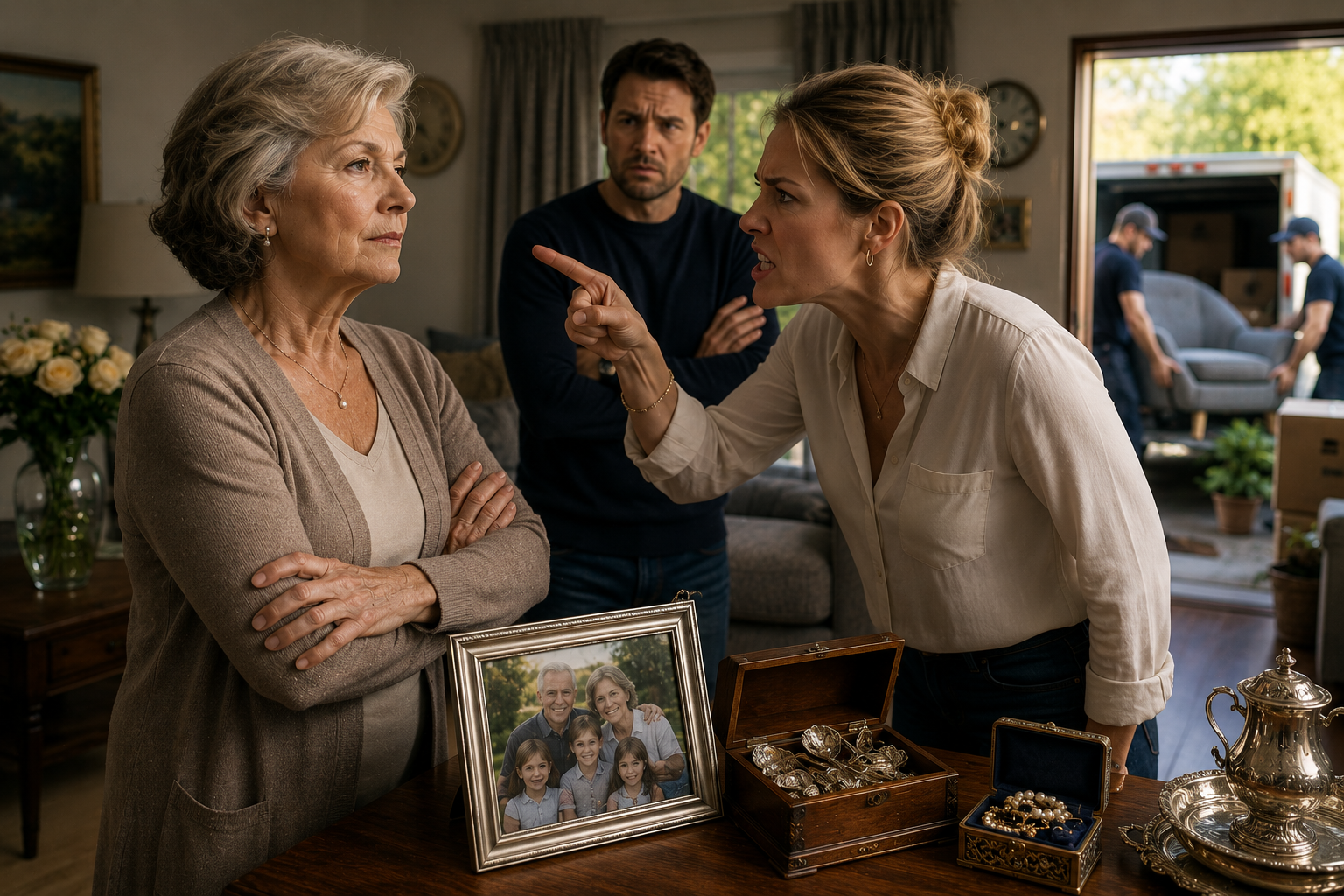
Ten years of silence, and she slid her arm through mine like we did this every Sunday. “She looks peaceful. ” And then, in the same breath, with the casket eighteen inches away, “We should talk about the estate, sweetheart, as a family. ”
I said nothing.
I’d made a promise about exactly this moment, even if I didn’t understand it yet. Two days later, the letter came. Law office of Harriet Cole, addressed to me, with copies noted to my parents. All interested parties were invited to attend the reading of the estate plan of Marlene Woods.
My phone rang within the hour. My mother, warm as fresh bread. “We’ll pick you up, sweetheart. We should walk in together.
” I drove myself. Harriet was sixty-six with reading glasses on a chain and the general climate of a woman who had never once been talked over successfully. My parents arrived in their church clothes. My mother had brought a leather folio.
It sat on her lap the whole time, prepared. Harriet read without theater. The estate consisted of the house on Sycamore Street, appraised at $475,000. The commercial building downtown that used to be her fabric shop, valued at $610,000.
Investment accounts totaling $2,290,000. Cash and personal property, $125,000. $3. 5 million.
And every dollar of it, the house, the building, the accounts, all of it, to her granddaughter Ansley Woods, sole beneficiary. To her son Gregory and his wife Pamela, $10,000 each, quote, “With my thanks for the lesson they taught me in 2014. ”
The room went so quiet I could hear the coffee machine. I watched my mother.
She didn’t flinch. She smiled. She reached over, took my hand in both of hers, and said, warm as a heating pad, “Oh, sweetheart, what a responsibility for you. Of course, we’ll manage it for you.
” Like the money had been left to them with an errand attached. I took my hand back gently. “No, thank you. ”
My mother kept smiling as she gathered her coat.
That smile scared me more than the note on the door had. It was the smile of a woman with a plan. The first move wasn’t a lawyer. It was casserole diplomacy.
My mother called that Sunday, her voice soft and almost shy. She wanted to have me over for dinner. No business. No estate talk.
Just family. “I’ve missed you. ”
I knew what this was. I had watched this woman price a stroke victim’s house from the visitor chair of the hospital.
But here’s the truest thing in this whole story. You can know exactly what someone is and still be starving for them. Estrangement doesn’t kill the hunger. It just teaches you to eat around it.
So I said yes. For one hour, I’ll admit it to you and to nobody else, it was nice. Then the dessert plates came out. Next to my slice of pie, my mother set down a plastic-bound folder.
Woods Family Wealth Management Plan. Inside was the whole architecture. A family LLC to hold everything. Managing members: Gregory and Pamela Woods.
A monthly allowance for me. The word “allowance” in print, aimed at a twenty-eight-year-old woman who ran night shifts alone with dying strangers. Page six had a signature line with a little plastic arrow stuck on. My dad studied his pie.
My mother talked the whole time in her loan officer voice, terms like fiduciary responsibility and protecting the assets. “You’re so busy with your work, honey. ” I let her finish. Then I closed the folder and said, “Thank you for dinner.
The pot roast was perfect. I’m not signing this. ”
The temperature dropped ten degrees in one second. My mother looked at me, and the softness went out of her face like a switch had been flipped.
“We tried the nice way,” she said. Three weeks later, a man in a golf shirt handed me a manila envelope in front of two co-workers and a grieving family. I’d been served. Gregory Woods and Pamela Woods were contesting the last will and trust of Marlene Woods.
The grounds made my hands go cold on the steering wheel. Undue influence by a caregiver. Lack of testamentary capacity. The dutiful granddaughter recast as a professional who had isolated a dying woman, alienated her from her loving son, and steered three and a half million dollars into her own pocket.
And buried in the motions was the tell. “Petitioners further request the court appoint them interim managers of the estate. ” Manage it for you. She’d found a way to say it in legal stationery.
Until it was sorted out, everything froze. The accounts, the house, all of it locked while the court decided whether my grandmother had been of sound mind. Harriet called me that evening. “They have every legal right to file this.
Any fool can knock on the courthouse door. Now come to my office. Your grandmother left some instructions about this exact knock. ”
The family phone tree got to work.
My aunt in Columbus heard I’d gotten myself written into the will. A great uncle heard I’d been medicating Marlene at the end. By Friday, a woman at Hartman’s grocery looked at me too long, and I knew my mother’s version of me had beaten me to the checkout line. Then my cousin Kayla texted.
“I just think you should do the right thing and share. They’re your parents. ” When I picked my phone back up an hour later, I’d been blocked. That one cost me something real.
That Sunday, someone knocked. Ruth Delgado stood in my hallway holding a pot of chicken soup with both hands, her eyes dry and furious. “Marlene told us this would happen. All of it.
Every move they’re making. She called it. ” I wanted the rest, but Ruth only patted my hand. “Harriet does the explaining in this outfit.
I just do the soup. ”
Two things happened that week. First, Harriet, as trustee, asked me to move into Nana’s house. An occupied house is an insured house.
My parents’ lawyer objected within a day, calling it “the caregiver occupying the disputed asset. ” Harriet replied in writing that the trustee had made an operational decision, and they were welcome to bring it up with Judge Marsh. So I packed the same two suitcases and moved six streets over into the house where the porch light was. Second, the first night there, I went looking for the switch.
I wanted to be the one to turn it on, the way she’d turned it on for me. I traced the wire from the porch fixture into the hall closet, and there, screwed to the wall above the fuse box, was a little mechanical timer, beige plastic, older than me. Its dial notched at seven in the evening. She hadn’t been flipping that switch by hand all those years.
She’d bought a machine to make me a promise back in October of 2014, and that machine had kept it every single evening for more than ten years, through storms and Christmases and her own dying. Click. Seven o’clock. Light on.
I sat on the closet floor and finally came apart, quietly, on my own time. Then I did something that didn’t come natural. Ruth knocked that evening with soup number three, and instead of telling her I was fine, which was my whole personality, I opened the door all the way and let her in. She looked around the kitchen at the green table and said, “Good.
Now, has Harriet shown you the letters yet? ”
Harriet spread the file across her conference table the next morning like a surgeon laying out instruments. “Your grandmother did not guess. She remembered.
” Then she walked me through the fortress Marlene Woods had spent ten years building. The trust was created in March of 2015, five months after my parents put my suitcases on the porch. She’d sat in this same office, seventy-two years old, furious in her Sunday coat, and said she’d just watched what her son would do for money, and she intended to make it useless to him. Every few years she came back and tightened a bolt.
The final amendment, January of 2024, nine months before any diagnosis, back when she was still hauling her own mulch. Attached to it, two letters from two different doctors, each certifying her memory and her judgment, and in Dr. Patel’s dry phrasing, “a degree of financial acumen exceeding my own. ” Harriet had met with her alone each time.
Every meeting logged. Capacity, documented twice, independently, dated. Influence, impossible. My grandmother had built her paperwork like a woman who’d been ambushed once and never intended to be ambushed again.
“There’s more,” Harriet said. “There’s a page I’m not permitted to show you before the hearing. Marlene’s orders. Judge Marsh gets to read it first.
Out loud. She was very specific about the out loud. ”
In August, they deposed me. My parents’ attorney was a man named Barrett Voss, with the bedside manner of a paper cut.
For two hours, he asked reasonable questions in a reasonable voice. My shifts. My access to Nana’s house. Whether I’d driven her to the bank.
Cooked her meals. Been alone with her. All the ordinary mechanics of loving somebody old, replayed slow so they’d look like grooming. Then, without any change in tone, Voss slid the knife in.
“Ms. Woods, have you ever been admitted to a psychiatric facility, voluntarily or otherwise? ”
Ten years I’d kept that November locked in a drawer no one knew existed. At nineteen, I was still listed on my father’s health insurance, and the statements go to the policy holder.
They had known for ten years. They had known and said nothing and saved it. I heard myself answer anyway, level, the voice I use at four in the morning with frightened patients. “Yes, in 2015, for three days.
I checked myself in and I checked myself out. ” Voss made a small note, pleased. “Debts of gratitude are still debts. Wouldn’t you agree?
” I didn’t answer that one. Two weeks after the deposition, my supervisor called me in before my shift and couldn’t look at me. An anonymous complaint had been filed with the Ohio Board of Nursing. Elder financial abuse by a hospice professional.
Anonymous. But it cited the probate case number, so we can retire the mystery of authorship. The board has to investigate. And while it grinds, an agency that cares for the dying cannot staff a nurse under an abuse investigation.
My supervisor’s voice wobbled when she asked for my badge, and I unclipped it and set it on her desk. Understand what they’d found. The trust was a fortress, so they stopped shooting at the fortress. They were shooting at me.
The license was the one thing I’d built entirely alone. By then my savings were nearly gone, too. Eighteen of my twenty-one thousand had already gone out the door. That night I sat in my car outside Nana’s house and watched the porch light click on at seven, right on schedule.
A dead woman keeping her promise while I figured out how to keep mine. The preliminary hearing was in October, Judge Ellen Marsh presiding. My parents sat at the petitioners’ table in their church clothes. My mother was serene.
Judge Marsh put on her glasses and paged through the trust in the quiet. Then she stopped turning pages. “Counsel, before we schedule anything, has your client read Article 9 of this instrument? ” And she read it out loud into the record.
“If any beneficiary of this trust contests its validity or seeks control of its assets through proceedings, that beneficiary forfeits any and all interest granted herein. ” The $10,000 bequests were conditional. Contest the trust, and the gift evaporates. But the judge wasn’t finished.
“There is an attached statement of intent, executed and notarized January of 2024. The testator requests it be read aloud in open court in the event of any challenge. ” She turned the page. From Marlene Woods.
“In 2014, my son Gregory and his wife Pamela petitioned to have me declared incompetent so they could manage my affairs. The court said no. I have spent ten years making sure the answer stays no. If they are in your courtroom now, they have come after my death, smiling, offering to manage what I left behind.
I ask you to read this page to them, so they understand that I am, one final time, ahead of them. ”
The silence was total. I watched my mother’s smile drain from the eyes down, like something unplugged. My grandmother had predicted their exact play in writing, sixteen months before they made it.
In the hallway after, my mother walked straight to me, close, perfume unchanged, and said, quiet enough that only I could hear it. “You think a dead woman can protect you? ”
Three nights later, my dad came to the house alone. He stood at the bottom of the porch steps, inside the circle of the light, not knocking.
He looked older than the funeral. “Your mother wasn’t always like this. ” And then he told me a story I’d never heard. My mother’s mother died in 1991 when my mom was twenty-three.
There was no estate. There was bills, collection notices, a repossessed car. My mother worked three jobs to bury her own mother and spent two years paying off a dead woman’s debts. “She thinks she’s protecting you,” he said, “from ending up like her mother.
”
For a second, standing in Nana’s doorway, I saw the whole sad machine of it. A scared twenty-three-year-old building a ledger so the floor could never fall out again. But here’s what I said. “And you?
What’s your story? ” He looked at his keys, the shadow behind the curtain, forty years of “if you think it’s best, Pam. ” “Just give her something, Ansley,” he said finally. “She’ll stop.
We can be done. ” Not “I’m sorry. ” Not “she’s wrong. ” An installment plan.
I said goodnight and closed the door gently. Three days later, my mother offered me the one thing money can’t buy, and I almost took it. Four pages, in her handwriting. “Ansley, my firstborn, not a day has passed.
We can withdraw everything, the case, the complaint, all of it, tomorrow. Come home. Sunday dinners, Christmas, your room. We’ll be a family again, the way your grandmother would have wanted.
All we ask is that the estate be divided fairly and managed properly by all of us together. ”
I sat under the porch light with those pages until two in the morning. I’m not going to perform strength for you here. I read it nine or ten times.
Some animal part of me, the one that sat up at her voice on the phone, was howling. Because this was the actual prize. Not the money. This.
The door reopened, the ledger burned. All it cost was everything Nana spent ten years building, handed over to the people she built it against. Toward dawn, I understood the letter was the deposition again, in softer font. She came the next morning for her answer, and I met her on the porch.
“You can’t buy back what you threw away, Mom, and I’m done paying interest on being your daughter. ” Something in her face closed like a bank at five. She walked to her car, and from the open door she gave me one last look. “Then you’ll lose the license, too.
” And that was the last conversation my mother and I ever had as mother and daughter. The formal offer arrived the following week. $700,000 styled as a family settlement in exchange for full withdrawal of the will contest. And one paragraph lower, the sentence that had been aimed at me all along.
“It has been our client’s experience that licensing matters tend to resolve themselves when families reconcile. ” Translation: pay us, and the board complaint evaporates. Fight us, and it doesn’t. And if I fought, my medical history from November 2015 would be subpoenaed and examined in open court.
My own attorney told me plainly that taking the deal was the rational move. “You’d keep eighty percent and your privacy. ”
Even the math of surrender was reasonable. That’s what a good trap looks like.
I sat at the green table that night with the agreement flat, pen uncapped. I had decided to sign it. My hand was actually moving when the knock came. It was Ruth, with Carmen behind her holding a pie.
They didn’t ask what the papers were. Ruth put her hand flat on the pages. “Let me tell you what I watched for ten years,” she said. “Every evening, seven o’clock, that porch light came on.
Rain, snow, the night of her diagnosis, the night she died. I used to check it from my kitchen window like a lighthouse. One time I asked her why she didn’t just leave it burning all day. And Marlene said, ‘Because then it wouldn’t mean anything, Ruthie.
It has to be a choice. It has to cost a little every single day or it’s not a promise. It’s just a bulb. ‘”
Carmen cut the pie without asking.
“She wasn’t leaving you money, honey,” Ruth said. “Money was the smallest thing in that house. She was leaving you witnesses. ”
I looked at the signature line, at the little plastic arrow.
Ruth asked the question I have thought about every day since. “You’ve been paying for their love your whole life, Ansley. Whatever this paper costs, add it to that pile. What’s the interest rate?
”
I sat with that. Then I picked the agreement up, squared the pages, and tore them in half. And the sound was the best thing I’d heard since Nana laughed. Nobody at that table knew yet what I was going to do instead, including me, until I said it out loud.
“To beat their story, I have to tell mine. All of it. Under oath. ”
Here is what I understood.
Their entire artillery ran on one fuel: my silence. The seventy-two hours was only a weapon while I treated it like a wound. A secret can be extorted. A story can’t.
So the next morning, I sat in Harriet’s office. No settlement. No counteroffer. No delay.
And then the part that made my own lawyer blink. I would sign a waiver and release my behavioral health records myself, voluntarily, into the case before Voss could subpoena a single page. You cannot threaten to expose what a woman has already laid on the table in her own handwriting. The blackmail died in that signature.
Eighteen months of leverage gone in one stroke of a pen. Because people who keep ledgers cannot imagine giving away the thing you could charge the most for. Then we built the witness list. Dr.
Patel and his twenty years of charts. Dana, the hospice nurse who actually ran Nana’s case. And the green table. Ruth, Carmen, the whole gray-haired nation of Maple Glen.
The people who had watched a porch light burn for eleven years and knew exactly who it burned for. The evidentiary hearing opened in November, and the courtroom was full. Voss went first, and I will give the man this, he was good. For one entire day he built a woman out of my outline.
A trained medical professional embedded in a dying widow’s home. Access to her routines, her moods, her medications. A granddaughter with a documented psychiatric history who stood to gain three and a half million dollars. My mother testified in a blue suit with a tissue in her fist, poised, wounded, reasonable.
“We only ever wanted to manage things properly. Ansley is fragile. She’s been fragile for years. ” Then Kayla, my cousin, testifying that I’d kept to myself and gotten close to Mrs.
Woods at the end. Two innocent facts arranged into fingerprints. That was the day I learned you can lose a person twice. The judge listened without a face.
When they adjourned, Voss looked like a man ahead on points. And honestly, he was. That night the porch light clicked on at seven, and I sat under it and practiced nothing. Nana always said the truth doesn’t need rehearsal.
It just needs a witness willing to go first. I took the stand at nine in the morning in the gray dress. And I told it all of it. October 2014, two weeks past my eighteenth birthday, the key that wouldn’t turn, two suitcases packed with the sweaters folded.
My father’s shape behind the curtain. My mother’s voice through four inches of door. “Family is a ledger, Ansley, and you are deep in the red. ” I watched the court reporter type my mother’s sentence into the permanent record of the state of Ohio.
Then I told them about the six-street walk in the dark and the porch light coming on. And then, because it was mine to tell now, I told them about November 2015. Nineteen years old, thirteen months into exile, the night my hands wouldn’t stop, the drive I made alone, the form I signed alone, the seventy-two hours, the form I signed to leave alone. “Counsel has called me fragile,” I said, and I looked at nobody except Judge Marsh.
“I checked myself in at nineteen with no one to call, and I checked myself out and finished nursing school and spent six years sitting with this county’s dying. I’m told that’s a psychiatric history. On my ward, we call it surviving. ”
Harriet read my waiver into the record.
Every page of those records released by me voluntarily, weeks ago. Last, the dates, laid out plain. The trust was born in March of 2015, five months after the porch. Amended for the last time in January of 2024, nine months before the diagnosis, two doctors certifying her mind the same week.
“My grandmother didn’t change her plan because I got close to her money,” I said. “She changed it because she watched them come for hers. ”
Then came the afternoon I want read at my funeral. Dr.
Patel, twenty years of charts, and the flat professional opinion that Marlene Woods had a degree of financial acumen exceeding his own. Dana, the hospice nurse of record, confirming under oath that I had never once handled her chart, her drugs, or her paperwork. That I was, in the file, listed only as family. And then the gray-haired nation took the stand one by one.
Carmen, telling Judge Marsh that Marlene planned this trust the way she planned everything. “Sober as a hymn and twice as loud. ” And Ruth, seventy-one years old, testifying about the porch light, the timer set in October of 2014, the bulb she watched from her kitchen window every evening for eleven years. “That light was for the girl.
Everyone on Sycamore Street knew what it meant. It meant that child had a home whether her parents wanted her or not. ”
Voss tried to cross her. He suggested elderly neighbors misremember things, and Ruth looked at him over her glasses the way you’d look at gum on a pew.
“Old women notice things, young man. It’s all we do. ”
The gallery laughed, and Judge Marsh let them. And that’s when my mother broke.
She stood up at the petitioners’ table over Voss’s hand on her arm. “We fed her for eighteen years. You don’t get to walk away from a debt like that. Family is a ledger.
It is. ” Fifty strangers, a court reporter, and a judge heard my mother state the household religion out loud in her own voice, the exact sentence from the porch, and no one had extracted it from her. She’d offered it. Judge Marsh called a thirty-minute recess.
When she came back, she had the trust in one hand and a ruling in the other. The petition to invalidate the trust of Marlene Woods was denied with prejudice. On incapacity, the court found two independent contemporaneous medical certifications and the testimony of a treating physician of twenty years against zero medical evidence from the petitioners. On undue influence, the court found “no evidence whatsoever that the beneficiary influenced this estate plan and abundant evidence that the plan was a response of many years standing to the petitioners’ own prior conduct.
” The trust stood. Every bolt Nana tightened held. Then, Article Nine. The contest had been brought without probable cause, which meant the conditional bequests were forfeit.
My parents had sued for three and a half million dollars, and the arithmetic of their ambition came due at zero. The court noted it would entertain the trustee’s motion to recover fees from the petitioners. My mother took the sound of all this the way you take a diagnosis. My father took it looking at his keys.
Outside, in the hallway, by the tall windows, she crossed to me one last time. Up close, her composure had cracks in it now. Fine ones, like a windshield the morning after a cold night. And she said, and I believe it was the truest thing she ever said to me, “After everything we gave you.
” Not sorry. Not even angry, really. Just the ledger open to my page one final time. I heard my own voice come out the way it does when I turn off a monitor that’s done its work.
Quiet and finished. “Then consider us settled. ” I walked past her through the doors into the November cold and I did not look back. It didn’t feel like victory.
It felt like a discharge. Somebody I’d been treating my whole life had finally been released. The county paper ran it on page two. My name, the trust, and one paragraph about a nineteen-year-old girl and seventy-two hours in the behavioral health unit.
For a week, people at Hartman’s looked at me one second too long, and I let them. That was the cost of taking the weapon away, and I’d pay it again. But I did pay it. Privacy once spent doesn’t refund.
And there was the other thing. That night I sat under the porch light, took out my phone, and found the contact that still said “mom and dad,” a habit ten years dead. I didn’t block the number. Blocking is for doors people might knock on.
I just deleted it. And the screen asked was I sure. For the first time in my adult life, the answer was clean. The girl who kept a door cracked open for them was gone.
I’d left her on the stand under oath, where she finally got to matter. Six weeks after the ruling, the board of nursing closed the complaint unsubstantiated, and my supervisor handed my badge across her desk with wet eyes and a speech she couldn’t finish. My first shift back, an eighty-pound farm widow held my hand at three in the morning and told me I had calm hands, and I had to step into the hallway for a minute on my own time. The house came fully mine when the appeal window closed.
The green table runs full again on Sunday mornings. Ruth and Carmen and the gray-haired nation, pancakes on the old griddle, coffee still criminally weak. Some recipes are load-bearing. The rent from the Spool and Thimble building goes into something Harriet helped me set up called the Marlene Fund.
It pays for respite care, a weekend off, a paid aid, a tank of gas for family caregivers in Curran County. The daughters and granddaughters sleeping in recliners next to hospital beds. No applications longer than one page, no payback, ever. House rule.
In the spring, one envelope came from Dayton, my father’s handwriting, alone. Inside was a check for $3,900. A hundred fifty a month from sixteen to eighteen. He had refunded the room and board to the dollar, with one line on a sticky note.
“I’m sorry. ” I didn’t tear it, and I didn’t call. I signed it over to the fund, where it bought eleven exhausted caregivers a weekend of sleep. Which is the only interest that debt could ever pay.
And in June, Ruth showed up on the porch with a girl named Nadia, eighteen, a nursing student whose parents had put her things in garbage bags. I heard myself say the rent was a dollar a year, and no, she could know me. House rule. Then I went to the hardware store and had a key cut.
Handing it over felt like the entire estate changing hands for the second time, correctly. Tonight, it’s late September again, coming up on twelve years since two suitcases sat on a porch. Through the kitchen window, I can see Nadia at the green table with her anatomy flashcards, wearing my old sweatshirt, eating pancakes she did not pay for. At seven o’clock exactly, the timer in the hall closet gives its little click, the same click it has given every evening since 2014, and the porch light comes on over Sycamore Street.
Here is everything I know, and it fits in one sentence. Love doesn’t keep books. It keeps a light on.
And a light like that, it turns out, can outlive the hand that lit it.