The wedding was supposed to start at 4:00 in the afternoon, and at 3:47 my 4-year-old grandson pulled on my sleeve and said, quiet as a confession, “Pop-Pop, she pinches Mommy when you drive away. And then she smiles again when you come back. ”
I went still inside the way you go still when something cold passes through you before your mind has named what it is. Around us, 300 guests were settling into white folding chairs arranged across the south field of my property under the old oak canopy that my late wife had always called the prettiest spot on Earth.
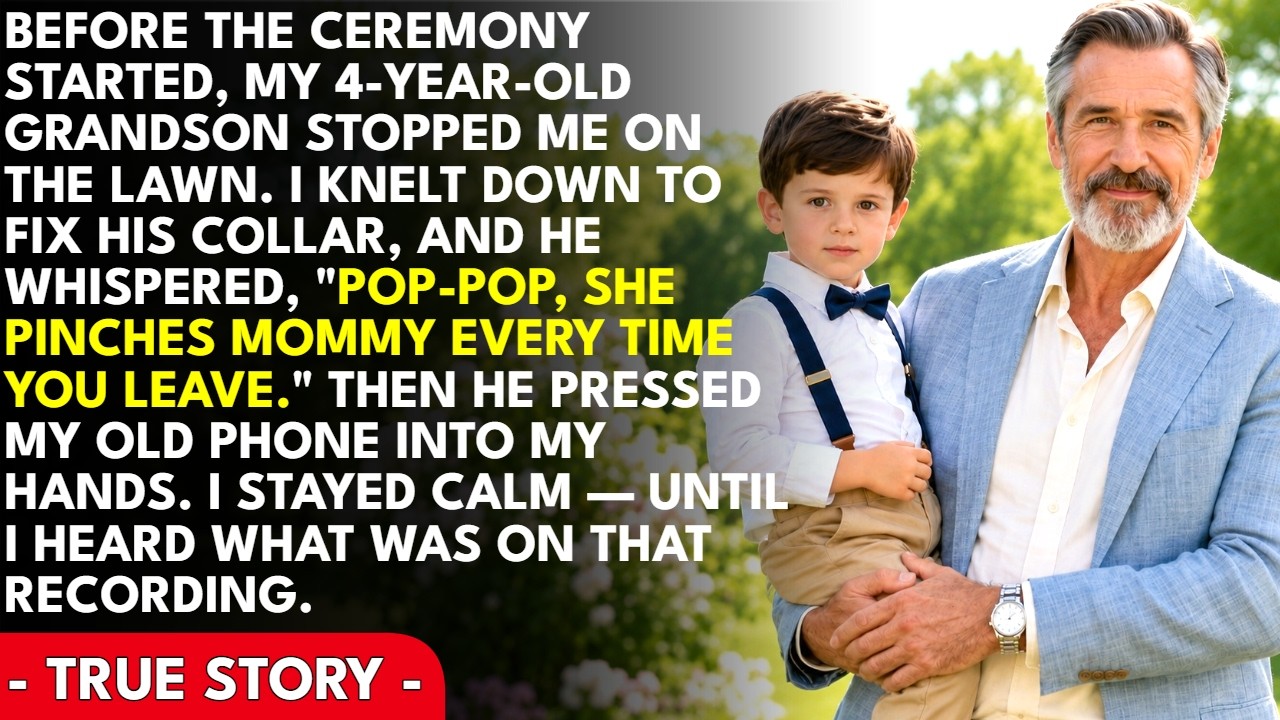
I crouched down to his level. He was wearing his little linen suit, the one his mother had pressed twice that morning. He held out my old iPhone in both hands, careful, the way a child holds something he has been told matters. “Oliver,” I said, “what did you say?
”
He looked up at me with his grandmother’s eyes. “I was playing phone,” he said. “By accident. But, Pop-Pop, I think the people talking in it are talking about you.
”
I built Caldwell Orchards on 32 acres of red Georgia clay and one stubborn conviction: that if you tended something faithfully enough, it would give back more than you put in. My grandfather had peach trees on this land. My father kept half of them. I kept all of them and planted more.
By the time I was 50, we were selling at 17 farmers markets across the state and hosting weddings and corporate retreats every weekend from April through October in the barn my grandfather built in 1951. I did not do it alone. I never once did anything alone. My wife was the one who turned the barn into a venue.
She had an eye for things, for the way a space could feel if you lit it right and didn’t crowd it with furniture. She sourced the Edison string lights herself, drove to three different salvage yards on one Saturday to find the right harvest tables. She named the event packages. She handled the bookings.
She did all of it while raising our daughter Avery and never once made me feel like she was carrying more than her share. We had 31 years together. Not perfect years. Years with the weight and the texture of years.
Arguments about money and lean winters, the particular joy of a good harvest, the way she laughed at her own jokes before the punchline landed, the coffee she made too strong that I eventually stopped complaining about because it started to feel like home. She was diagnosed in the spring of 2021. Ovarian cancer, stage three. The doctor was kind and careful and told us the truth, which was that we had time but not unlimited time.
She spent that time doing exactly what she wanted. She finished the South Garden she’d been planning for 3 years. She taught our daughter how to make her grandmother’s peach jam. She held Oliver every chance she got and pressed her face into his hair and breathed him in like she was storing it.
She passed on a February morning in 2023 with the peach trees bare outside the window and my daughter in the doorway holding Oliver on her hip. I was holding her hand. My younger brother Prescott was in the chair by the wall. After the funeral, after everyone went home, I sat in our bedroom for a long time.
The house was very large and very quiet. I was 62 years old and I had never once in my adult life been this alone. That was the man Lenora found when she walked into my life 9 months later. My brother called it a chamber of commerce mixer.
I called it the last place I wanted to be on a Thursday evening in November. Standing in a hotel ballroom with a glass of sweet tea I hadn’t asked for, talking about peach yields with people who’d never touched a tree in their lives. I went because Prescott asked me three times and I had run out of excuses. She was near the window when he walked me over.
She was wearing a dark green blouse and her hair was pulled back simply, not the way someone styles themselves when they’re trying to impress. Just the way a person looks when they’ve gotten ready without fussing. She was perhaps 52 with steady eyes and a composed way of holding herself that I found restful without meaning to. “This is Lenora,” Prescott said.
“She moved up from Charlotte about 8 months ago. Does consulting work for nonprofits. ”
She extended her hand. “I’ve heard good things about Caldwell Orchards.
”
“That’s Prescott talking,” I said. She smiled. It was a real-seeming smile. “He mentioned you’re the kind of man who built something worth building.
I have a lot of respect for that. ”
We talked for 40 minutes. She asked about the farm with what seemed like genuine curiosity. Specific questions about growing seasons and soil that someone had to actually care about to think to ask.
She mentioned losing her husband 2 years prior, briefly, without theater, just a fact set down and moved past, and I appreciated that more than I could express because I was not yet capable of talking about my wife without my voice doing things I couldn’t control. I called her 6 days later. I told myself I was being polite. What I did not see in those early months, what I had no reason to look for because grief had narrowed my vision down to whatever warmth was directly in front of me, was what happened every time I turned my back.
My long-time operations manager, Maggie, saw it first. Maggie had worked at Caldwell Orchards for 16 years. She knew where every key was, every vendor contract, every equipment warranty. She was the kind of person who noticed things the way a good nurse notices things, quietly, without announcing it, and with the patience to wait until she was certain before she said a word.
She told me about it months later, sitting across from me at the kitchen table, with her hands flat on the surface and her voice even in a way that told me she had rehearsed how to say it. “The first time was in April,” she said. “You had gone out to check the irrigation line on the south end. I could see her through the office door she’d left open.
She was going through the filing cabinet by the window, going through it slowly, the way a person reads, not the way a person searches for something they already know is there. ”
She asked me questions, too, friendly questions about whether the farm had a line of credit, whether the event bookings were processed through a personal account or a business one, whether I handled payroll or if that went through me directly. She never pushed. She always asked like she was just curious, just learning her way around.
Maggie looked at me steadily. Then she reached into the front pocket of her uniform and placed a composition notebook on the table between us. Black cover, half filled with neat, careful handwriting. I looked at that notebook for a long moment.
16 months of Maggie watching and writing and carrying it alone, because she understood that the housekeeper raising concerns about the man’s new companion tends not to end well for the housekeeper. “Why are you telling me now? ” I asked. She looked at me without flinching.
“Because the wedding is in 3 weeks. And because some things can’t wait anymore. ”
My daughter, Avery, was 34 and had, until 2 years ago, been the kind of person her colleagues described as formidable. She ran risk assessment for a regional investment firm in Atlanta, managed a team of 11, and had a reputation for finding the flaw in any proposal within the first reading.
She had her mother’s instincts and my stubbornness, and she had always, always known her own mind. Flynn came into her life at a conference in Savannah in the spring of 2022. He was well-dressed and articulate, and had a startup concept that shifted shape every time he described it. He was charming in the way that wears thin once you’re looking for it, but photographs very well.
My daughter brought him home that summer. I shook his hand and looked him in the eye and found nothing I could name as wrong. My wife was still alive then, though already sick. She watched Flynn across the dinner table that first evening with those steady eyes of hers that had never once missed anything.
Later, when we were alone, she said, “That man has never lost anything that was truly his. ”
I told myself she was being cautious the way sick people sometimes were. They married in October of 2022. I walked my daughter down the aisle and believed I was doing what a father does.
Oliver arrived the following spring, and for a while things seemed ordinary. The ordinary ended quietly, the way real trouble always does. My daughter stopped answering calls from her work friends. Then she stopped going into the office on Fridays.
Then one morning in early 2024, she called to say she was taking an indefinite leave of absence. “Flynn thinks it’s better,” she said, “for Oliver. ”
Her voice had a quality I hadn’t heard in it before. Careful, measured, like she was choosing each word from a list of approved options.
I asked her four questions. Four careful answers came back. I told myself she was tired. New motherhood was hard.
I told myself all the reasonable things a father tells himself when he doesn’t want to believe the alternative. I did not know then what I learned later. How Flynn had spent months before that phone call methodically convincing my daughter that her job was making her anxious, that her colleagues didn’t appreciate her, that a real home required her full attention. Said it so many ways, so many times, that she began to hear it in her own voice.
How he had filmed her on the hard nights when Oliver was sick and she was running on no sleep and had moments of ordinary human overwhelm that he then used as evidence she was fragile. How he told her once, in the flat tone he used when he wanted something to land, that if she ever involved her father in their private business, he would take Oliver and she would spend the next 3 years in a custody fight she could not win. I was 50 miles away at Caldwell Orchards, watching Lenora learn the layout of my filing cabinets and calling it love. My long-time business associate Sutton called me on a Wednesday in July.
We’d known each other 22 years, done four deals together, and he had never once called me about money without a real reason. “I need to ask you something,” he said, “and I’m going to ask it straight. ”
“Go ahead. ”
“Your son-in-law came to see me in May.
Said he was looking at short-term capital for a logistics startup. Said you were aware of it. ”
A pause. “I lent him $35,000 on the strength of our history.
”
Another pause. “You weren’t aware of it, were you? ”
I looked out the window at the peach trees. Late July, heavy with fruit.
The light gold on the leaves, the way it gets in Georgia that time of year. “No,” I said. “I wasn’t. ”
After I hung up, I sat with that for a while.
Then I called the man who handled security for our events, a former county deputy named Rollins who’d worked with us for 9 years. I told him what I needed. He didn’t ask why. He said he’d start reviewing the access logs.
What I’m about to tell you is the hardest part of this to say. But it’s the part that matters most. Our family doctor, Dr. Aldridge, had known us for 18 years.
He had delivered my wife’s diagnosis. He had sat at my kitchen table the week after her funeral and stayed until midnight because he understood that some grief doesn’t do well alone. He called me on a Sunday evening in August with the careful voice he used when something was difficult. “I saw your daughter for her annual physical last week,” he said.
“Her husband brought her and waited in the parking lot. ”
A pause. “During the exam, I noted bruising inside her left forearm. Recent.
She said she caught it on a kitchen cabinet. ”
I didn’t say anything. “I’ve been a doctor for 30 years,” he said. “I know what a cabinet bruise looks like.
”
He explained that under HIPAA, he couldn’t have shared this without my daughter’s explicit permission. But she had called him herself 2 days after the appointment and given that permission in writing. She had told him she wanted it on record. She had told him to tell me when the time was right.
“She’s been protecting you,” he said quietly. “Even through all of it. She didn’t want to be the person who broke your heart again. ”
I sat on the edge of my bed for a long time after he hung up.
Outside the window, the orchard was silver in the August moonlight. 30 years of peach trees standing in their rows, faithful to whoever tended them. I went downstairs. Lenora was in the living room reading.
She looked up and smiled at me with that warm and practiced warmth of hers. I sat down beside her and asked how her day had been. I listened to her answer. I said the right things.
I was in that hour the finest actor I have ever been in my life. Rollins brought me the footage on a Tuesday morning in September. Three screenshots from the farm security cameras, timestamped. The first showed the back gate to the event barn at 10:42 on a Saturday night in late August.
Flynn’s truck parked outside, engine running. The second showed a man I didn’t recognize coming through the gate carrying a leather portfolio case. The third showed the same man at the door of my farm office at 10:51. Rollins set a fourth photo on the table.
Same hallway. 12 minutes later, the man was leaving. The portfolio case was thicker than it had been going in. “Near as I can tell, nothing removed,” Rollins said.
“But the original deed documents and the LLC operating agreement were disturbed. I noticed when I walked the property the following morning and replaced them. ”
I thought about what that meant in practical terms. Under Georgia law, a properly drafted management transfer agreement can redirect operational control of a limited liability company with the right signatures and the right notarization.
These are legitimate legal instruments used in business succession planning all the time. If someone handed me a document at the right moment, in the right setting, framed the right way, at a reception, at a celebration, I could have signed away control of Caldwell Orchards without fully understanding what I was looking at. Flynn had a lawyer walk onto my property at 11:00 on a Saturday night. He had been in my family for 2 years and he had already been inside my deed cabinet.
My brother Prescott came to the farmhouse the night before the wedding, just the two of us. We sat on the porch the way we’d sat on porches our whole lives and I told him enough of it, the shape of it, the outline, enough to understand what I needed from him the following day. When I finished he was quiet for a while. The September crickets were loud in the tall grass past the fence line.
Then he said, in the voice he used when something had settled into decision, “What do you need from me tomorrow? ”
I told him. He nodded once, the way our father had always nodded when a thing was decided and would not be revisited. I called Rollins that evening.
I called Dr. Aldridge. I called Sutton and two other business associates Flynn had borrowed from without authorization. I called Maggie last.
She answered on the first ring. “It’s time,” I said. “I know,” she said. “I’ve been ready.
”
The morning of the wedding was the clearest September morning I’d seen in years. The kind of sky that doesn’t apologize for being beautiful. I stood at the bedroom window in my suit, the charcoal one with my wife’s embroidered handkerchief in the breast pocket, the one she’d stitched with a small peach blossom for my 60th birthday, and watched the event crew setting up the last of the chairs in the south field under the oak canopy. My daughter arrived at 10:00 with Oliver.
I met them at the door. She looked at me with her mother’s eyes, steady, a little too still, the way she looked when she was holding something in. I hugged her and held on a moment longer than usual. She held on back.
Oliver ran past us both to find the barn cats. By noon the guests had started arriving. 300 people. Old friends, farm customers, neighbors, business partners going back two decades.
People who had come because I had mattered to them and because they wanted to see me find something good after what I’d lost. At 3:45, I was near the South Field when I felt a small tug at my sleeve. Oliver was standing beside me in his little linen suit, hair already loose on one side, holding my old iPhone in both hands with the careful grip of a child who has been thinking about whether to do this for a long time. “Pop-Pop,” he said, “she pinches Mommy when you drive away and then she smiles again when you come back.
”
The field tilted. I crouched down. He held the phone out. “I was playing phone,” he said, “and I made a call by accident, but I think the people talking are talking about you.
”
I took the phone from his hands. My fingers were steady. My chest was not. I looked up and found Maggie standing at the edge of the tent.
She had been watching. She walked toward me and stopped just behind my shoulder and neither of us needed to say anything. I looked down the field toward the barn entrance. Through the open doors, I could see Lenora near the entryway in her cream-colored dress, one hand resting on a guest’s arm, laughing at something the guest had said.
She was radiant. She looked exactly like the woman I had believed she was for 9 months. I pressed my hand to the top of Oliver’s head. “You did exactly the right thing, buddy,” I said.
“Pop-Pop’s going to take care of this. ”
He nodded, satisfied, the way children nod when they have been carrying something and are relieved to set it down. Then he looked out at the rows of chairs and said, with perfect 4-year-old sincerity, “Pop-Pop, why is there so much food? ”
I almost laughed.
“Because a lot of people came,” I said, “to see something important happen today. ”
I stood up. I handed Maggie the phone without a word. She took it without a word.
“Get Prescott,” I said quietly. “Get Rollins and Dr. Aldridge. 5 minutes.
Tell them to come quietly. ”
She was already moving. I have stood in front of difficult rooms before. Rooms where I had to tell people the harvest was short, the insurance wouldn’t cover it, we were going to have a hard year.
Rooms where I had to absorb someone’s anger because absorbing it was more useful than fighting it. I had believed I understood what it felt like to stand somewhere and know that what you were about to say would not be forgotten. I had not understood it until 4:00 on that September afternoon. The ceremony was scheduled to begin.
The officiant stood at the front. 300 people had settled into their chairs under the oaks. Lenora had started her walk toward the aisle from the barn entrance. I asked the officiant to step to the side.
He looked at me for one careful second and then he did. I walked to the front of the gathering. The musicians stopped. 300 people looked at me.
I said I needed a few minutes before we began. I said I had something I needed them to hear. Then I nodded to Rollins, who was standing at the portable speaker unit we used for events. He pressed play.
Oliver’s accidental recording lasted 51 seconds. The first 20 seconds were ambient sound. The kitchen, birds outside, a cabinet closing somewhere. Then Lenora’s voice came through the speakers clear and unhurried.
The voice of someone discussing a business matter they’d already decided. “He signs the property transfer at the reception. I’ve already spoken with your contact. ”
And then Flynn, relaxed, almost bored.
“And she stays quiet. ”
And then Lenora. “She’ll do what she’s told. She always does.
The only problem is that old housekeeper. She watches too much. ”
Flynn, after a beat. “Deal with her after.
”
I watched 300 faces move through confusion, then concentration, then understanding, then something colder and harder than understanding. When the recording ended, I let the silence hold for 10 full seconds. Then I said, “Maggie. ”
She stepped forward from the side of the tent.
She was wearing her good gray jacket, and she had her composition notebook open in her hands. She looked out at 300 people with the composure of a woman who had waited 16 months for this moment and was not going to hurry through it now that it had come. She read for 4 minutes and 12 seconds. Dates, times, exact amounts.
She read the record she had photographed of withdrawals from the joint farm account we’d opened. Amounts calibrated to stay below the $10,000 federal reporting threshold, totaling just over $91,000 across 7 months, transferred to an account in a name she’d looked up and could not connect to any legitimate business purpose. She read verbatim the conversations she had recorded in her notebook. Lenora asking me about my estate plan, asking Maggie about the deed, telling a contractor that after the wedding, all spending approvals over $5,000 would route through her directly.
She read every word she’d written in that black composition notebook in a voice that did not waver once. When she closed it and stepped back, I looked at Dr. Aldridge. He rose from the front row.
He introduced himself. He stated that his patient had authorized him in writing to disclose what he was about to say. He described what he had observed in his examination room. He used plain words and a doctor’s precision and did not editorialize.
He spoke for 2 minutes. Every person in that field understood exactly what he was saying. Then Prescott opened the gate at the south edge of the field. My daughter walked in.
She was wearing jeans and a blue shirt she’d had since college. Her hair was pulled back simply. She had not dressed for a confrontation. She had dressed like herself because herself was what she had come to reclaim.
She walked down the side of the rows of chairs with her chin level and her eyes on me, not on Lenora, not on Flynn, just on me, the way she’d looked at me from the end of the aisle at her own wedding when she wanted to make sure I was steady. I reached out my hand. She took it. Her grip was hard and certain and warm.
We stood at the front of the South Field in front of 300 people and we didn’t need to say a single word because the room had already said everything. Flynn stood from his chair. The smooth surface of him had slipped, not completely, but enough, the way a wall cracks before it gives. He moved toward the side gate and stopped.
Sutton was standing in the path, arms at his sides, eyes steady. Two other men I recognized were beside him. Behind them, two attorneys from an Atlanta firm had arrived through the back entrance 20 minutes earlier and were holding documents that Flynn was legally required to address. He looked at Sutton.
He looked at the attorneys. He looked finally at me. I held my daughter’s hand and looked back at him. I did not feel anger in that moment.
What I felt was the particular stillness of a man who has done what needed to be done and can now simply stand in the fact of it. Lenora had not moved from the barn entrance. She was still holding her flowers. And then she set them down on the nearest chair, gently, with the last performance she had left in her.
She stood in her cream dress in front of 300 people and the warmth she had worn for 9 months was simply gone. What was underneath it was nothing I recognized. It was the face of someone whose strategy had failed and who had nothing below it that belonged to her. My daughter’s hand tightened in mine.
Outside the oak canopy, the September light moved across the field in long steady bars, gold and indifferent and beautiful, the way light has always moved across this land, regardless of what the people on it were doing. I looked at my daughter. She looked back at me with her mother’s eyes. That was enough.
That was more than enough. That was everything. Lenora and Flynn left Caldwell Orchards at 6:17 that evening. Rollins logged it because Rollins logged everything.
They left through the back gate, not the front, which I hadn’t specifically arranged, but which felt right. The front entrance of this property was built for people who belonged here. The guests took their time leaving. Some came to find me in small groups, pressing my shoulder, saying what decent people say when they want you to know whose side they’re on without making it about themselves.
I thanked each one and meant it every time. The food went to three churches and a food bank on the south side of town. I saw no reason for good food to go to waste. The white flower arrangement stayed.
They were good flowers. They had done nothing wrong. I found my daughter in the south garden at dusk, sitting on the stone bench her mother had placed there specifically to catch the late September light. She had Oliver in her lap, and they were watching a hawk circle above the orchard.
I sat beside her without speaking at first. After a while, she said, “I tried to write you a letter in February. I put it in the mailbox at the end of the drive. ”
“I never received it,” I said.
“I figured that out eventually. ”
A pause. “I’m sorry I couldn’t find a way to tell you sooner. ”
“Avery,” I said, “look at me.
”
She looked at me. “You protected your son,” I said. “Every single day, in impossible circumstances, you protected Oliver. That’s what I see when I look at what you did.
Not the silence. The protection. ”
I put my hand over hers on the bench. “Your mother would have seen the same thing.
I know that without any doubt. ”
Her jaw tightened. Her eyes went bright. She looked out at the peach trees and breathed carefully for a moment, the way she had done since she was small, when she was determined not to cry in front of anyone.
Then she said, “Rough at the edges, but certain at the core. She would have figured the whole thing out in about 2 weeks. ”
“10 days,” I said. She laughed, a real laugh from somewhere genuine, the kind that surprises you when it comes.
And then she was crying quietly, with Oliver oblivious in her lap, narrating the private adventures of a stick he’d found with complete concentration. That night I went to the storage room at the back of the farmhouse, the overflow room, where the off-season decorations lived and the boxes of books that hadn’t found their shelf yet. Lenora had taken my wife’s photograph from the wall in April. I had found it in here afterward and told myself I would rehang it when the time was right.
The time was right. I carried it upstairs and hung it back on the wall above the landing where it had always been. My wife and I at the edge of the orchard, the summer we planted the third row of trees. She was laughing at something and the afternoon light was good, and whoever had taken the picture had caught it exactly right.
I stood there looking at it for a while. Then I found Maggie in the kitchen, finishing the last of the evening’s cleanup the way she finished everything, without fuss, without waiting to be asked. I told her I wanted to talk about her position at the farm, effective immediately. She looked at me with the careful expression of someone bracing for the unexpected.
I told her she was being promoted to general operations director of Caldwell Orchards. I told her the salary and the new benefits package. I told her about the small house on the north edge of the property that had been sitting empty for 2 years. That was hers if she wanted it.
She was quiet for a moment, looking at the kitchen counter. “Your wife would have done this years ago,” she said. “Yes,” I said. “She would have.
I’m sorry it took me longer. ”
Maggie nodded once, accepting that the way she accepted most things without ceremony. “I’ll take the house,” she said. “I’ve always liked the north side.
Better light in the morning. ”
Later that night I sat in my study with the desk lamp on and wrote in the notebook I kept in the bottom drawer. Not a record, not a plan. Just three words for the version of myself that would read them someday when the distance had made this whole year something I could finally see whole.
I wrote, “I was loved. ”
Not by Lenora. That had never been true. Not for a single day of the time I’d known her, and I would need to sit with that fact for longer than one evening before I could see its shape clearly.
But before her, and underneath everything she had tried to build over and around the life I’d made on this land, there had been 31 years of a woman who’d loved me all the way down to the soil of this place. A daughter who’d protected her child rather than save herself. And a four-year-old boy who had pressed an old iPhone into his grandfather’s hands and said, without ceremony, without understanding the weight of what he was handing over, “I think the people talking are talking about you. ”
I closed the notebook.
I turned off the lamp. Outside the study window, the orchard was dark and still. The peach trees standing their ground the way they had for 50 years and would for 50 more, indifferent to who walked among them and faithful to whoever tended them with care. Upstairs, Oliver was asleep.
Down the hall, my daughter was settling in for the night. And on the wall above the landing, my wife was back where she had always belonged. I went to bed and for the first time in a long time I slept without trying.