The iron poker trembled in Mary’s hands as she wedged it beneath the hearthstone of the decaying cottage. With a harsh scrape, the rock gave way, revealing a hidden black tin box. Back at the grand estate, her stepmother Judith and cruel stepbrothers were likely celebrating, certain they had seized the entire Weaver fortune and banished Mary with a mere £5. They were completely unaware of the dramatic irony.
They had fiercely fought over ledgers and flocks, while the family’s true liquid wealth, and a secret legacy that could destroy their claim, lay buried right here under Mary’s soot-stained fingertips. She only had to survive long enough to protect it. Mary Weaver had been born in the spring of 1848 in a stone farmhouse on the eastern slope of Ash Creek, a scattered parish of some 40 households set between the low hills and the slow brown water that gave the place its name. She was the only child of Thomas Weaver, a grazier and wool merchant of moderate holdings, and his first wife Ann, who died of a fever when Mary was four.
Ann Weaver had been remembered in the village as a small, brown-haired woman who sang while she worked, and who had brought with her, upon her marriage, a modest oval locket of chased silver holding a lock of her own mother’s hair, which she gave to Mary on the last afternoon they sat together in the parlor, pressing it into the child’s palm and closing the fingers around it as though sealing a promise. Mary had kept the locket ever since, first strung on a bit of ribbon under her pinafore, and later, when she was older, in a small inner pocket she had stitched herself into every dress she owned, and she touched it in the same absent way another girl might touch a rosary or a wedding ring. Her father, Thomas, was a man of long silences and long ledgers, and after Anne’s death, he ran the household and the flocks with the same patient exactness until three years later he married a widow from the neighboring parish named Judith Marlowe, who brought with her two sons, Edwin and Peter, and a firm conviction that a household required a mistress with plain views on the ordering of children. Mary was moved from the room that had been her mother’s sewing room into a smaller chamber above the scullery, and though she was never mistreated in any way a village gossip could name, she was gradually and thoroughly moved to the outer edge of her own family, taking her meals at the corner of the long table and her lessons alone with whatever book her father set beside her plate.
What saved her, in the way that saving so often happens in quiet houses, was the presence of the household’s cook and general keeper, a widow named Hannah Sowerby, who had come into Thomas Weaver’s employment at the age of 42, the year Anne died, and who was still there, gray-haired and stiff-shouldered, when Mary was old enough to stand on a stool at the kitchen table and hold a rolling pin. Hannah had lost her own husband and infant son to the same fever that had taken Anne, and she said very little about it and a great deal about pastry, and she taught Mary the whole slow language of a working kitchen: how to render lard clean, how to salt a ham, how to set a milk pan so the cream rose true, how to steep chamomile for a headache and yarrow for a cut, how to keep a household book in a neat column of pence and shillings so that no farthing walked off unaccounted. She taught her to mend a torn hem so the stitch could not be found, to darn a stocking heel over an egg-shaped darning ball of turned beech, to lay a coal fire that would hold through the small hours of a winter morning, and to speak civilly to a butcher who thought he could pass off yesterday’s mutton to a girl. Mary was quick and she was patient.
By the time she was 16, she could keep the Weaver books better than her stepmother and cook a Sunday dinner for eight without hurry. Hannah, watching her from the doorway with her arms folded and her mouth soft in a way that never showed itself in company, told her once and only once that a woman who knew how to work would never in her life be truly poor. Mary remembered the sentence the way she remembered the weight of the locket, and she carried both of them into every room of the years that followed. Thomas Weaver died in the second week of February, 1870, of a chill that settled into his chest after a night out with a lame ewe.
He was buried in the parish churchyard on a gray Tuesday with the ground still hard enough to ring under the sexton’s spade. The will was read three days later in the front parlor of Mr. Bramwell, solicitor of Ash Creek, a narrow man with narrow spectacles who spoke as though every sentence cost him a penny he did not wish to spend. Judith sat in the good chair with Edwin and Peter, now 24 and 21, arranged behind her like a pair of well-tailored fence posts.
Mary sat on the small hard chair by the window with her gloved hands folded and the locket, a familiar shape, against her hip. Hannah Sowerby was not in the room. Hannah had been asked to wait in the kitchen with the other servants because it was understood by all present that the reading of a gentleman’s will was not the business of the woman who had baked his bread. Mr.
Bramwell unfolded the first document with a dry crackle and read the outer will in a voice that made no distinction between a shilling and a soul. To his wife, Judith Weaver, née Marlowe, he left the house on the eastern slope and its contents and the greater portion of the flocks and the yearly income therefrom. To his stepsons, Edwin and Peter Marlowe, he left equal shares in the wool trade and the ledgers of the merchant house. To his daughter, Mary Weaver, he left—and here Mr.
Bramwell paused only long enough to turn the page—the sum of £5 and a keepsake to be selected from the household linens, being the customary provision made for a servant of long service in a respectable house. There was a small silence in the parlor. Judith did not look at Mary. Edwin examined a spot on the carpet, and Peter permitted himself the faintest movement of the corner of his mouth.
Mary did not speak. She folded her hands a little tighter and watched the window light move across the brass fender, and she thought with a clarity that surprised her of the way Hannah had taught her to set a milk pan. Mr. Bramwell coughed once and asked whether the family required a moment, and Judith said in the voice she used with tradesmen that they did not, and that the girl might collect her five pounds at the office on the following Monday, and that a linen sheet from the second press would suit for the keepsake.
Mary rose then and thanked Mr. Bramwell for his time in the level voice Hannah had taught her to use with butchers, and she walked out of the parlor and down the hall and up the narrow back stair to the chamber above the scullery where her small trunk stood already half packed, because a woman who knew how to work also knew how to read the weather in a house. She folded her three dresses, her two shifts, her Sunday shawl, her Bible, her mother’s hymn book, her darning ball of turned beech, her small tin of chamomile, and her household book with its columns of pence and shillings. She laid Anne’s locket in the inner pocket she had stitched into her traveling dress, and she closed the trunk and sat on it and waited for morning.
She left the house at first light on the Wednesday with the five pounds in a knotted handkerchief and the folded sheet from the second press wrapped in brown paper under her arm, and Hannah standing in the yard in her gray shawl watching her go. Hannah did not embrace her, because Hannah did not embrace, but she pressed into Mary’s hand a slip of paper folded twice and told her in a voice pitched low against the frost to go to the address written on it and to ask no questions of anyone on the road. The carter who took her as far as the crossroads at Nether was a man named Job Ackley, who charged her a shilling and gave her back sixpence when he saw her face. From Nether Bridge she walked.
The lane out of the village ran between hedgerows of blackthorn still bare and beaded with the night’s rime, and the fields on either hand lay gray under a low gray sky. The rooks went up in ragged clouds from the plowland as she passed. She walked with her trunk on a small handcart borrowed against the promise of return, and the wheels caught in the ruts and had to be lifted. By the second mile her gloves were wet through and her boots were heavy with the clay of the lane.
She passed a shepherd on a stile who nodded to her without speaking, and a woman drawing water at a pump who watched her with the flat curiosity of a village, and a boy driving three geese who called out a greeting she did not quite hear. The country beyond Ash Creek was country she had never walked, though she had seen it named on the coach map her father kept in the hall. She read Hannah’s slip once at the milestone where the lane forked. The handwriting was Hannah’s, careful and square.
It named a cottage called Hollow Stone at the end of a track past the Denby Smithy, and it named a key hidden under the third stone of the doorstep, and it said in the last line that the place was hers now if she could bear it. Mary folded the paper back into her glove and took the left-hand fork and walked on into the wind that had begun to come up off the ridge, carrying the smell of coal smoke from cottages she could not yet see. The smithy at Little Denby stood at a bend in the lane with a red door and a black anvil set out under a lean-to, and Mary passed it without stopping and turned onto the track it marked. The track was narrower than the lane and rutted deeper, and hazel grew close on either side with the last of the year’s brown leaves clinging in the hedge.
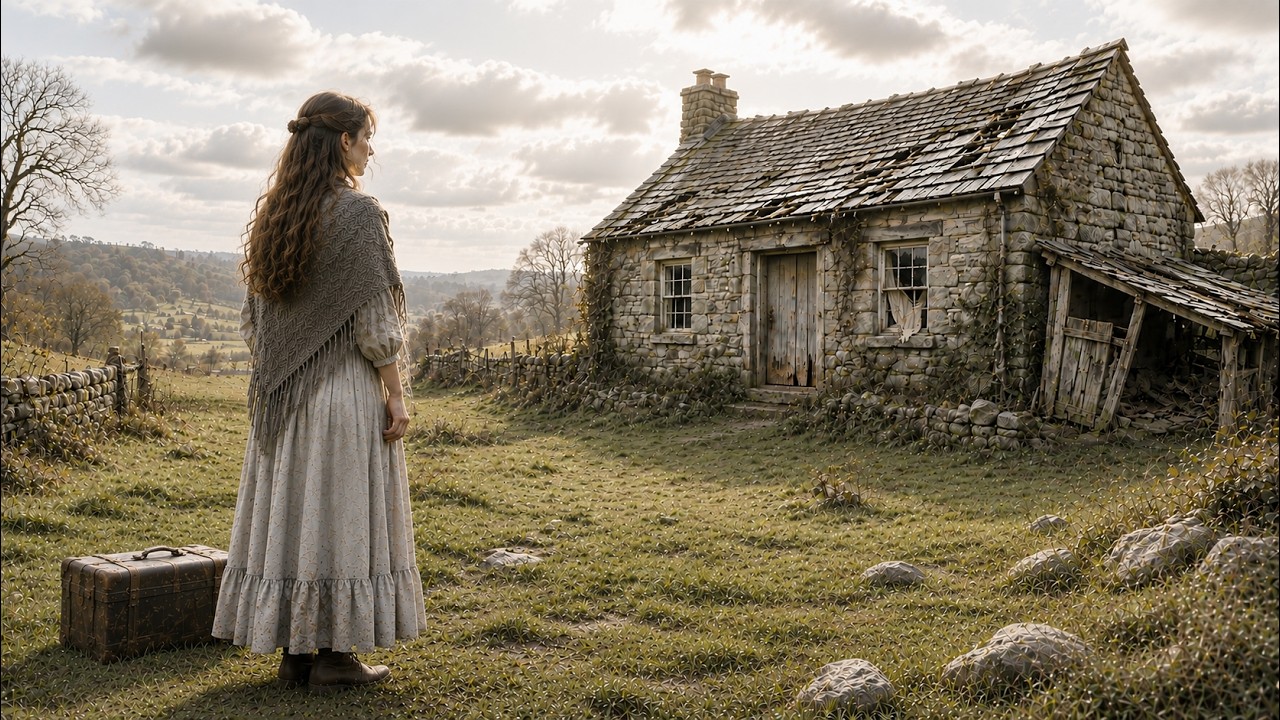
At the end of the track, set a little back from a low stone wall, stood the cottage called Hollow Stone. It was small, a two-room cottage of coarse gray stone under a roof of thin slate with a single chimney at the western gable and a lean-to at the eastern gable that had once been a washhouse and was now more or less a pile of leaning boards. The front door was of oak planks bound with two iron straps and studded with square nails, and the wood had gone silver from weather, and the lower edge had rotted where the rain came off the step. There were two windows on the front, each of four small panes in a leaded frame, and one of the panes was cracked across and another was gone altogether and had been stuffed with a wad of sacking.
The doorstep was a single slab of gray sandstone worn into a shallow dish in the middle from years of feet, and set into the ground before it were three flat cobbles laid as a path. Mary set down the handles of the handcart and knelt and lifted the third cobble with her fingers. Beneath it, in a small hollow lined with clay, lay a heavy iron key wrapped in a scrap of oiled cloth. The key turned in the lock with effort and a dry sound, and the door opened inward on hinges that had not been oiled in a long time.
Inside was one room across the front, some 12 feet by 15, with a flagged floor and a wide hearth of rough stone. A crane hung in the hearth with a pot hook still on it. Above the hearth was a mantel of oak split down its length. Under the front window stood a settle with the seat lifted off its pegs and leaning against the wall.
Against the back wall stood a dresser of dark wood with three shelves, and on the shelves were four plates, two mugs, and a chipped brown jug. A ladder in the corner led up through a square hole to a small loft under the slates. Behind the front room, through a plank door, was a scullery of about 8 feet by 10, with a shallow stone sink drained out through the wall, a copper set into brickwork, and shelves for crocks. Everything smelled of cold stone and old smoke and the mildew that comes into a place where no fire has been lit in a year.
The ceiling was low and beamed with rough oak, and the beams were sound. Two of the slates had slipped on the north pitch, and a patch of the ceiling plaster had come down onto the flags. The limewash on the walls had gone yellow and was flaking at the corners. There was a broom leaning behind the door, its besom worn to a stump.
There was a rush candle in a pewter holder on the mantel with half an inch of tallow yet to burn. Mary stood in the middle of the flagged floor with her gloves in her hand and looked at the room slowly, corner to corner, the way Hannah had taught her to look at a kitchen before starting work in it. Then she went back to the door and dragged her trunk over the sill and set it down beside the hearth. And she began.
She swept the flags with the worn besom and carried the fallen plaster out and tipped it against the wall of the lean-to. She wiped the dresser shelves with a rag torn from the folded sheet Judith had allowed her from the second press. She laid a small fire in the hearth with kindling from a bundle she found in a corner of the scullery, dry and years old but still willing to catch. She struck a light from a tinderbox on the mantel that held one scrap of char cloth and a good flint.
The fire took, and a thin pale smoke went up the chimney, and after a moment the chimney drew clean. It was while she was on her knees at the hearth feeding small sticks to the flame that Mary noticed the hearthstone was not one stone but two. The larger slab lay across the front of the fire, and behind it, tight against the back wall of the fireplace under a coat of soot, was a second stone about a foot square, set flush and mortared at three edges. The mortar on the fourth edge had crumbled away, and a fine dark line showed where a knife had once been slid in.
Mary sat back on her heels and looked at it. Then she rose and fetched the poker from the settle and worked the point of it into the line. The stone was heavy, but it moved. She eased it out with both hands and set it on the flags beside her, and she looked into the cavity behind.
Inside was a tin box the size of a Bible, painted black once and now flaked, with a small brass hasp. Behind the box, laid flat against the back of the cavity, was a folded paper tied with a length of blue thread. Mary lifted them both out. She wiped her hands on her apron before she opened the box.
The box held a small cloth bag of coins and a bundle of banknotes folded together. Mary counted them on the flags in the firelight. There were 42 sovereigns in the bag, heavy and bright, and there were banknotes for a further £60. It was more money than Mary Weaver had ever held in her life.
She set the coins back in the bag and the bag back in the box, and she took up the folded paper. The thread came apart at a touch. Inside was a single sheet of good paper, close written in a small careful hand in brown ink that had faded evenly with the years. At the head of the sheet was written a date, the 14th of June 1841, and a name: Elizabeth Fenn, widow of Hollow Stone Cottage, Little Denby.
Mary read the first line and stopped and looked up at the fire and then back at the page. Elizabeth Fenn had been her mother’s mother. The lock of hair in the locket at Mary’s hip had been cut from this woman’s head. Mary had never met her and had known her only as a name spoken once or twice by her mother in the parlor.
Now she sat in the woman’s cottage on the woman’s flagged floor with the woman’s savings in a tin box at her knee and the woman’s letter in her hand. Mary read the letter through twice and then folded it and set it on the mantel under the pewter candle holder, where it would be safe from ash. She did not weep. She banked the fire, set the tin box in the trunk under her folded shifts, and slept that first night wrapped in the shawl on the settle she had put back on its pegs, with the poker within reach and the door bolted with a length of oak she cut from the leaning boards of the washhouse.
At first light she began the work in the order Hannah would have set it: shelter first, water second, food third, and only then the finer repairs. She walked back to the smithy at the bend in the lane and spoke to the smith, a broad man of about 50 named Roland Peak, who had been at his forge since he was 12 and knew every roof and gate in the parish. She showed him the two slipped slates on the north pitch and asked what a man would charge to set them. Roland Peak looked at her and at Hollow Stone standing behind her and said his boy, Thomas, would come with a ladder on Thursday and set them for two shillings and a loaf if she could spare one.
Mary said she could and would. On Wednesday she walked into Little Denby village and spent one of Elizabeth Fenn’s sovereigns at the grocer’s counter kept by a small, sharp woman named Mrs. Ada Fewster, aged 61, widowed of a lay clerk. Mrs.
Fewster weighed out flour, oatmeal, salt, sugar in a blue paper, tea in a twist of brown, a pound of lard, half a pound of bacon, and a cake of yellow soap. She gave the change and a look that took in Mary’s boots and her clean cuffs and her steady hand on the purse. She asked no questions. She told Mary the well at Hollow Stone was good water, and that the pump handle had wanted a new leather since 1868, and that Jervis Hoggart, the cooper, would cut her one for 3 pence.
By Thursday afternoon, Thomas Peak, aged 19, had set the slates with fresh copper nails and pointed them in with lime mortar mixed on a board on the doorstep, and Mary had baked him the loaf in the copper set into the scullery brickwork, having lit a first small fire beneath it with cut hazel from the hedge. The loaf came out dense and pale and honest, and Thomas Peak ate half of it on the walk home and told his father the cottage was drying already. Mary set the rooms in a sequence. She lime-washed the front room herself with a bucket of slaked lime she bought from a builder passing through with a cart, brushed on with a worn stock brush in even strokes across the ceiling first and down the walls after, three coats laid two days apart.
She scrubbed the flags with sand and hot water and lye until the gray stone showed its own quiet color. She oiled the dresser with linseed rubbed in with a wool rag and buffed it dry. She mended the split oak mantel with two iron straps forged for her by Roland Peak at a shilling the pair and set flush into notches cut with a chisel borrowed from him. She reglazed the cracked pane with a small square of glass from a broken pantry window at the vicarage, which the vicar’s wife, Mrs.
Harriet Bly, aged 44, gave her for nothing when Mary called with a jar of chamomile for the vicar’s headaches. The scullery she took last. She scoured the sink with river sand and set a new leather in the pump. She whitewashed the copper’s brickwork and swept out a jackdaw’s nest from the flue.
She hung the darning ball of turned beech and Anne’s hymn book on the shelf above the settle, and she put the household book with its columns of pence and shillings on the dresser where the light from the front window fell across it in the afternoons. She entered every farthing spent. Two shillings to the Peakes. Three pence to Jervis Hoggart.
Eleven pence three farthings to Mrs. Fewster on the second week. Six pence for a bundle of tallow candles. A shilling to a boy who cut and stacked her a rick of hazel and blackthorn for the fire.
By the end of the third week, Hollow Stone stood clean and quiet under a sound roof with a fire that drew properly and a door that closed on oiled hinges. And Mary Weaver had spent £7 and had £94 and change still folded in the tin box behind the hearthstone, where she had put it back without hesitation. Word traveled in Little Denby as it travels in any small parish. Mrs.
Fewster spoke of the young woman at Hollow Stone who paid in full and asked the price of things and did not haggle unkindly. Roland Peak spoke of the young woman who could describe a slipped slate correctly and knew what lime mortar was. Mrs. Bly spoke in a softer voice of the young woman who brought chamomile in a clean jar with a paper cover tied down with string.
By the fourth Sunday, when Mary walked into the parish church of Little Denby in her Sunday shawl and sat at the back on the left, three people nodded to her before the first hymn. And the vicar, the Reverend John Bly, a stooped gray man of 58, said her name in the porch afterwards as though he had known it a long time. Mary began to take in work. She mended for the vicarage, turning collars and cuffs and setting invisible patches into the knees of the vicar’s second-best trousers at 3 pence a garment.
She kept Mrs. Fewster’s shop book on Saturday evenings for a shilling and her tea, setting the week’s columns straight in the neat hand Hannah had drilled into her over the kitchen table at Ash Creek. She sold small jars of chamomile and yarrow salve at the grocer’s counter at 2 pence the jar, and Mrs. Fewster took a farthing on each and said it was fair.
A rhythm formed. On Monday mornings, Mary washed at the copper and hung her linens on a line strung between the lean-to and a hazel stump. On Tuesdays, she baked two loaves and a plain cake and left one loaf on the doorstep of an elderly widower named Absalom Reed, aged 73, a retired hedger who lived alone in a cottage half a mile down the track and who left her in return a pat of butter wrapped in a dock leaf or a handful of walnuts in season. On Wednesdays, she walked into the village.
On Thursdays, she mended. On Fridays, she cleaned. On Saturdays, she kept Mrs. Fewster’s book.
On Sundays, she went to church and sat at the back on the left, and after the service she walked home along the track past the smithy and heard Roland Peak call good afternoon to her over the wall. By the end of the summer of 1870, the people of Little Denby spoke of Hollow Stone as Miss Weaver’s Cottage and of Miss Weaver as a fixture of the parish. And the ejected daughter of Thomas Weaver had become, without anyone quite noting the moment, a woman of Little Denby with a trade, a fire, a door of her own, and a name spoken plainly in the porch of the parish church. On a still afternoon in early October of that year, with the hazel outside the front window turning to copper and the wind off the ridge carrying the first coal smoke of autumn from the cottages of Little Denby, Mary Weaver sat at the dresser in the front room of Hollow Stone with the household book open before her and the low sun coming in across the flags in a long yellow slab.
She had finished the week’s columns in ink from a stone bottle Mrs. Fewster had ordered for her at 4 pence, and she had drawn a neat line under the total, and she had wiped the nib clean on a scrap of the same folded sheet from the second press that Judith had allowed her, and which had by now served as rag, curtain lining, and window cloth and would go on serving until nothing of it was left. On the dresser beside the book lay two objects set close together on the oiled wood where the light fell most clearly. The first was the small oval locket of chased silver on its plain black ribbon, opened so that the lock of soft brown hair inside it was visible against the tarnished lining.
The second was the single sheet of good paper dated the 14th of June 1841, folded once now along the crease where Mary had folded and unfolded it so many times that the paper had grown soft at the fold, and signed in a small careful hand: Elizabeth Fenn, widow of Hollow Stone Cottage, Little Denby. Mary looked at the two things side by side and understood, as she had come to understand slowly over the summer, that the lock of hair in the locket her mother had pressed into her four-year-old palm on a last afternoon in the parlor at Ash Creek had been cut from the head of the woman who had also written the letter, and had also hidden the tin box behind the hearthstone, and had also, in a plain closing line, hoped that whoever found the box would sit at the fire she had sat at and be warm. Two women who had loved a child they had not lived to see grown had left her between them this cottage and this locket and this letter and the knowledge that she had never been quite as alone as the parlor at Ash Creek had made her feel. She thought of Hannah Sowerby in a gray shawl in the yard pressing a folded slip of paper into her hand, and she understood that Hannah had known the whole of it from the beginning and had kept it in a widow’s silence until the day it was needed.
She thought of Thomas Weaver, who had let the outer will stand and had also, before he died, permitted Hannah to keep the slip of paper with the name Hollow Stone written on it, which was perhaps the only apology a long silent man had known how to make. She thought of Judith Weaver in the good chair and of Edwin and Peter Marlowe behind her and of the sheet from the second press folded under her arm as she left the house on a February morning, and she felt no wish to answer them. Mary Weaver had been 22 and disinherited with five pounds in a knotted handkerchief and a locket in the seam of her pocket, and she had spent that five pounds on a cart and a carter and the walk to Little Denby, and it was the best five pounds she ever spent.