The man on my porch wore a gray suit and carried a manila envelope. In his other hand, a set of house keys that did not belong to him. I was on my second cup of coffee, still in my flannel robe, when I watched him climb the steps. He had that particular walk, shoulders set, chin raised, of a man who expects no resistance.
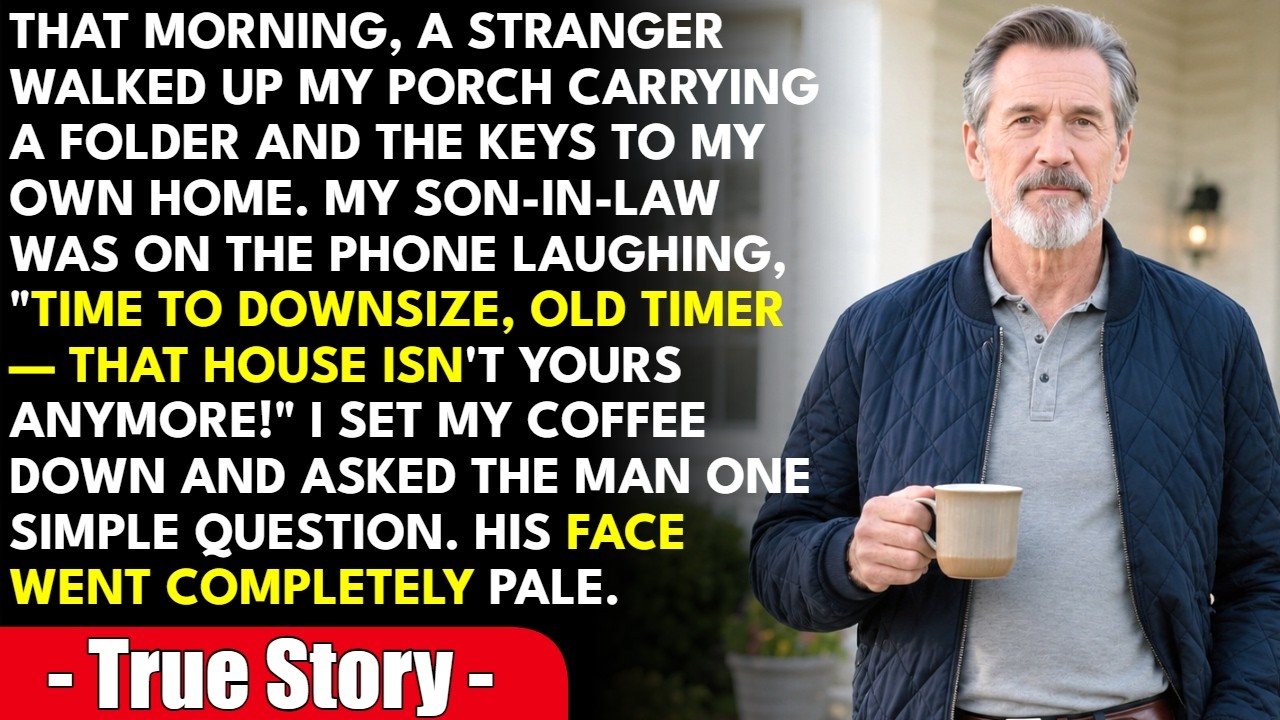
He pressed the doorbell twice, then knocked. He introduced himself as a representative from Keller Property Solutions, a commercial acquisitions firm out of Chattanooga. He had a laminated ID badge clipped to his jacket. He told me, with the measured courtesy of someone who had delivered bad news before, that his company had recently completed the purchase of this property, and that I would need to begin vacating within 30 days.
I did not say a word. I looked at the keys dangling from his fingers. The keys to my home. The home I had lived in for 29 years.
The home where my wife had taken her last breath in the upstairs bedroom. My phone buzzed on the entryway table. I already knew who it was before I looked at the screen. My son-in-law.
He didn’t wait for me to speak. I could hear the grin in his voice before the first word was out. “Hey there, old-timer,” Cole said. “You got company yet?
I told you for years that house was too big for one person. Time to simplify. Everything’s been handled. You don’t need to worry about a single thing.
”
Simplify. As though 29 years of a life could be folded into a storage unit and a studio apartment somewhere off the interstate. I stayed quiet for a beat, long enough to let him enjoy it. Then I asked the representative standing on my porch one question.
His expression changed immediately. He looked down at his folder, then back up at me, and for the first time since he’d climbed those steps with such certainty, he did not look certain at all. My name is Duncan Reeves. I am 66 years old, a widower, and a retired forensic accountant who spent 32 years untangling financial fraud for federal agencies and private litigation firms.
I still live in a 1910 Victorian home on a quiet tree-lined street in Knoxville, Tennessee. To understand the morning those federal vehicles turned onto my street, you have to go back six months. Because nothing that happened on that porch makes any sense without what came before it. My wife, Clara, passed away four years ago from an illness that took three years to finish what it started.
She was the kind of woman who made every room she entered feel more inhabited, more real, more worth being in. After she was gone, this house felt like a building I was borrowing from someone else. My daughter, Tara, had always seemed close to me. She is 39, a licensed real estate agent, married to Cole for 11 years.
Cole runs a commercial development company out of Chattanooga. Strip malls, mixed-use projects, the kind of developments that turn neighborhoods into parking structures with retail facades bolted to the front. He is the sort of man who uses phrases like yield optimization in ordinary conversation and waits to be admired for it. For most of those 11 years, I thought of Cole as tolerable.
Ambitious in a way I sometimes found exhausting, but committed to Tara, and that was enough. What I did not know, what I would not know until much later, was that Cole had been watching my property for nearly three years. A 1910 Victorian on a corner lot in a neighborhood that had recently begun to attract serious development interest. Four bedrooms, original hardwood floors, leaded glass windows that Clara had spent two patient years restoring by hand, a wrap-around porch, three-quarters of an acre in a city where land had become genuinely scarce.
To me, it was home. To Cole, it was inventory. The execution of his plan required one specific condition. It required me to be at least temporarily vulnerable, confused, trusting.
In February of last year, I had a cardiac catheterization at UT Medical Center. They went in through the femoral artery to place two stents in a partially blocked vessel. I was under conscious sedation for several hours and spent one night in the cardiac recovery unit. Tara was there.
She had driven up from Chattanooga the evening before, which touched me. She sat with me while the nurses ran pre-op checks and brought me coffee in a good thermos. She was still there when I came out of sedation that afternoon. I remember the light being very bright, my mouth being very dry.
Tara’s hand over mine, which also touched me. I remember thinking that whatever complicated distance had grown between us over the past couple of years, she was still my daughter. “Dad, the hospital just needs a few signature pages for your discharge file. ” Her voice was gentle, practiced in the specific way of someone who had rehearsed the phrasing carefully.
“Medical power of attorney, advanced directive, standard documents. They need them on file before they’ll release you. I can walk you through it. ”
She handed me a clipboard.
A stack of papers. Her thumb indicated where to sign. I have spent considerable time since then trying to reconstruct exactly how much mental clarity I had in that room. The sedation had mostly worn off, but I was tired in a way that went past physical.
There was a faint ache behind my sternum. The room felt slightly behind where I was trying to be. I signed. I did not read the page buried two-thirds down the stack.
The page that gave Cole Landry full durable power of attorney over my financial affairs. Not just medical decisions, but property transactions, banking, asset transfers. A document prepared not by the hospital, but by Cole’s corporate attorney, which Tara had slipped into the stack among the legitimate discharge forms. She kissed my cheek.
The nurse brought me apple juice. Tara drove home to Chattanooga. Three months later, my property tax statement arrived addressed to a company I had never heard of. I sat at the kitchen table and read the line four times.
The assessed owner of my home was listed as Keller Property Solutions LLC. I put the statement down, walked to the window, looked at the magnolia tree for a long moment, then picked up the phone. Tara answered on the third ring. There was restaurant noise in the background.
“Dad, is everything okay? ”
I told her what the statement said. A pause, just a beat too long. “Oh, that’s almost certainly a filing error.
” Her voice had shifted into that particular register, soft, patient, gently condescending, that I had been noticing more frequently over the past several months. “Title companies misfiled things all the time when there’s been estate planning activity. Do you remember we talked about setting up a management arrangement to protect the house from probate? It’s just paperwork.
I’ll call the county clerk. ”
I told her I did not remember that conversation. Another pause. “You were still recovering, Dad.
We talked at the hospital. You agreed it made sense. ” Her voice stayed smooth and unhurried. “Go rest.
You just had heart surgery. ”
It was not heart surgery. It was a catheterization. She knew the difference.
She had sat through the pre-op briefing. I said nothing more. I told her I loved her and ended the call. Then I sat in my kitchen for the better part of an hour, perfectly still.
In 32 years of forensic accounting, I had worked alongside hundreds of people who had taken things that did not belong to them. The effective ones had two things in common. They understood the person they were working against, and they never considered the possibility that their mark might start looking back. I went to my study and opened the file cabinet in the corner.
At the back of the third drawer, behind insurance documents and the original 1996 closing papers, was a thick envelope from a law firm in Asheville, North Carolina. A firm with no connection to anyone in my family’s orbit, retained specifically for that reason. In 2018, after Clara’s diagnosis, we had driven to Asheville to meet with an elder law attorney. The conversation had been one of the most difficult of my life.
We were planning for a future I was not ready to look at directly, but Clara had always been more practical than I was, and she insisted we do it properly. We transferred the home into an irrevocable Medicaid asset protection trust. The trustee was not me. It was the corporate trust department of a regional bank in Asheville, an independent fiduciary with no connection to our family, our friends, or anyone in Knoxville.
Under the terms of the trust, Clara and I, and after her death, I alone, retained the right to occupy the property for the duration of my life, but neither of us, and no person acting on our behalf under any power of attorney, held the legal authority to sell, mortgage, transfer, or encumber the property in any way. A durable power of attorney is a broad and powerful instrument. But it cannot reach inside an irrevocable trust. The law does not permit it.
The trustee is the only authority that matters, and the trustee is a bank in another state that has never heard of Cole Landry. The house was never mine to sell. That was the entire point. Clara and I had structured it that way deliberately.
I also opened my laptop and navigated to the National Park Service database. Two years ago, on the advice of a preservation historian who had admired the house’s original architectural detailing, I had submitted an application to list the property on the National Register of Historic Places. Confirmation had arrived seven months ago. I had not mentioned it to anyone in my family.
The property was a federally recognized historic landmark. Any demolition or substantial structural alteration required a Section 106 review under the National Historic Preservation Act. No developer could bulldoze it on a 30-day timeline without federal approval. Cole had paid what I would later learn was $2.
3 million for something he could not sell, could not develop, did not legally own, and could never have transferred to him in the first place. And if he had used a federally insured bank to finance the acquisition, which he had, he had pledged as collateral a property to which he held no valid title. That is not a real estate dispute. That is federal bank fraud.
I sat in my study for a long time. The grief I had been carrying since Clara passed had always had a particular quality, constant but manageable, like a low pressure behind the sternum that you learn to work around. What I felt now was different, cooler, more structural. I had spent my career finding the hidden thing.
I was good at it. I was about to be very good at it again. Over the following two weeks, I did three things. First, I retained an attorney.
Not a family lawyer, not a mediator. I contacted a former professional acquaintance, a woman named Price, who had spent 15 years as an assistant US attorney before entering private practice, where she specialized in complex financial fraud litigation. She was not warm. She was not reassuring.
She was precise, relentless, and expensive. I drove to Atlanta on a Thursday and laid out the complete picture. When I finished, she was quiet for a moment. Then she said, “If he used bank financing and ran a standard Tennessee-only title search, this is going to be a very short case.
” She was already reaching for her phone. I asked her to wait. “Why? ”
I told her I needed two more weeks.
I needed them to proceed. I needed them to feel untouchable. She understood immediately. She told me not to do anything I could not undo.
Second, I purchased a small voice-activated recorder from an electronics shop across town. Smaller than a deck of cards, matte black, nearly invisible on a bookshelf. Third, I began to perform. I had always been a quiet man, not cold but reserved, measured.
I now allowed myself to seem confused in small accumulating ways. I left Tara a voicemail that repeated itself as though I had forgotten I was mid-message. When Cole came by with a bottle of wine, I asked him twice which vehicle he had driven, then stood in the driveway seeming to count my steps back to the door. I mentioned I couldn’t locate my reading glasses, then pulled them from my shirt pocket 30 seconds later with an expression of embarrassed bewilderment.
I watched his face very carefully each time. The small releases of tension, the fractional glances he exchanged with Tara when he thought I wasn’t tracking them. They were not worried. They were satisfied.
Tara came by one afternoon with soup from a place downtown. She stayed two hours. The recorder sat in the breast pocket of my cardigan the entire time. I let the conversation drift toward the property tax question, expressing low-level, vaguely confused worry about it.
She reassured me with the same smooth patience she had been rehearsing. “It’s all being handled, Dad. You really don’t need to think about it. Cole has managed everything.
”
I asked what Cole had managed specifically. She smiled. “The estate paperwork, the arrangements to protect the house long-term. Remember how we talked about simplifying things so you wouldn’t have to worry?
”
I said I wasn’t sure I remembered. She patted my hand. “That’s what family is for. ”
I sent the audio file to Price that evening.
She called within the hour. “She’s on the recording confirming both the transaction and your purported consent. Combined with the forged POA and the fraudulent title transfer, this is conspiracy at minimum. And Cole used First Appalachian Bank to close.
I’ve confirmed the financing. That makes it federal. ”
I asked how she had confirmed the financing. “Title search,” she said simply.
“Four minutes. ”
I told her it was time to move. She said she would make the calls she needed to make. The representative from Keller Property Solutions arrived nine days later with his particular walk and his envelope and his keys.
I had been awake since five. Coffee was made. The recorder was positioned on the entryway shelf behind a framed photograph of Clara, and Price had confirmed by seven that morning that federal investigators were aware of the situation and positioned accordingly. The man introduced himself.
He presented his folder. He explained the timeline. My phone buzzed. Cole’s name on the screen.
I answered. I let him talk. I gave him the silence he was filling with his own certainty. Then I looked at the representative who was watching me with the careful expression of a man bracing for tears or an outburst.
And I asked him whether he was aware that the property listed in his purchase agreement had been held in an irrevocable trust administered by an independent corporate fiduciary since 2018. And whether his client had, at any point during the transaction, obtained written authorization from that fiduciary, because without it, no power of attorney, regardless of how thoroughly it had been drafted, was legally capable of effecting the transfer of trust property. The silence that followed was the kind you get when a load-bearing element fails. Not catastrophic and sudden, gradual and somehow worse for it.
The representative lowered his envelope. He looked at the keys in his hand as though he was not sure anymore what they opened. I told him one more thing. The property had been listed on the National Register of Historic Places seven months ago.
Any commercial development requiring demolition would need a federal Section 106 review. And given the property’s documented architectural integrity, that review would be neither fast nor favorable. He was already reaching for his phone. Two dark sedans turned onto my street from the north end at a steady, unhurried pace.
Two more came from the south. Cole’s suburban, parked two houses down where he had positioned himself to watch, was boxed in before he could move ten feet. Price stepped out of the lead vehicle in a charcoal blazer. She looked, as I had expected, like someone who had been waiting for this for some time.
She glanced up at my porch and gave one brief nod. The representative stood on my front walk, looking from the activity across the street back to me. “I had no knowledge of any of this,” he said quietly. “I know,” I said.
“Go home. ”
He left. I walked down my porch steps and across the street. The federal agents acknowledged me with the quiet courtesy of people who have been briefed.
I stopped beside Cole’s vehicle. He was in the back seat, wrists secured, just staring at me through the window with an expression I had never seen on him before. The polished certainty, the read-the-room confidence he had worn in every conversation we had ever had, was completely gone. I did not raise my voice.
“You spent three years watching this property. You studied the neighborhood. You tracked the development trajectory. You calculated the land value.
You brought my daughter into it. You planned around my grief, around my health, around every variable you thought made me manageable. ”
I paused. “You were thorough, Cole.
I want you to know I recognize that. ”
He said nothing. “What you did not do,” I said, “was retain an attorney familiar with multi-state trust law. And you did not consider the possibility that a man who spent 32 years professionally tracking exactly the kind of fraud you just attempted might have arranged his affairs in anticipation of precisely this scenario.
”
I stepped back. “The trust has been in place since 2018, recorded in Buncombe County, North Carolina. The historic designation was confirmed seven months ago. The property was never yours to sell, not legally, not under any instrument you could have obtained.
The $2. 3 million loan you secured from First Appalachian Bank was collateralized by an asset you did not own and could not lawfully convey. That is federal bank fraud. That is not a negotiation.
That is a mandatory sentencing guideline. ”
The federal agent in the front seat glanced at me in the rearview mirror with the practiced composure of a professional who has learned not to visibly enjoy these moments. He was working hard at it. I turned and walked back across the street.
On the porch, I stood for a moment and looked at the house. The leaded glass windows Clara had spent two years restoring caught the morning light and scattered small bright patterns across the floorboards. The magnolia was beginning to turn. A cardinal was working the feeders she had hung the spring before she got sick.
I went inside and let the door close behind me. There would be depositions. There would be federal hearings. Tara would eventually call from wherever she was.
And she would cry, probably, in the way she had learned to cry when she needed something from me. For the first time in 39 years, I would let the call go to voicemail. Cole’s development company would face charges that his attorneys would spend years attempting to manage down to something survivable. The bank would pursue recovery of funds secured against a property that had never been available to collateralize.
Keller Property Solutions would discover, at considerable expense, that they had purchased nothing at all. The house would remain exactly as it had always been. The trust would protect it. The historic designation would stand.
I put a fresh pot of coffee on and thought about Clara. I thought about the afternoon in Asheville when she had insisted, against my reluctance, that we plan it carefully and put everything in writing. “You are an optimist,” she had told me, and it was not entirely a compliment. “You believe things will work out.
I need the paperwork to believe it, too. ”
She had been right. She was right about most things that mattered. I took my coffee out to the porch and sat in the chair I have sat in every morning for 29 years, watching the neighborhood come to life in the early light.
And I felt, for the first time in a very long time, that the ground beneath my feet was entirely, irrevocably mine.