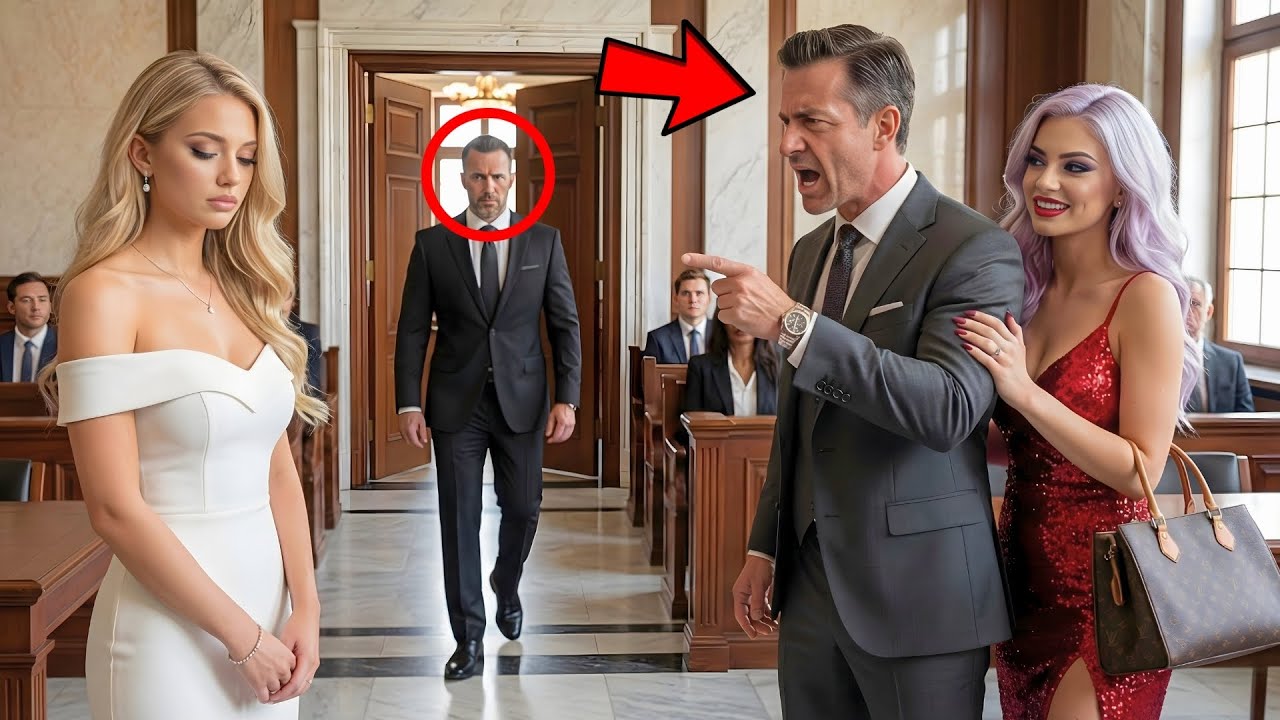
“The dinner was supposed to be about unity,” my father said, lifting his glass. “Instead, my daughter will be looking for work. ”
The words landed like a verdict. He wasn’t angry, wasn’t joking.

He was simply certain—the kind of certainty that assumed I had already failed and that everyone at the table agreed. This was his villa, his guests, his business partners. I was there only because he’d texted: “Be here tonight. Family should show unity.
”
So I came. I’d learned my role long ago: fill the chair, complete the portrait. No one corrected him. No one looked at me.
The heat rose in my chest—not rage, but the dull burn of knowing I was present yet not counted. I was deciding whether to swallow the insult as I always did when I heard a chair scrape. William Crawford stood. He didn’t look at my father.
He looked directly at me, smiling like a man who already knew how this story ended. My father stopped speaking. The silence was sharp and deliberate. His hand froze mid-gesture, wine glass suspended like an unfinished sentence.
I knew this pattern. Holiday dinners where my brother was congratulated on promotions while I was asked if I was “still doing that computer thing. ” Sunday brunches where my mother mentioned a friend’s child with a real job in finance. Birthdays where my father introduced everyone with full titles, then gestured vaguely: “And this is Victoria.
”
Richard Whitmore, 32 years at Meridian Capital, believed success was measurable—titles, square footage, properties like this villa. He never considered which side of that line his daughter might be on. My mother was a master of social redirection. She remained silent, calculating her next move.
My brother Marcus wore his familiar look: *Poor Victoria, she means well. *
“Richard,” William Crawford said calmly. “There’s been a misunderstanding at this table. Since we’re among colleagues, I’d like to clear it up.
”
My father set down his glass with exaggerated care. He sensed his control slipping but didn’t know why. “William, I apologize if Victoria has done something. ”
“Done something?
” William repeated lightly. “Interesting choice of words. ” He turned to the table. “How many of you have heard of Vertex Holdings?
”
Several hands went up. I saw recognition cross my father’s face. Vertex Holdings was the company Meridian had been chasing for months—an enterprise software firm with ownership buried under layers of LLCs. “Vertex Holdings has agreed to a strategic partnership with Meridian Capital,” William continued.
“It will be announced next week. It represents the largest technology investment in our firm’s history. ” He paused. “And the founder is sitting at this table.
”
The room shifted. Attention rearranged itself. My father shook his head slightly, rejecting information that didn’t fit his reality. “That’s not…” my father started.
William looked directly at me. “Would you like to tell them, or should I? ”
This wasn’t how I’d imagined it. If the truth came out, I thought it would be on my terms, in a boardroom, surrounded by lawyers.
But some moments don’t wait for permission. “Vertex Holdings is mine,” I said. “I founded it six years ago. I own 83%.
Current valuation is approximately 1. 2 billion pre-money. ”
The numbers landed heavily. Confusion on some faces, disbelief on others.
On my father’s face—something I’d never seen before: genuine shock. “That’s impossible,” Marcus stammered. “Victoria works from home. She does freelance work.
”
“She runs a company with 400 employees and three Fortune 100 clients,” William countered. “I’ve seen the financials. They are exceptional. ”
My mother had gone pale, staring at me like a stranger.
“Why? ” my father asked, his voice rough. “Why would you hide this? ”
I’d asked myself that many times.
Part was protection—I wanted something not attached to the Whitmore name. Part was exhaustion—explaining myself to people who had already decided who I was felt pointless. But the simplest answer was the truth no one had ever asked. “You didn’t want to know,” I said.
“You wanted me to be the example of what not to do. ”
William cleared his throat, shifting back into professional mode. He excused the guests. They exited quickly.
When the villa was quiet, my father looked smaller. He hadn’t just missed a business deal. He’d missed the possibility that I could be on the other side of it. “I’m going home,” I said, picking up my bag.
“We can talk later. Or not. ”
I walked out into the night without looking back. For the first time in years, I didn’t feel the need to explain myself.
The truth was out, and it would do its own work. The next morning, I woke to 47 texts, 12 missed calls, and one email that mattered. It was from William Crawford’s assistant. Subject: “Partnership documents urgent.
” I opened it first. Attached was the partnership agreement on Meridian letterhead. At the bottom, a scanned handwritten note: *Victoria, my office, 2 p. m.
alone. WC. *
I showered, dressed in clothes my family had never seen me wear, and drove downtown. The Meridian building was a glass tower designed to make visitors feel small.
This time, I walked through the front door. “Miss Whitmore, Mr. Crawford is expecting you,” the receptionist said. She pointed to the elevators.
Forty-second floor. William’s office had floor-to-ceiling windows and furniture that didn’t need a logo to prove its cost. He stood when I entered. “Thank you for coming.
”
“Your note said it was urgent. ”
“It is. ” He folded his hands. “I’ve worked with your father for fifteen years.
I know how he operates. I’ve watched him dismiss you at company events and talk about you like you were a disappointment he didn’t want to acknowledge. ” He paused. “Last night wasn’t an accident.
”
“You knew before the dinner. ”
“For eight months,” he admitted. “When Vertex first crossed my desk, the ownership structure raised flags. It took time to trace it back.
When your name finally appeared, I was surprised. ”
“Why didn’t you say anything? ”
“Because the deal mattered more than the reveal. And because I wanted to see how Richard would react when the truth arrived without warning.
” He leaned forward. “Your father has been angling for a board seat for years. Last night’s dinner was supposed to be his moment. Instead, they watched him dismiss the founder of the most valuable partnership Meridian has signed in a decade.
”
“So you used me to damage him. ”
William shook his head. “I used the truth. What it damaged was his illusion of control.
”
“The partnership—is it still happening? ”
“That depends on you. ” He slid a folder across the desk. The terms were unchanged, favorable, clean.
“What happens to my father? ”
“Richard’s standing has always been built on perceived judgment. If that judgment is now questioned, that’s not something I can undo. ” He walked to the window.
“Twelve senior investors watched your father reduce you to a failure. By this morning, eight had called asking about Vertex, about you. The market corrects itself. I didn’t create that correction.
I just didn’t stop it. ”
I signed the documents. When I left the building, my phone was full of messages from Marcus, my mother, and my father, all asking for control back. I deleted them without reading.
I called Jennifer, my CFO. “The Meridian deal is signed. Prepare the team for the announcement. ”
She paused.
“You sound different. ”
“I am,” I said. The press would come. That was inevitable.
But when they did, it would be because I allowed it. The power had shifted, and I wasn’t giving it back. Three days later, I received a calendar invite from my father’s assistant: “Family discussion, private dining room, the Wellington Club, 7:00 p. m.
” No greeting, no explanation—just the assumption I would show up. The Wellington Club was his home turf. He’d chosen it on purpose. Familiar ground, his rules.
I arrived fifteen minutes early. I chose the chair facing the door. Marcus arrived first, slipping into his practiced smile. “Vicki, you look different.
”
“Do I? ”
He scanned everything—my clothes, my watch, my posture—like reviewing a legal document for risk. “The suit, the watch. You’ve been hiding more than just a company.
”
“I haven’t been hiding,” I said. “You never bothered to look. ”
Before he could reply, our parents walked in. My mother’s eyes were red, though her makeup was carefully done to suggest she hadn’t been crying.
My father looked heavier, burdened. He took the head seat out of habit. “Victoria,” he said in his negotiation voice. “We need to talk about what happened.
”
“Which part? ”
He jaw tightened. “Don’t play games. You’ve lied to this family for six years.
You humiliated me in front of colleagues I’ve worked with for decades. ”
“I didn’t lie,” I said calmly. “I never told you I was unsuccessful. You decided that.
I never said I was struggling. You filled in the gaps yourselves. Every version of me you believed in was your story, not mine. ”
My mother reached across the table.
“Sweetheart, we just want to understand. ”
“Understand what? Why I built something successful, or why I didn’t tell you? ” I looked at all three of them.
“How many times did any of you actually ask me about my work? Not jokes, not concern disguised as advice. Real questions? ”
No one answered.
“Exactly. ”
My father exhaled sharply. “This is about your deception. ”
“This is entirely about you,” I said, leaning forward.
“I kept my name off the company because I knew the moment you found out, you’d try to make it yours. You’d brag, offer unsolicited advice, turn my work into a reflection of your ego. ”
“I’ve spent thirty years building my reputation. In one night, nothing was destroyed.
”
“Your reputation is built on people believing you see what others don’t. What happened merely exposed the truth that you never bothered to look. ”
I was at the door when Marcus spoke. “The Meridian partnership—Dad has to recuse himself, right?
”
I turned back. He wasn’t upset. He was calculating. “Ask compliance.
”
“I’m asking you. ”
“Then yes. Vertex is now a conflict of interest. That means the biggest deal Meridian has ever signed is one Dad can’t touch.
He can’t leverage it or use it for his board ambitions. ”
Marcus glanced at our father. Something cracked in his expression—not anger, but something colder. “That’s convenient.
”
“It’s a consequence,” I replied. I opened the door. “I didn’t plan for any of this. William Crawford did.
But I’m not sorry about the result. ”
Behind me, voices rose. My father’s, my mother’s attempts to calm him, Marcus saying something low and urgent. My phone buzzed with an email from Jennifer: *Board meeting tomorrow at 9.
Crawford’s team will be there. Also, something odd with David Palmer. Expense reports, access patterns. Might be nothing.
Want me to flag it? *
David Palmer was head of business development. Smart, efficient, always a little too well-informed. *Flag it,* I typed back.
*Pull his access logs. Don’t alert him. *
The Vertex boardroom occupied the entire 28th floor of a building I owned through three holding companies. Floor-to-ceiling windows wrapped around the space, the kind of view meant to signal control, scale, permanence.
Today only six chairs were filled: me, Jennifer, two lawyers, and William Crawford with his senior partner. “Before we begin,” William said, “I should inform you that Richard Whitmore has been placed on administrative leave pending a compliance review. ”
I set my pen down carefully. “That was fast.
”
“Three of our largest institutional investors contacted the board yesterday. They expressed concerns about Mr. Whitmore’s judgment. ”
Because he didn’t know.
“Undisclosed regardless of the reason,” William replied. He slid a document across the table. “This is the final partnership agreement. Page 17 addresses potential conflicts.
Your legal team should review the language carefully. ”
The provisions were standard but thorough: disclosure requirements, mandatory recusals, safeguards. Any executive with a family connection would be removed from decision-making immediately. “This effectively removes my father from any involvement with your technology practice,” I said.
“It removes him from this partnership specifically. His broader role is a matter for Meridian’s board. ”
We signed. When William’s team left, Jennifer closed the door.
“I pulled David Palmer’s access log,” she said, turning her laptop toward me. “Over the past six weeks, he’s accessed files related to our investor relations strategy, our cap table, and our upcoming IPO timeline. None of these files are relevant to his role. ”
I scanned the timestamps—late nights, weekends, odd hours.
“There’s more. His expense reports show recurring meetings at the same restaurant in Midtown every Thursday, same table, same time, for the past two months. ” She hesitated. “The name on the bookings was Whitmore.
My father. ”
I sat back. The pieces arranged themselves quietly, clicking into place. “How did they connect?
”
“Before joining Vertex, David worked at Harrington Associates,” Jennifer said. I didn’t need her to finish. “My father sits on Harrington’s advisory board. ”
“What do you want to do?
”
The old version of me would have hesitated, confronted David quietly, asked for explanations, contained the damage. That version had walked out of the Wellington Club last night. “Lock his access immediately,” I said. “Every system, every file, every building.
Change any security codes he knows. ” Jennifer typed. “Have legal prepare termination documents for cause. Itemize every breach of his employment agreement.
And pull any emails between his personal devices and external addresses. If he’s been forwarding information, I want to know to whom. ”
“That could take a few days. ”
“We have time.
He doesn’t know we’re looking yet. ”
I walked to the window. Somewhere out there, my father was waiting to find out whether I was vulnerable, or if there was an angle left to exploit. He didn’t realize yet that the game had changed.
My phone rang. Marcus. I let it go to voicemail, then listened. “Vicki, it’s me.
I know things are complicated, but I think we should talk. Just the two of us. I’m not Dad. I’m not going to lecture you.
I just want to understand what’s happening. ”
I deleted the message. “One more thing,” I said to Jennifer. “If anyone from my family contacts anyone at this company, anyone at all, I want to know immediately.
”
She looked up. “You think they’ll try something? ”
“I think my father is used to controlling information. And I think he doesn’t realize yet how much control he’s already lost.
”
The documents arrived Tuesday morning in a manila envelope, hand-delivered by a courier who checked my ID. No explanation. Inside were three months of emails, meeting transcripts, and internal financial projections—every page stamped with Vertex Holdings confidential watermark. David Palmer had been thorough.
Patient. It didn’t start with theft. It started with casual questions at industry events, networking introductions that felt coincidental. They weren’t.
My father had been cultivating David for almost a year before David ever applied to Vertex. The job application had been engineered—a chance meeting with our HR head, a glowing recommendation from a trusted colleague. Even the salary was calculated: slightly below market, cooperative enough to look reasonable. Once inside, David didn’t rush.
He delivered results, built credibility, waited. Slowly, deliberately, he gained access. Just enough to matter. The emails between him and my father were careful, professional.
My father was never named. He was “the client. ” I was “the subject. ” Vertex Holdings was “the target.
”
*The subject shows no awareness of surveillance. The target’s IPO timeline appears to be Q3. Board composition suggests vulnerability to activist pressure. *
This wasn’t curiosity.
It was preparation. My father hadn’t been trying to understand what I built. He’d been building a dossier. Jennifer knocked.
“Legal is ready. ”
The termination took less than ten minutes. David sat in the conference room flanked by HR and two security officers. At first he looked confused, confident this was a misunderstanding.
Then I placed the printed emails in front of him. I watched his face change—confusion to anger, denial, then cold understanding. “These communications were obtained through standard internal security protocols,” I said evenly. “Your employment agreement includes confidentiality and conflict of interest provisions.
You violated both. ”
“Victoria, if you’ll just let me explain—”
“There’s nothing to explain. You were hired to spy on me. You’ve been transmitting confidential company information to an external party for over a year.
The only remaining question is whether we pursue this criminally. ”
His face drained of color. “Corporate espionage is a felony in this state. Our lawyers have already drafted a complaint.
Your father—my father—is currently on administrative leave pending his own investigation. Whatever protection you thought he could offer no longer exists. ”
David was escorted out through the service entrance. From my office window, I watched him stop on the sidewalk, look up at the building as if it had betrayed him.
Twenty minutes later, my phone rang. My father. “Victoria. ” His voice was strained, barely controlled.
“My attorney just called. He says Vertex Holdings is threatening criminal charges against an employee who was feeding you confidential information about my company. ”
“Yes. ”
Silence.
“This doesn’t have to be public. We can settle this privately. Family business. ”
“Family business?
” I let the phrase sit. “Is that what you call planting a spy in your daughter’s company? Spending a year building a file on her? Looking for ways to—what exactly, Dad?
What was the plan? ”
More silence. “I was trying to understand what you built. You wouldn’t tell us anything.
”
“So you committed corporate espionage. ”
“I wanted to protect you. You have no idea what you’re dealing with. Private equity and institutional investors will eat you alive if you’re not careful.
I was trying to help. ”
“By gathering intelligence you could use against me. ” I laughed once, without humor. “You weren’t protecting me.
You were trying to control me. When you couldn’t control me directly, you went around me. ”
“Victoria—”
“The charges against David Palmer will move forward. Your involvement will be documented.
If I find out you traded on any non-public information or shared it with anyone who did, this becomes a federal matter. The SEC is very clear about that. ”
I heard his breath catch. In thirty years of corporate warfare, Richard Whitmore had never been on the receiving end of such a threat.
“You would do that to your own father? ”
“You did this to your own daughter. ”
I hung up. The next call was to William Crawford.
“I need to inform you of a development that may affect Meridian’s position. ” I told him everything—David Palmer, the access, the emails, my father’s role. He didn’t interrupt. “This will need to go to our board.
Your father’s administrative leave is about to become permanent. This information will accelerate that timeline. ”
“I know. ”
“Are you prepared for that?
”
I looked out at the city below. “I’ve been preparing for years. I just didn’t know it until now. ”
Within a week, the story would be public.
Richard Whitmore, respected dealmaker, would be known as the man who committed espionage against his own daughter. There was no way back from this. For the first time since it all began, I felt nothing at all. The counteroffensive began Thursday.
Not with lawyers or threats. With my mother. “Victoria, please,” she said, her voice soft and careful. “Can we just talk as a family?
Your father is devastated. There has to be a way to work this out. ”
“I’m not available,” I said. “You don’t mean that.
”
“I do. ” I ended the call. An hour later, Marcus showed up at my office without warning. Entitlement disguised as familiarity.
“I’m not here to defend Dad,” he said smoothly. “What he did was wrong. But going public with criminal charges—that’s extreme. It’s going to destroy him.
It’s going to tear this family apart. ”
“Our family fell apart a long time ago. I just stopped pretending it hadn’t. ”
His mask slipped for a moment.
Then he leaned forward, lowering his voice. “This is about revenge, isn’t it? All those years of being overlooked. Now you finally have the power to hurt him back.
”
“If I wanted revenge, I would have leaked everything to the press myself. Instead, I followed legal process. The fact that the process exposes Dad’s behavior isn’t spite. It’s a consequence.
”
“Same outcome. ”
“Different intent,” I replied. “And intent matters. ”
I stood.
“I have a meeting. Security will walk you out. ”
His expression hardened. “You’re making a mistake.
Dad still has friends. Powerful friends. ”
“Is that a threat? ”
“It’s a reality check.
You’ve won a battle. Don’t assume you’ve won the war. ”
After he left, I called Jennifer. “Increase security protocols, personal and corporate.
Run background checks on anyone who’s contacted my assistant in the last two weeks. ”
She didn’t ask why. The family’s next move came through lawyers. My father’s attorneys demanded we drop all charges against David Palmer in exchange for a confidential settlement.
The amount was substantial—life-changing for most people. I had my lawyers respond with one sentence: *Our client declines your offer and intends to pursue all available legal remedies. *
The following Monday, the narrative shifted. An article appeared in a financial trade publication: “Family Feud or Corporate Warfare Inside the Vertex Scandal.
” Someone had leaked the story. It reframed me as unstable, vindictive, unable to maintain relationships. An anonymous family source painted me as a bitter daughter who had hidden her success out of spite and was now punishing the people who had always supported her. “Your father’s PR firm,” Jennifer said.
“They’re pushing this narrative everywhere. ”
“Call Margaret Cole,” I said. By Wednesday, I was under studio lights across from a host who looked like she could have been my mother’s friend. “Some people say this has become personal,” she said.
“That you’re pursuing legal action against your own father out of spite rather than legitimate business concerns. ”
I smiled. “Can I show you something? ”
The screen filled with a timeline—David Palmer’s employment access logs, meeting records, emails, all verified, timestamped, documented.
“This isn’t personal. It’s factual. Over eighteen months, an employee betrayed his company at the direction of someone with a financial interest in undermining it. The fact that that person is my father doesn’t change the nature of the crime.
It just makes it more painful. ”
“Your father says he was trying to protect you. ”
“If my father wanted to understand me, he could have asked. In six years of building this company, he never asked a single question about what I was doing.
Instead, he hired someone to spy on me. ” I paused. “That’s not protection. That’s control.
When you spend decades believing you have the right to control something, losing that control can make you do desperate things. ”
The interview aired that night. By morning, the press stopped asking if this was personal and started asking whether Richard Whitmore should have been trusted in the first place. On Friday, Meridian Capital announced his termination.
No ceremony, no face-saving narrative. Just a brief statement thanking him for his years of service. It was over. I was heading to a dinner meeting when my mother called again.
I let it go to voicemail. “Victoria,” she said, her voice breaking. “Your father’s in the hospital. Chest pains.
The doctors say it’s stress-related. Whatever you think of us, whatever we’ve done wrong, he’s still your father. Please, please call me. ”
I stared at my phone for a long moment.
Then I put it away and told the driver to continue. Some doors, once closed, do not reopen. My father had spent years making sure I knew I wasn’t good enough to belong in his world. Now that world was collapsing, and he was looking for someone to stop the fall.
But I wasn’t that person anymore. He spent three days in the hospital. Stress-induced arrhythmia—not a collapse, a warning. His body was doing what his mind refused to do: admit the empire was decaying.
I didn’t visit. My mother called every hour. Marcus sent messages that grew shorter and sharper. “The family needs to come together.
This has gone too far. Dad could die. ”
I read them, deleted them, and looked back at my monitors. In my world, reality still followed rules.
If you break the law, you pay the price. It was that simple. Ironically, the family scandal was the best marketing we ever had. In the cutthroat circles of high finance, I wasn’t seen as a traitor.
I was a legend—the woman who built a billion-dollar firm in the dark and outplayed a giant. On the fourth day, William Crawford called. “I thought you should know. Richard has retained new counsel.
They’re preparing a defamation suit against you, Vertex, and Meridian Capital. ”
I felt a cold sense of predictability. My father, staring at the wreckage, was doing the only thing he knew: attacking instead of accepting consequences. “Our legal team is already moving.
The evidence against Palmer is ironclad. Any lawsuit your father files would trigger discovery. ”
Discovery. The magic word.
It meant a deep dive into decades of private records, emails, back-channel deals, shady arrangements that had never seen the light of day. “I suspect his lawyers will explain that to him,” William added dryly, “right after they cash his retainer check. ”
The lawsuit was filed Tuesday and withdrawn Thursday. My father realized that if he opened that door, the SEC wouldn’t just look at his role in Vertex.
They’d look at his entire life. A brief blurb appeared: “Richard Whitmore drops lawsuit, cites family reconciliation. ” It was a total lie. But at this stage, fiction was the only currency he had left.
Two months later, my mother showed up at my office without an appointment. She walked past my assistant and opened my door with the same entitlement she used to enter a country club. “I’m not leaving until you talk to me. ”
She looked thinner.
The expensive polish she’d maintained for decades was peeling. She wasn’t just older. She looked defeated. “Your father’s been diagnosed with depression.
He barely leaves the house. The doctors are worried. ” She paused, looking for a crack in my expression. “I’m not asking you to forgive him.
But you’re his daughter. That has to mean something. ”
“Does it? ” I asked.
Her voice cracked. “After everything we gave you, everything we sacrificed. ”
“What exactly did you sacrifice? I went to the schools you chose.
I had opportunities because of your name. But I built this company while you told me every single day that I would never be enough. Every joke at my expense, every comparison to Marcus, every time you asked when I’d get a real job—that was your story, not mine. ” I leaned forward.
“I hid my success because I knew you’d try to claim it. You didn’t love me, Mom. You loved the version of me you could control. ”
She was crying now.
I didn’t reach for the tissues. “He committed a crime. He hired a spy. That’s not fear.
That’s ego. ” I stood. “Your five minutes are up. ”
“What do you want from us?
An apology? A statement? Please don’t let the family end like this. ”
I opened the door.
“The family ended years ago. I just stopped pretending it existed. ”
I watched her leave, then stood by the window. There was nothing left to break, only the truth.
The IPO roadshow took us to twelve cities in eighteen days. San Francisco, New York, Boston, Chicago, London, Hong Kong. Hotel rooms blurred together. Every morning: early wake-up, black coffee, tailored suit, waiting car.
Every afternoon: numbers, charts, projections. Every night: dinners with people who measured worth in decimals and growth curves. It was in Chicago that everything cracked. Halfway through a Q&A at a glass-walled conference room, someone asked about regulatory exposure.
My phone vibrated. Jennifer caught my eye from across the room, turned her phone so I could see the screen. *Breaking news. Richard Whitmore hospitalized after a critical incident.
*
For a fraction of a second, the room tilted. Years of discipline took over. I finished answering the question, clarified a margin assumption, smiled when appropriate, shook hands when the meeting wrapped. Only when the doors closed behind me did I step into the hallway and exhale.
“What do we know? ” I asked Jennifer. “Your mother found him this morning. Doctors say he’s stable.
The press is already linking it to Vertex. ”
“Cancel my remaining meetings. I’m flying back tonight. ”
“Victoria, the media is already outside the hospital.
If you show up—”
“I know. But some things can’t be delegated. ”
The flight was six hours. I didn’t work, read, or sleep.
I stared out the window, replaying years in my head. Had I pushed him there? If I’d stayed quiet, softened the consequences, let him save face—would this still have happened? Or had the fracture always been there, hidden under decades of certainty and authority, waiting for the moment when the illusion collapsed?
The hospital sat on the edge of the city, private and discreet. Security kept reporters at a distance, though cameras flashed anyway. I showed my ID and was directed to the third floor. My mother stood in the hallway, arms crossed tightly around herself.
When she saw me, something crossed her face—relief, hope, desperation. Maybe all three. “He’s awake. Stable.
He keeps asking if you’ve called. ”
I nodded and walked past her. My father lay in the bed, surrounded by quiet machines. He looked smaller than I remembered, less solid.
The man who had once dominated rooms now occupied only the space he absolutely needed. His eyes opened when I stepped inside. “You came? ”
“I did.
”
“I didn’t think you would. ”
“Neither did I. ”
I pulled a chair closer and sat down. “I didn’t know how to stop it,” he said after a moment.
“The noise, the pressure. ” His voice wavered. “I built my whole life on being right, on being in control. And suddenly, none of it mattered.
”
“That’s not why I’m here. ”
He turned his head slightly. “Then why? ”
I took my time answering.
“Because the point was never destruction. The point was truth. And truth doesn’t disappear just because it’s uncomfortable. Showing up now is part of not pretending anymore.
”
“Does that mean you forgive me? ”
“No,” I said immediately. “I can’t forgive what you did. Not yet.
You didn’t just hurt me. You planned, you controlled, you crossed lines. ”
“I was trying to understand. ”
“You were trying to contain,” I said quietly.
“There’s a difference. ”
Silence filled the room. “What happens now? ” he asked.
“You get help. Real help, not image management. And you accept that the life you built is over. ”
His eyes filled with tears.
“I don’t know who I am without it. ”
“I know. That’s the work. ” I stood.
“The IPO is next week. After that, if you’re willing to do therapy and have honest conversations with no manipulation, then maybe we can talk. But only if it’s real. ”
“Victoria,” he said softly.
“I’m sorry. ”
I turned back. “I know. But sorry isn’t enough.
You have to become someone who wouldn’t have done it. ”
I left the room. My mother was still in the hallway, looking at me like she’d watched something irreversible unfold. “Thank you,” she said quietly.
“I didn’t do it for him. I did it because it was right. ”
“Will you come back? ”
“I don’t know.
I won’t pretend anymore. Whatever happens has to be real. ”
I walked out as the sun rose. Cameras flashed, questions were shouted.
I didn’t answer. The IPO was in six days. There was still work to do. But something had shifted—not forgiveness or peace, but acceptance.
Truth doesn’t always heal. But it does end the lies. The IPO went live Tuesday morning. I stood on the trading floor just before the opening bell, surrounded by Jennifer and the senior leadership team.
Screens wrapped around the room, glowing with numbers that shifted faster than the eye could track. The bell rang—sharp, clean, final. Vertex Holdings appeared on the board. The opening price was higher than projected—not by a little, but by enough that I felt a tightness in my chest.
By midday, we had exceeded every analyst forecast. Jennifer leaned toward me. “We’re outperforming across every metric. ”
The cameras were everywhere.
News crews lined the edges, lenses trained on me. This wasn’t just a financial event anymore. It was the story of a daughter who built an empire quietly and a father who tried to control it and failed. Two days earlier, William Crawford had called.
“Richard Whitmore is officially under SEC investigation. ”
The information David Palmer had stolen—IPO timelines, confidential investor communications, internal projections—had been shared with three individuals. They had traded. Poorly concealed.
Enough to raise flags. My father hadn’t made the trades himself; he was too careful. But control breeds confidence, and confidence breeds carelessness. “How long?
” I’d asked. “Months, possibly longer. But the outcome isn’t in doubt. ”
I thanked him and went straight back into IPO prep mode.
Now, watching Vertex’s valuation climb, I felt something unexpected: distance. A journalist approached mid-afternoon. “Miss Whitmore, reports indicate your father is facing federal investigation. Any comments?
”
“Today is about Vertex Holdings and our investors. Questions about my father should be directed to his legal counsel. ”
“Do you feel any responsibility for what’s happening to him? ”
“My responsibility is to this company and the people who helped build it.
My father made his own choices. The consequences are his to face. ”
By market close, it was official. Vertex Holdings was publicly traded.
I was officially a billionaire. That evening, I sat alone in my office. The city stretched below, lights pulsing like a living thing. My phone buzzed with congratulations, invitations, messages from people who suddenly remembered knowing me.
One stood out—from Marcus. *Congratulations on the IPO. I hope it brings you what you’re looking for. If you ever want to talk, really talk, I’m here.
*
I stared at it, then deleted it. His concern was strategic, not emotional. He’d learned too well from our father. Jennifer stepped in.
“Final numbers are in. We exceeded every target. The board is ecstatic. ”
“Good.
”
She studied me. “You don’t seem happy. ”
“I am. I’m just tired.
”
“That’s not what I mean. I’ve seen you angry, focused, driven. But this—this feels like you’re waiting for something that isn’t coming. ”
I turned back to the window.
“When I started this company, I told myself it was about independence. About proving I could build something without my family’s shadow. ”
“You did that. ”
“I did.
Somewhere along the way, it became about something else. About being seen. About finally being undeniable. ” I paused.
“But they never really saw me. They just reacted when they lost control. ”
“So what now? ”
I’d spent so long defining myself in opposition to them.
Now that it was over, I needed to figure out who I was without the fight. “I don’t know yet,” I said. “I spent so long defining myself against them. Now I need to figure out who I am without that fight.
”
She smiled faintly. “That might be the hardest part. ”
“Probably. ”
Six months after the IPO, the federal investigation concluded.
Richard Whitmore was offered a plea deal: one count of securities fraud, cooperation in exchange for leniency. He took it. The coverage was loud for exactly forty-eight hours. Then the world moved on.
There were always new scandals. I didn’t attend the hearing, but I watched the footage later. He walked up the courthouse steps slowly, shoulders hunched, suit hanging loose on a body that had lost weight it couldn’t afford to lose. The man who had once filled rooms now seemed to shrink inside his own clothes.
My mother walked beside him. Marcus was nowhere in sight. He called the day after the plea. I let it ring.
Then I answered. “Victoria. ” His voice was steady, but the steadiness felt practiced. “I need to see you.
”
“Is this about sentencing? ”
“No,” he said quickly. “It’s about everything. Please.
”
We met at a restaurant neither of us had ever been to. Neutral territory, no memories attached. He was already seated, a glass of water untouched in front of him. “Thank you for coming,” he said.
“I almost didn’t. ”
He nodded, no argument, just acceptance. “I’m going to prison. Eighteen months, maybe less with good behavior.
The lawyers say cooperating could reduce it further. ”
“You’re going to testify against them. ”
“They weren’t my friends. They were useful contacts.
” He looked down at his hands. “I’m starting to understand the difference. ”
I didn’t respond. “Your mother wants a divorce.
Thirty-five years. The moment everything fell apart, she started talking to lawyers. ” He gave a hollow laugh. “I don’t blame her.
I would do the same. ”
“Is this what you wanted to tell me? ”
“No. ” He straightened slightly.
“I wanted to ask you for something. I know I have no right. When I get out, when this is over, I want a chance. Not to work with you.
Not to profit from what you built. Just a chance to know you. To understand what you became while I wasn’t looking. ” His voice cracked.
“I spent sixty years thinking I understood success. I was wrong about all of it. The worst part isn’t losing my career. It’s knowing I had a daughter who became extraordinary, and I didn’t just miss it.
I fought it. ”
“You’re asking me to forgive you,” I said. “No. I know forgiveness isn’t mine to ask for.
I’m asking for something smaller. The possibility. Just not closing the door forever. ”
I thought about the villa dinner, the Wellington Club, David Palmer, the hospital room.
Every moment stacked neatly until we were here. “I won’t visit you in prison. I won’t write letters. I won’t take calls.
While you’re serving your sentence, you’ll do it without me. ”
He nodded slowly. “But after—if you’ve actually changed, not just talked about it or performed it, but did the work—then we can talk. No promises.
No expectations. Just the possibility you asked for. ”
His eyes filled with tears he didn’t try to hide. “That’s more than I deserve.
”
“Probably. But I’m not doing this for you. I’m doing it because carrying this forever would cost me more than it costs you. And I’ve already paid enough.
”
I stood. “Victoria,” he said, stopping me. “What you built. Vertex.
The way you did it. ” His voice shook. “I spent thirty years in business and I never built anything that survived me. You did.
I was wrong about you. About everything. ”
I looked at him. “Don’t become better for me.
Do it because without control, without status, without leverage, you need to know who you are. That’s the only thing that matters now. ”
I left him there. Outside, the afternoon sun warmed the street.
No one noticed the fallen executive sitting alone inside. My father went to federal prison on a cold morning in January. I watched a thirty-second news segment from my office—the gray building, the gate opening, a man disappearing into a system designed to reduce people to numbers. He served fourteen months of his eighteen-month sentence.
I didn’t contact him once. I didn’t respond to Marcus’s updates or my mother’s tentative attempts to reopen communication. Every message carried the same unspoken hope that enough time had passed, the worst was over, and we could pretend again. I wasn’t interested in pretending.
Instead, I focused on what I could control. Vertex continued to grow. We acquired two smaller competitors quietly, expanded into European markets, launched a new product line that exceeded projections so dramatically that even my most conservative board members stopped tempering their optimism. By the time my father was released, our market cap had tripled.
I made changes personally too. I sold the warehouse apartment and bought a house outside the city—something with land, trees, silence. A place where the noise in my head had room to settle. I started therapy, not because I was broken, but because I’d learned functionality isn’t the same as health.
I wanted to understand patterns before they repeated. The day after my father’s release, I received a letter. Handwritten, no letterhead, no performance. He didn’t ask to see me, didn’t ask for forgiveness, didn’t try to justify himself.
He wrote about therapy, about prison, about how stripping away control strips away identity. “I’m trying,” he wrote. “Actually trying. ”
I folded it and placed it in a drawer with other things I wasn’t ready to resolve yet.
Three months later, I was in Arizona for a conference. On the final afternoon, I rented a car and drove to the address on the envelope. A beige apartment complex near the edge of town—the kind of place you live when you’re starting over. I knocked.
He opened the door and froze. “Can I come in? ”
The apartment was simple, not bleak—just unadorned. A couch, a table, a small television, worn books on a shelf.
A laptop was open with an online course on the screen. “I’m getting a degree,” he said, noticing where I was looking. “Philosophy. ”
That surprised me more than anything.
“I spent my whole life dismissing things that didn’t produce immediate value. Turns out meaning doesn’t work on quarterly timelines. ”
We sat on the couch. Light filtered through blinds that needed cleaning.
“I’m not here to reconcile,” I said. “I’m not here to forgive you. I’m here because your letter sounded different. I wanted to see if that difference was real.
”
“It is,” he said simply. “How do I know? ”
“You don’t. You can’t.
Trust isn’t something I get to ask for anymore. It’s something I have to earn slowly, quietly, without guarantees. ”
He talked about therapy, about volunteering at a shelter, about listening instead of advising. About how uncomfortable it was to exist without hierarchy or leverage.
“For the first time,” he said, “I’m not trying to be better than anyone. I’m trying to be better than who I was. ”
We talked for an hour—not about the past, not yet, but about ideas, about change. About how strange it is to realize late in life that everything you optimized for was the wrong metric.
When I left, I didn’t promise anything. I just said, “I’m glad you’re doing the work. ”
He nodded. “That’s enough.
”
I drove back to the airport and flew home. Two years after the villa dinner, I stood on a stage in front of two thousand people. Founders, investors, executives—the kind of people my father had spent his life trying to impress. I was giving the closing keynote.
The title behind me: *Building Without Permission. *
“When I started my company,” I began, “I told everyone I was doing consulting work. Freelance projects. Small contracts.
Nothing serious. ”
A few people smiled. “The truth was, I was building something much bigger. I hid it not because I doubted myself, but because I knew exactly how people would react if they knew what I was really doing.
” The room stilled. “They would question me. Criticize me. Suggest safer alternatives.
They would turn my ambition into something I was expected to justify or apologize for. ”
I let that land. “So I built it in secret. For six years, I worked quietly while the people closest to me assumed I was failing.
When the truth finally came out—not on my terms, not when I was ready—I learned something that changed everything. ”
I stopped speaking, letting silence hold its weight. “Their permission was never required. Their approval was never necessary.
The only thing that mattered was the work—the daily decisions, the unglamorous, repetitive act of building something real when no one is clapping yet. ”
For thirty minutes, I talked strategy, growth, mistakes that nearly killed us, the discipline required to recover. At the end, I came back to the personal. “Some of you know my story.
The family conflict. The investigation. The estrangement. I won’t pretend those things didn’t happen or that they didn’t hurt.
” I scanned the room. “But I also won’t let them define me. You cannot build a meaningful life while waiting for other people to validate it. You cannot create something extraordinary while worrying about who might feel threatened by your success.
” I felt my voice steady. “Build anyway. Create anyway. Succeed anyway.
Not to prove anyone wrong, but because this is what you were meant to do. When the people who should have supported you finally understand what you’ve accomplished, let them deal with that however they need to. It’s not your job to manage their feelings. It’s your job to keep building.
”
The applause wasn’t explosive. It was sustained, deep, real. At the reception afterward, I moved through conversations, introductions, follow-ups. But my mind kept drifting to the phone call I’d made that morning to my father—our first conversation in six months.
“I saw you’re giving the keynote,” he’d said. “I won’t watch. It feels like an intrusion. But I wanted you to know I’m thinking of you.
”
“Thank you. ”
“I’m proud of you. I know I have no right to say that, but it’s true. ”
“I know.
”
A pause. “Is that enough? ”
I thought about doors, trust, the difference between reconciliation and coexistence. “For now,” I said.
“Is that enough? ”
“It’s enough. ”
Standing in the reception hall, I understood what that word really meant. Enough meant my father living simply, doing the work without guarantees.
It meant my mother, divorced, learning who she was without managing someone else’s image. It meant Marcus, who had stopped reaching out once there was nothing left to gain. And it meant me, standing in a life I had built deliberately, without asking for permission. That evening, I flew home to my house outside the city.
I poured a glass of wine and sat on the porch, watching the sun sink behind land I owned and chose. My phone buzzed—Jennifer. *Great speech today. Team dinner tomorrow to celebrate Q3 numbers.
*
I typed back: *Count me in. *
Somewhere, my father was reading philosophy and preparing for his volunteer shift. My mother was building a life she’d never allowed herself to imagine. Marcus was doing whatever Marcus did.
And I was here, building, creating, moving forward. They had said I would always be looking for work. They were wrong. But in the end, that didn’t matter.
What mattered was that I knew exactly who I was, and I had chosen this life without anyone’s permission.