She knelt on the packed earth floor, her hands dark with a stranger’s blood. Wilhemina Ashby was three and twenty, her sleeves pushed to the elbow, pressing folded linen against a wound beneath a man’s ribs, and she understood that if she stopped, he would be dead before the physician could be fetched through eleven miles of December mud. He had been found at first light, half-buried in bracken at the edge of the West Covert, thrown from a horse that was nowhere to be seen. His greatcoat was too fine for a poacher, his hands too soft for a groom.
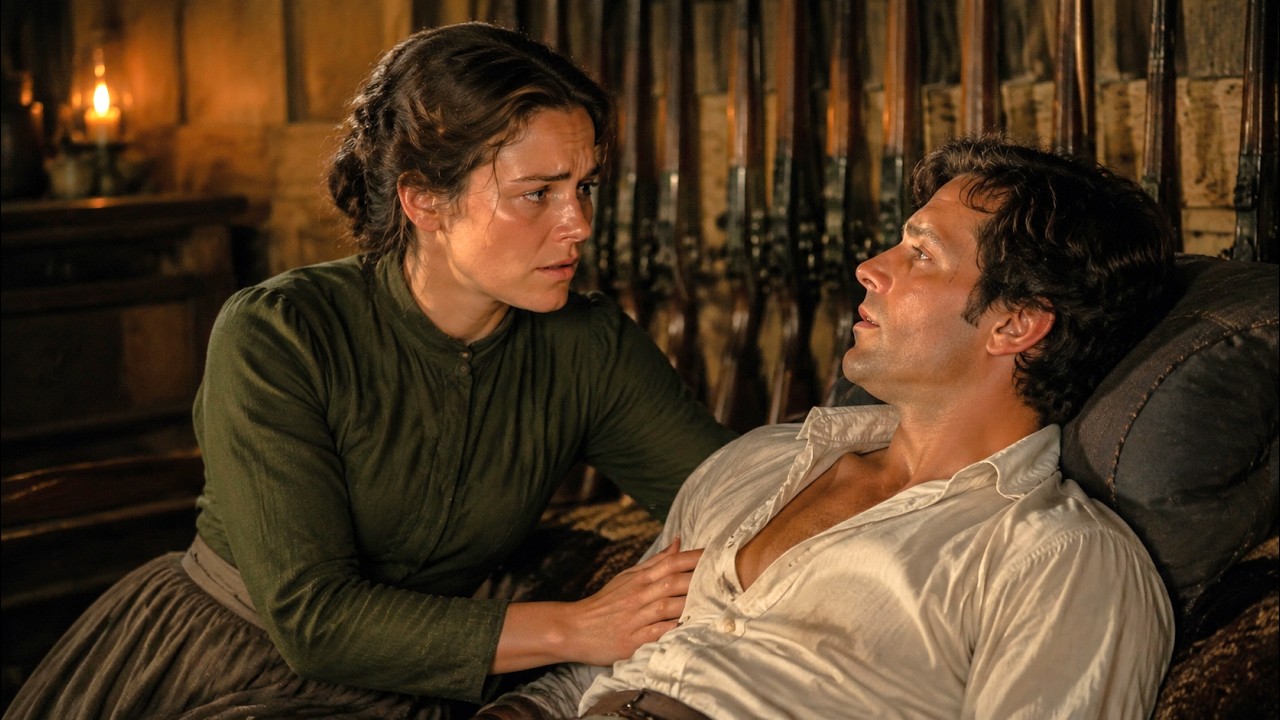
Her father had carried him in over his own shoulders, cursing the weight of him, and set him down on the narrow cot in the gun room where gentlemen changed their boots before a day’s shooting. “He’ll not see morning,” her father had said, and gone for the doctor, leaving her alone with the man whose blood soaked through three-folded cloths until she found the wound and pressed her whole weight against it. She did not know his name. She did not ask it.
There was no time for names, only for counting his breath and watching his eyes, which were a warm, steady brown even half-lidded with pain, and which fixed on her face each time she leaned close, as though she were the only solid thing left in a world gone to fever and shadow. What no one in that house yet understood was that the man bleeding onto her father’s gun room floor was Alaric Penrose, ninth Duke of Marrogate, and that all of Hampshire had spent the better part of a fortnight searching the wrong roads for him. The lodge belonged to her father, Josiah Ashby, gamekeeper to an estate whose owner had not set foot on it in eleven years. He had once been gentry himself, before debt and a dead wife’s creditors reduced him to keeping another man’s woods.
Wilhemina had grown up in the space between two worlds—too well-spoken for the village, too poor for the parlors of anyone who might have received her. She had learned to be useful rather than ornamental. She could set a bone. She could stop a bleed.
She could sit through a night without flinching from what the candlelight showed her. She had seen enough of gentlemen at a country remove to know most of them treated a gamekeeper’s daughter as a fixture of the landscape, useful and unremarkable, like a good gate or a well-kept path. She expected nothing different from this one, whoever he proved to be beneath the mud and blood and fine ruined coat. And it was precisely because she expected nothing that she was so unprepared for what he gave her instead.
By the second hour she had learned the shape of him—broad through the shoulder, not tall, compact and solid in the way of a man who rode rather than merely sat a horse. A signet ring on his smallest finger that she did not examine closely enough to read, because to examine it would have been to pry. “You must not die in my father’s gun room,” she told him somewhere past midnight, in the flat, unsentimental voice she used for frightened animals and frightened men. “It would be a great deal of trouble, and my father has enough of that already.
”
His mouth moved. It might have been a laugh, if a laugh could be made of nothing but breath. “Then I shall endeavor,” he said so quietly she had to lean close to catch it, “not to inconvenience you. ”
It would be many weeks before she learned that this was, for the Duke of Marrogate, an extraordinary thing to say to anyone.
That the man breathing shallow beneath her hands had not offered a single unguarded courtesy to a stranger in the better part of four years—not since a woman with a beautiful face and a mercenary heart had smiled at him across a ballroom and calculated, in the same breath, the exact worth of his signature on a marriage settlement. He had built, since then, a wall of icy, exacting politeness so complete that London had stopped trying to breach it. He gave nothing away. He wanted nothing anyone could see.
And here, bleeding into a gamekeeper’s cot with no notion of who had found him, he had said something warm to a woman whose name he did not know, because for the first time in four years no one in the room wanted anything from him at all. The physician came at dawn, pronounced the wound grave but not certainly mortal, stitched what wanted stitching, and left instructions that the patient was not to be moved for a fortnight at the least. For twelve days, Wilhemina nursed a man whose name she did not know, in a house too small and too honest to pretend at manners it did not possess. She brought him broth she had made herself, changed dressings her father could not stomach to look at, and read to him in the evenings from the one battered volume of poetry that had survived her mother’s death, because he asked her to, and because his eyes, when they were not glazed with fever, followed her with an attention she had never once been given by anyone above her own station.
On the third day, when the fever climbed dangerously and he did not know her, he called out a name that was not hers—Cordelia—twice, with a bitterness that startled her. And in the clear morning after, when she asked nothing and he offered everything, he told her, haltingly, of a woman four years gone who had smiled at him across a ballroom and married the calculation of his fortune before she had ever troubled to learn his given name. “I do not ask you to speak of her,” Wilhemina said, “if it costs you more than the wound already has. ”
“It costs me nothing to speak of her now,” he said, and seemed, saying it, faintly surprised to find it true.
“It is the strangest sensation. I came here half dead and expecting to remain, in every way that matters, half a man. Instead, I find myself telling a stranger things I have not told my own steward in four years. ”
“I’m hardly a stranger,” she said.
“I have seen the inside of your ribs, Mr. Penrose. There is very little modesty left between us. ”
That drew, for the first time, something that was unmistakably a laugh, though it cost him a wince and a hand pressed hard against his side.
On the fifth day he could sit propped against the bolster, and he used the time to watch her work—mending her father’s shirts by the window’s poor light, keeping the household accounts in a small, careful hand, setting bread to rise with the unthinking competence of a woman who had run a household since she was old enough to reach the hearth. He asked her once why a woman of evident sense and evident education had never married. “There is no one here to marry,” she said simply. “The village has its farmers, and the farmers have their own daughters to settle first.
I keep my father’s house, and I do not regret it. Regret is a luxury I have not been able to afford, Mr. Penrose, any more than lace, or a season in Bath. ”
On the seventh night the wind came up hard enough to rattle every shutter, and the beam of the old roof, never sound, always promised for next year’s mending that never came, gave way above the kitchen and let the rain in over the stores of salted meat meant to see them through to spring.
Wilhemina was out of the sickroom and up on a stool with the tarred cloth before her father had even reached the bottom of the stairs. It was Alaric—weak, forbidden to rise, disobeying the physician’s every instruction—who nonetheless levered himself upright and stood swaying in the kitchen doorway, refusing to be sent back to bed until he had seen with his own eyes that she was safely down again. “You will tear your stitches,” she said, furious and frightened in equal measure, “for the sake of a roof that is none of your concern. ”
“It became my concern,” he said, “the moment I saw you climbing toward it in the dark.
”
It was a small thing, a foolish and reckless and entirely useless thing—a duke standing sentinel over a leaking roof he could not himself have mended. But it was the first time in four years that anyone had positioned themselves between Alaric Penrose and a danger without first calculating what his gratitude might be worth. By the ninth day the fever had properly broken, and with it something in him that had been locked a long while. He told her, weak and lucid and unguarded in the candlelight, that he had not been spoken to plainly by anyone in longer than he could say, and that he did not know what to do with the sensation of being looked at by a woman who wanted nothing from him but his recovery.
She did not fall in love with him for his rank, because she did not know his rank. She fell in love—if it could be called falling; it felt more like the slow filling of a room with light. It was in the way he thanked her for every small service, as though it were not owed him. It was in the way he asked after her father’s rheumatism and remembered the answer.
It was in the way he watched her hands when she worked. “You mistake me for someone remarkable,” she said. “I’ve only done what anyone with sense would do. ”
“No,” he said.
“You have done what almost no one does at all. ”
She came to know him better in twelve days than most wives knew their husbands in twelve years. And she did not yet know his name. The truth arrived as such truths generally do, without her consent and at the worst possible hour.
On the thirteenth day a party of six riders came up the lodge track at a hard trot, liveried in blue and silver she did not recognize, led by a gray-haired man who flung himself from his horse before it had fully stopped and strode into the gun room calling in a voice cracked with something between fury and relief. “Your grace. Thank God. We had given you for dead in the river gorge.
”
Wilhemina, kneeling by the cot with a fresh dressing in her hands, went very still. Her father, in the doorway, went stiller. The gray-haired man looked at her. And something in his face—a swift, assessing pity, the particular pity reserved for those about to learn how small they truly are—told her everything the word had not yet made plain.
Alaric Penrose, who was not Penrose at all, who had never been Penrose, sat up against the bolster with the careful economy of a man managing pain, and looked at her with an expression she would spend a long while afterward trying to name. Not guilt, exactly, though there was guilt in it, but something nearer to a man watching a door he had been happy behind swing open onto weather he had hoped to outrun a little longer. “Wilhemina,” he said. It was the first time he had used her Christian name aloud.
“I ought to have told you. ”
“Told me what? ” she said, though she already knew. “Alaric Penrose,” said the steward, with the flat formality of a man correcting a grievous social error not his own to make, “ninth Duke of Marrogate.
He has been missing a fortnight. The whole county has been turned over for him. ”
The room did not spin, because Wilhemina Ashby did not permit rooms to spin around her. But something in her chest folded very quietly closed, the way a hand closes around something it does not wish examined.
She rose from her knees with the dressing still in her fingers and said, in a voice that cost her a great deal to keep level, “Then your grace is in good hands and no longer requires mine. ”
“Wilhemina—”
“I have broth on the fire,” she said, “and I will finish it, because I do not leave a patient bleeding for the sake of my own feelings, whatever his rank. After that, your grace, I imagine your household will manage the rest. ”
She finished the dressing.
Her hands did not shake, though she would allow herself, much later, alone in the loft above the kitchen, precisely a quarter of an hour to shake as thoroughly as she pleased—and not one minute more. He left the lodge within the hour, carried on a litter his own men had brought. Josiah Ashby watched him go with the particular blankness of a man recalculating, in real time, exactly how much trouble his daughter’s twelve days of kindness might yet cost them both. “He’ll send money,” her father said that night, not looking up from the fire.
“Dukes always do. A settlement for services rendered. It is how such men discharge a debt they’d rather not examine too closely. ”
“I do not want his money,” Wilhemina said, and meant it with a fierceness that surprised her.
No money came. What came four days later was the Duke of Marrogate himself on horseback, alone but for a single groom left waiting at the end of the track, dressed as plainly as a duke could manage to dress—which was to say not plainly at all. He walked into the gun room where she was scrubbing the last of the blood stains from the boards, and stood there until she looked up. “I did not come to pay a debt,” he said before she could speak.
“I came because I could not make myself stay away, and because a man who has spent four years refusing to want anything discovers, apparently, that once he has wanted a single thing honestly, he cannot unlearn the sensation. ”
“You lied to me under my father’s roof. ”
“I did,” he said. “I have no defense for it beyond the truth, which is that for twelve days no one in England wanted anything of me but my breathing, and I could not bear to end it.
”
“That is not an excuse. It is only what happened, and I will not dress it as better than it was. ”
Had anyone been watching closely, they might have seen that Wilhemina Ashby, gamekeeper’s daughter, stood very straight in that moment, the way she had stood through every hard thing life had yet handed her, and did not weep, and did not soften merely because a duke had ridden eleven miles through winter mud to say a true thing to her at last. “And what,” she said, “do you imagine happens now, your grace?
I am a gamekeeper’s daughter. You are the ninth Duke of Marrogate. The distance between those two facts has not altered because you rode out here to confess it. ”
“No,” he agreed.
“It has not. I am not fool enough to think a confession dissolves a class into which I was born and you were not. But I would ask you to consider—not tonight, not this week. Take whatever weeks you require.
Whether a man who has been cold and armored and careful with everyone in his life since a woman used his title to calculate his worth, and who was for twelve days none of those things with you, might be permitted to try to be worth the trouble a second time—honestly, with his name spoken from the first. ”
She did not answer him that night. She would not answer him, in fact, for the better part of a month, during which the Duke of Marrogate wrote to her father, not to her—a distinction she noted and respected him for—asking leave to call, and was refused twice, and came a third time regardless, on foot, through a slight that would have sent a lesser man’s pride straight back indoors. The county, in the meantime, had begun to talk, as counties will.
She overheard, one bitter afternoon at market, a woman she had known since childhood remark that a gamekeeper’s girl playing a duchess would do well to remember her place before the ton reminded her of it more cruelly. It was Alaric who reminded the county of its place instead. He did not defend her publicly, but he made it known in the quiet, deliberate manner of a man who had spent his whole life understanding how influence moved through a county without ever raising his voice—that any tradesman or tenant who repeated an unkind word of Miss Ashby within his hearing would find his custom withdrawn from Marrogate land within the week. The whispers did not stop entirely.
But they grew considerably more careful. What turned her in the end was not the title, nor the pleading, nor even the letters, three of which she burned unread out of a stubbornness she was not entirely proud of. It was a Tuesday in January when word reached the lodge that the Duke of Marrogate had quietly settled a debt of some forty pounds owed by a tenant family two farms over—a family Wilhemina had never mentioned to him, had in fact only once described in passing in the gun room in the dull hours of his fever as an example of the winter’s hardship. And he had done it without his name attached, without any word to anyone, in a manner she discovered only because the tenant’s wife wept with gratitude to the wrong woman at market and had to be gently corrected.
He had been listening. Not performing, not calculating what a gamekeeper’s daughter might be bought with. Listening. The way she had listened to him through twelve nights of fever, for no reward he expected her ever to learn of.
She wrote to Marrogate Hall herself the following week, went in her father’s cart in her one good dress, and was shown into a study of mahogany and ledgers, where the Duke of Marrogate sat at his desk looking, for the first time since she had known either version of him, entirely unguarded. He rose the instant she was announced, and did not sit again until she had chosen to. “I did not come for an apology,” she said. “You have already given a sufficient one, four times over, and I’m tired of you being sorry at me from a distance.
”
“And why have you come? ”
“Because a man who pays a stranger’s debt in secret, expecting no thanks and receiving none, is not the same man who lied to me in a gun room. And I find I’ve run out of patience for punishing the second on behalf of the first. ”
He was quiet a long moment, studying her with the same fixed, warm attention she remembered from the fever-lit gun room.
And when he spoke again, his voice had lost the careful polish she imagined he wore for the rest of the world. “I built this study, this house, this entire careful edifice of a life, to ensure that no one could ever again make me feel the fool I felt the night I learned what my marriage was truly worth to a woman I had believed loved me. I have not, in four years, said a single unconsidered word to anyone under this roof. And then I woke bleeding on a stranger’s floor, and told you, within the hour, that I did not wish to inconvenience you.
A courtesy I had not extended to a living soul since. I have thought a great deal, these weeks, about why that was so. And I have concluded it is because you never once looked at me the way this county has taught everyone else to look at a duke, as a sum to be calculated. You looked at me as a wound to be closed.
I do not think I have been so plainly seen in the whole of my adult life. ”
“I did not know I was looking at a duke,” she said. “That was rather the point. ”
“Yes,” he said.
“That was rather the point. And I have spent every day since trying to determine whether I am fool enough to believe that a woman who valued me before she knew my worth on paper might go on valuing me after. Or whether I am only a coward looking for one more excuse to be certain of something before I risk it. ”
“And which have you concluded?
”
“That I’m done being certain before I am brave,” he said. “I would rather be a fool who asked than a duke who never did. Wilhemina Ashby, I am not offering you a settlement or a debt discharged or the quiet arrangement a man of my rank is meant to offer a woman of yours. I am asking you to consider marrying a man you met without his name, who has nothing left to hide from you because you have already seen the worst of him bleeding on your father’s floor, and who finds he cannot make himself want anyone else’s opinion of the matter.
”
She did not answer at once. She had not, in three and twenty years of careful composure, been asked a question so entirely without calculation behind it. And she found she wanted, for once, to answer honestly rather than safely. “You are aware,” she said at last, “that half of London will say I trapped you.
That the other half will say you have lost your senses. That your own relations will very likely never fully receive me, whatever title I hold. ”
“I am aware,” he said. “And I find, examining the matter with what I hope is honest scrutiny, that I do not care what London says nearly so much as I care what you decide standing in this room in the next several minutes.
”
“Then you had better ask me properly,” she said, “rather than deliver me a speech, your grace. ”
He came around the desk and knelt—a duke on the floor of his own study before a gamekeeper’s daughter—and asked her properly. And she said yes before he had finished the sentence, because she had, in truth, decided the matter somewhere between the leaking roof and the forty pounds paid in secret, and had only been waiting with the same stubborn patience that had carried her through every hard winter of her life to see whether he would be brave enough to ask. The years that followed were not, by the reckoning of the ton, a fashionable match.
A duke and a gamekeeper’s daughter were the subject of exactly the scandalized correspondence one would expect, and the Duchess of Marrogate never once pretended to a polish she did not possess. When asked by a particularly cutting dowager how she had come to know his grace, she answered only that she had once kept him from bleeding to death upon her father’s floor, and had found, in the process, that she preferred a man’s honesty to his title, though she had eventually secured both. Josiah Ashby lived to see his daughter’s first son christened in the Marrogate Chapel, and was heard, at the small country supper afterward, to remark that he had always known his gun room was good for something more than the storing of muddy boots. He was given, at his own quiet insistence and against his son-in-law’s repeated offers of a finer cottage, leave to keep his old post as gamekeeper until his hands grew too unsteady to manage a gun, because a man’s usefulness, he said, was not a thing to be pensioned off before its time.
And the duke, who understood a great deal more about a man’s need to be needed than most of his rank ever troubled to learn, did not press him further. The old hunting lodge itself was never pulled down, though Marrogate’s steward twice suggested it. Wilhemina refused both times, and had the gun room’s floor—the very boards she had scrubbed clean of a stranger’s blood—left exactly as they were, unvarnished and honest. Because she had decided early in her marriage that she would not spend it pretending to have arrived at Marrogate Hall by any grander road than the one she had actually walked.
The county’s talk, in time, faded the way county talk generally does, worn smooth by years and by the plain, stubborn evidence of a marriage that did not falter. The Duchess of Marrogate was known, by the time her eldest daughter came of age, less for the scandal of her origins than for a quiet, exacting fairness in the management of the estate’s tenants that her husband freely admitted he could not have managed half so well alone—a quality rooted in a girl who had once stretched a gamekeeper’s wage across a hard winter and never forgotten what it cost. And in the family’s private papers, sealed and passed down through three further generations before ever being read aloud again, was found a single line in the duke’s own hand, dated the winter of his rescue, written not for any eye but his own: that he had gone into the woods a duke and been carried out of them twelve days later a man, and that the woman who had made him one had never once known, until it no longer mattered, that there had been anything to save beyond the ordinary, breathing, frightened stranger bleeding under her hands.