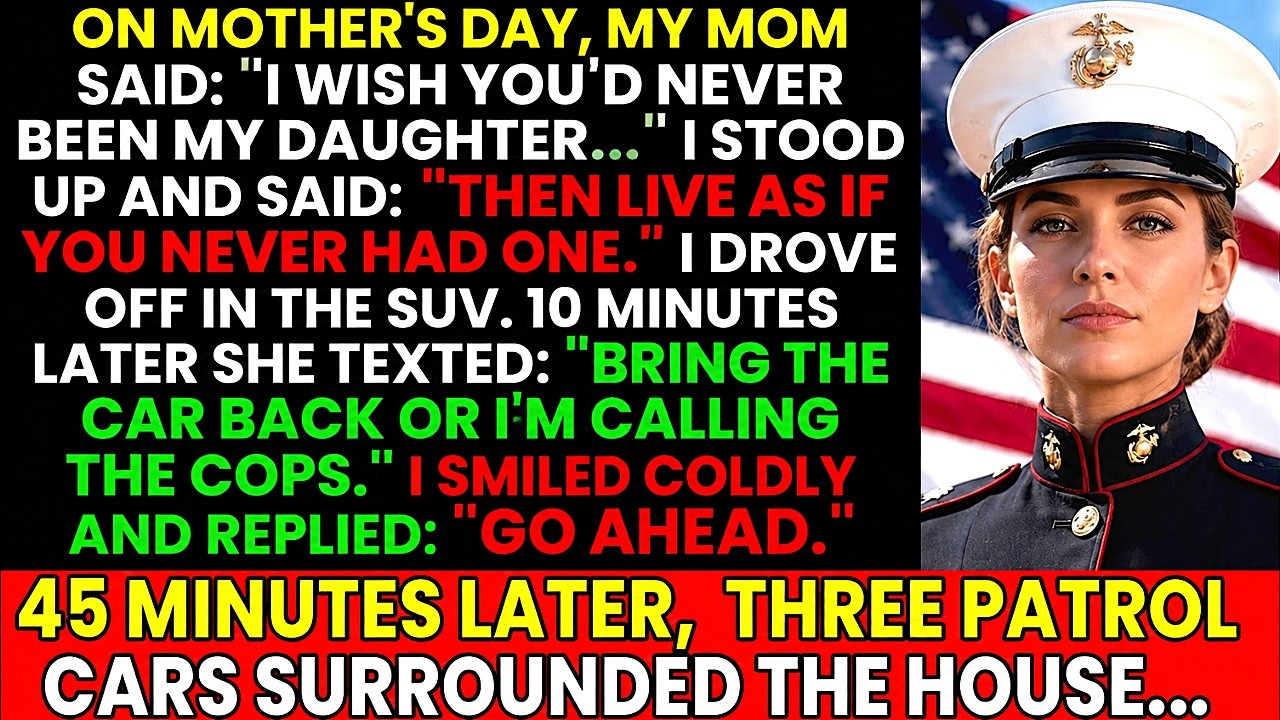
My own mother looked me in the eyes and said, “I wish you’d never been my daughter. ”
For a moment, I couldn’t breathe. After everything I had done for her, after years of putting my own life aside whenever she needed me, those words broke something inside me. I quietly stood up, placed the car keys on the table, and said, “Then live as if you never had one.
”
I drove away without arguing. For as long as I could remember, Mother’s Day had always been complicated in our family. My mother, Diane, was never the type to show affection easily. She didn’t hug me every morning or tell me she loved me without a reason.
But I always believed that deep down she cared. I held onto the small moments—the way she saved my favorite dessert during holidays, the way she called me when she needed advice, and the way she always said, “Family takes care of family. ”
After my father passed away five years earlier, that phrase became my responsibility. I was the one who drove my mother to doctor appointments.
I was the one who handled paperwork when she got overwhelmed. I helped with groceries, home repairs, and every emergency phone call that came in late at night. I never complained because she was my mother, and I believed that was what a good daughter did. Even when we argued, even when she said things that hurt me, I always found a reason to forgive her.
That Mother’s Day, I arrived at her house carrying a gift I had spent weeks choosing. It was a beautiful necklace with a small silver pendant because I wanted her to have something that reminded her of how much she meant to me. I walked through the front door expecting a peaceful afternoon. I expected a normal family meal.
Maybe I even hoped we could finally fix the distance that had grown between us. But within thirty minutes, the conversation changed. Old arguments came back. Old disappointments.
Things I thought we had moved past. My mother looked at me with tears in her eyes, but instead of saying something loving, she said those words that would stay with me forever. I wish you’d never been my daughter. For a few seconds, I just sat there, completely frozen.
Because no matter how old you are, some words from your mother can still break something inside you. And that was the moment I realized I couldn’t keep begging for a love that was always conditional. I don’t remember standing up from that table. I only remember the silence that followed my mother’s words.
Those words kept replaying in my mind as I walked toward the front door. I waited for her to stop me. I waited for her to say she didn’t mean it. I waited for anything that would tell me that the woman sitting behind me was still my mother, but nothing came.
I picked up my purse, grabbed my keys, and quietly walked outside. I didn’t slam the door. I didn’t yell. I didn’t give her the dramatic reaction she probably expected.
After years of trying to prove that I was a good daughter, I finally understood something painful. Sometimes silence says more than an argument ever could. I got into my SUV and sat there for several minutes with my hands on the steering wheel. The same vehicle my mother had used countless times.
The same vehicle I had bought with my own money because I wanted to make life easier for both of us. I had driven her to appointments in that car. I had taken her grocery shopping. I had helped her when she couldn’t manage things alone.
And now, after one sentence, I felt like a stranger. I started the engine and drove away. I wasn’t trying to punish her. I wasn’t trying to hurt her.
I just needed space to breathe. But I had barely driven ten minutes when my phone started ringing. It was my mother. For a moment, I thought maybe she was calling to apologize.
Maybe she realized how deeply she had hurt me. I answered. “Emily, bring the car back,” she said immediately. No apology.
No concern. No, “Are you okay? ” Just a demand. I was confused.
“Mom, what are you talking about? ”
Her voice became sharper. “You heard me. Bring the SUV back or I’m calling the police.
”
I pulled the car over and stared out the windshield. After telling me she wished I had never been her daughter, she was threatening me over the one thing I had spent years using to help her. That was the moment I realized the argument was never really about the car. It was about control.
My mother believed that no matter what she said or how she treated me, I would always come back because I was her daughter. But for the first time in my life, I wasn’t sure that was enough anymore. I thought the worst part was hearing my mother say she wished I had never been her daughter. I was wrong.
The worst part was realizing that even after saying something so painful, she still believed I was the person who had done something wrong. I spent the next hour sitting in my apartment, staring at my phone, hoping that somehow she would call back and say, “Emily, I’m sorry. I was angry. I didn’t mean it.
”
But that call never came. Instead, I received messages from family members. My aunt wrote, “What happened between you and your mother? She says you just walked out and left her.
” My cousin sent, “You really shouldn’t have abandoned her on Mother’s Day. ”
Abandoned her? That word stayed in my mind because for years I was the one who showed up. I was there when she needed rides.
I was there when she needed help. I was there when everyone else was too busy. But somehow, after one painful argument, I became the villain. Then, about forty-five minutes after I left my mother’s house, I looked outside my window and saw flashing lights.
Three police cars had stopped near my driveway. My heart dropped. For a moment, I couldn’t believe what I was seeing. My mother had actually called the police.
I walked outside slowly and saw two officers approaching. “Are you Emily Carter? ” one of them asked. “Yes,” I replied.
He glanced at his notes. “Your mother reported that you took her vehicle without permission. ”
I almost laughed, but there was nothing funny about it. The situation was so unbelievable that I didn’t even know how to respond.
“Officer, that vehicle belongs to me,” I said calmly. I went back inside and returned with the paperwork showing the registration and ownership documents. The officer looked through everything carefully while my neighbors watched from their windows. A few minutes later, my mother arrived.
She stepped out of her car expecting a completely different outcome. I could see it on her face. She thought I would be embarrassed. She thought I would apologize.
She thought the police showing up would force me to give in. But instead, the officer handed the documents back to me. “Ma’am, this appears to be a family dispute, not a criminal matter,” he explained. My mother’s expression changed instantly.
For the first time that day, she looked unsure because she finally realized something she had never expected. The one thing she thought she could use to control me no longer worked. And standing there in front of my house, surrounded by police officers and watching neighbors, I understood something, too. This was never really about the SUV.
It was about the fact that for the first time in my life, I had stopped obeying. For several days after that incident, I kept replaying everything in my mind. Not just the police showing up. Not just my mother’s threat, but the sentence that started it all.
“I wish you’d never been my daughter. ”
Those words hurt more than anything else because they came from the person whose approval I had spent my entire life chasing. I had spent years thinking that if I helped enough, sacrificed enough, and showed enough patience, my mother would finally see how much I loved her. But standing in front of my house that day, I realized something I had been avoiding for a long time.
I couldn’t force someone to value me. A week later, my mother called me. When I saw her name appear on my phone, I almost ignored it. Part of me still hoped she would say the words I had been waiting for.
“I’m sorry. ”
But when I answered, her first words were not what I expected. “You embarrassed me. ”
I closed my eyes and took a deep breath.
Not “Are you okay? ” Not “I shouldn’t have said those things. ” Just anger. I asked her calmly, “Mom, do you understand why I left?
”
There was silence. Then she said, “You always make everything about yourself. ”
That was the moment I understood that this wasn’t one argument. This was a pattern that had existed for years.
I wasn’t leaving because I hated my mother. I was leaving because I finally understood that love should not require me to constantly accept being hurt. A few days later, I agreed to meet her one last time. We sat across from each other at a small coffee shop.
And for once, I didn’t try to defend myself or convince her. I simply told her the truth. I love you, Mom, but I can’t keep being the person you hurt and then expect to come back like nothing happened. For the first time, she became quiet.
I don’t know if she fully understood. Maybe part of her still believes I would eventually return to the way things were, but I knew I had changed. I learned that setting boundaries doesn’t mean you stop loving someone. Sometimes, it means you finally start respecting yourself.
Today, my relationship with my mother is different. We speak less, but when we do, there are rules. There is respect. There are boundaries.
And even though that Mother’s Day was one of the most painful days of my life, it was also the day I stopped begging someone else to recognize my worth. Because sometimes walking away isn’t giving up on family. Sometimes walking away is the only way to save yourself.