The solicitor’s office smelled of sealing wax and dust. Helen Ward sat on a hard-backed chair, her hands folded in her lap, her plain black mourning dress a stark contrast to her brothers’ increasingly smug faces. Mr. Davies read their father’s will in a dry monotone.
Oak Shade Manor went to Thomas. The South Farms went to Edward. The Northwoods and timber rights went to George. Each bequest was met with a satisfied nod.
Then he cleared his throat. “And to my daughter, Helen Grace Ward, I bequeath the parcel of land known as the well plot, comprising one-quarter acre, situated at the eastern boundary of the estate, along with the dry well situated thereon. ”
A small smirk touched Thomas’s lips. The well plot was a joke—a patch of stony ground good for nothing but rabbits and gorse, its well dry for fifty years.
“Furthermore, a sum of ten pounds sterling is to be provided to my daughter for her immediate needs. ”
He slid a small cloth bag of coins across the polished mahogany table. It made a dull, insufficient sound. Helen looked at their faces.
Thomas’s smug authority. Edward’s grasping pleasure. George’s boyish satisfaction. They were strangers to her.
Men who had shared her father’s name, but never his substance. She stood, her movements calm and deliberate. “I will require the deed to the property,” she said. Mr.
Davies, surprised by her composure, produced the document. She took it, folded it neatly, and placed it in her satchel next to the familiar weight of her small stone mason’s hammer. She picked up the bag of coins. She did not look at her brothers again.
She walked out of the office, leaving them to their inheritance of land and timber. She had a deed, ten pounds, and the memory of her father’s words about a useless well. She was twenty years old, homeless, and entirely alone. The walk to Cannwick Village was less than two miles, but it measured a lifetime in loss.
She walked past fields that had been her father’s, now belonging to Edward. She passed the copse of ash and oak that was now George’s. Every landmark was a memory sealed in the past. When she reached the eastern edge of the estate, she saw it.
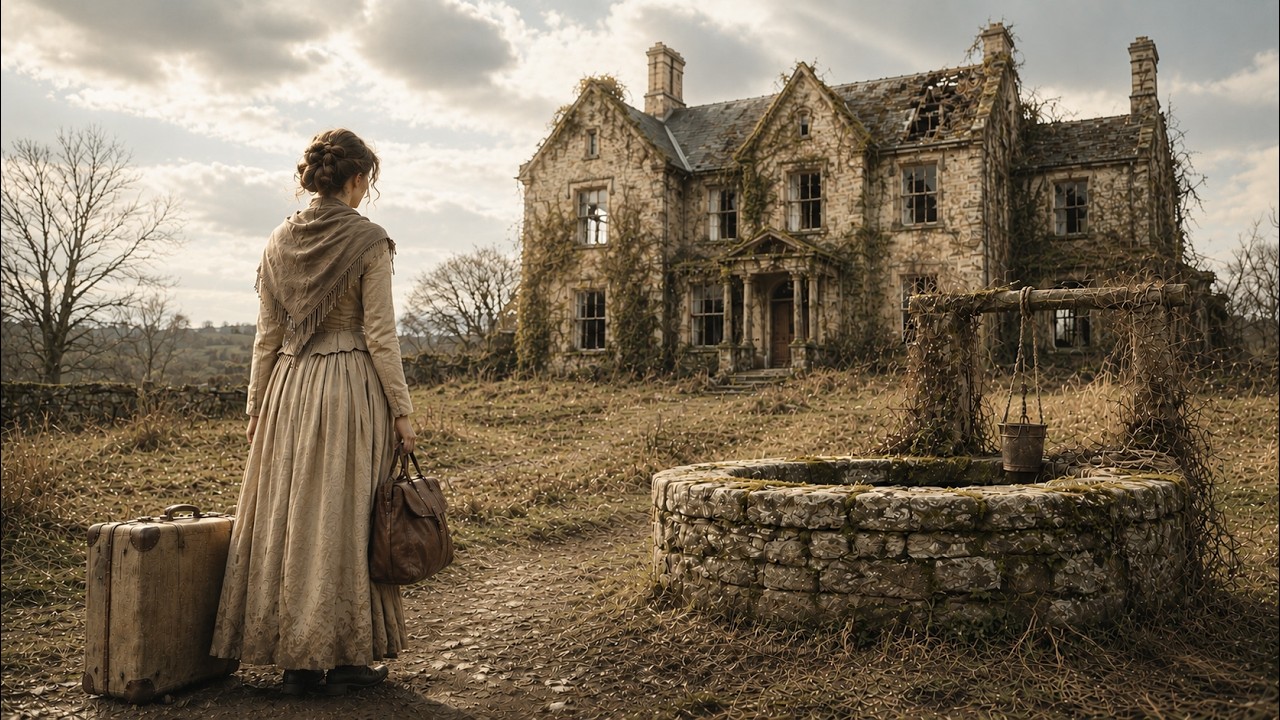
A low crumbling stone wall marked the boundary of her inheritance. Beyond it lay a quarter acre of neglect. Gorse bushes clung to the rise. Last year’s thistles stood like skeletal sentinels.
In the center stood the well. A circle of dark, moss-speckled stone rising three feet from the ground, capped with a weathered oak winding assembly whose rope had long rotted away. This was hers. This patch of weeds and stone and a deep, dark hole.
She pushed open the rickety gate and stepped onto her own land. She walked to the well and leaned over the coping, peering into the blackness. A cool, earthy smell rose to meet her. It did not smell of stagnant water.
Only of damp stone and deep earth. For a long moment, she just stood there. This was not a home. It was not a farm.
It was a problem, a puzzle, an ending. But as she looked down into that silent darkness, her father’s words echoed in her mind. “The best thing I own. ”
She did not feel despair.
Instead, a flicker of something else took hold. The quiet, stubborn curiosity of a builder looking at a ruin, wondering not what it was, but what it could be. Her first act as a landowner was pure practical assessment. She walked the perimeter.
The dry stone wall was tumbled down in places, but fundamentally sound. Abel Finch had taught her that a good wall has its own grammar. It was salvageable. She returned to the well, running her hands over the coping stones.
They were gritstone, locally quarried, expertly dressed. The tooling marks were still visible beneath the moss. This was no farmer’s field well. It was built with skill and intention.
She lay on her stomach, her head and shoulders over the edge, and peered down the shaft. It was a perfect circle, four feet in diameter, descending into absolute blackness. She dropped a small stone and counted. A faint thump echoed up from the bottom.
It was deep. And unquestionably dry. For the rest of the day, she worked. She went into Cannwick and used a few of her precious shillings to buy rope, a pulley, a bucket, and a lantern.
The shopkeepers watched her with pitying curiosity. They all knew the story of Arthur Ward’s strange daughter and her worthless inheritance. She ignored their whispers. Back at the plot, she rigged the pulley to the oak crossbeam, threaded the rope, and tied one end securely around her waist.
She lit the lantern and lowered it into the shaft. The walls were slick with dampness, but not streaming. The construction was impeccable. Each course of stone laid with a precision that spoke of military engineering.
Her father’s hand was in this. She felt it. With a deep breath, she began her descent. Bracing her feet against the curved walls, she walked herself down, hand over hand, the rope biting into her palms.
The air grew colder, smelling of stone and deep time. She was not afraid. She was a mason’s apprentice inspecting a piece of work. This was familiar territory.
She was home. She had descended about thirty feet, a little more than halfway, when her searching hands found it. One section of the wall felt different. The mortar joints were thinner, the texture finer.
A set of three dressed blocks forming a neat rectangle were set back by less than a quarter of an inch. A detail no one would ever notice unless they were feeling for it. She paused, her heart beating faster. She pulled the small hammer from her satchel.
She remembered Abel’s lesson. Listen to the stone. A solid wall sounds dead. A hollow place sings.
She tapped the center stone gently. Thud. She tapped the one next to it. Thud.
She tapped the middle of the strange section. It made a distinctly different sound. A hollow, resonant thunk. Using the chisel end of her hammer, she began to work at the fine mortar joint.
It was hard but brittle. Cement, not lime mortar. After ten minutes of patient work, she pried the tip of her hammer into the gap and levered it. The stone shifted inward.
It was not a stone. It was a plug. Behind it was a dark cavity. Her hands trembling, she reached inside.
She felt the cold, smooth surface of a metal box. It was heavy. She drew it out—a tin deed box about a foot long and eight inches wide, sealed with a thick layer of wax. She secured it in a canvas bag tied to her belt, replaced the stone plug as best she could, and began the slow climb back to the surface.
Pulling herself over the coping stone, she collapsed onto the grass, breathing heavily. She sat there for a long time, the gray sky above, the silent earth below, holding the secret of the well in her hands. With the edge of her hammer, she broke the wax seal and pried open the lid. The contents were packed tightly, cushioned with oilcloth.
On top lay a sealed envelope with her name written on it in her father’s neat architectural script. Beneath it, she felt the unmistakable heavy weight of stacked coins in canvas bags. She lifted one out. She loosened the drawstring and poured a cascade of gold into her palm.
Sovereigns, bright and clean, each stamped with the Queen’s profile. She counted the first bag. Fifty. There were five bags in total.
Two hundred and fifty gold sovereigns. A fortune. For a moment, she felt dizzy. This was not just survival.
This was a foundation. This was the means to build a life. Her hands shaking, she picked up the letter. It was dated six months before her father’s death.
“My dearest Helen,” it began. “If you are reading this, then I am gone. Your brothers have proven to be the men I always knew they were. I am sorry for the manner of this inheritance, but it was the only way I could ensure it reached you, and only you.
Your brothers see land as power. You, like me, see it as potential. They would have squandered this on frivolities. You will build something with it.
In my time as a sapper, I learned that the safest place to hide something of value is not in a locked room, but in a place of such obvious worthlessness that no one ever thinks to look twice. Everyone in the county knows this well is dry. No one would ever think to go down it. The money here is the result of my own savings over many years, separate from the estate.
It is yours, free and clear. Use it to make a place for yourself. Buy the cottage adjacent if old man Hemlock will sell. Sink a new bore if you must, but I do not think you will have to.
The well is not dry. Its feeder spring is merely blocked. I collapsed the lower seam myself thirty years ago. The plans for the original bore are with this letter.
You will know what to do. The well was my first project when I left the army, a way to keep my hands busy. It is built to last, just as you are. Be well, my girl.
Your loving father, Arthur Ward. ”
Tucked into the fold was a small rolled schematic—a cross section of the well showing its depth, its stone lining, and a secondary channel marked “feeder spring,” with a note indicating a deliberate blockage of clay and stone at the fifty-foot level. At the bottom of the box, beneath the bags of coin, lay one last object. A small, perfectly preserved ammonite fossil.
Its spiral polished smooth by the touch of a thousand hands. The one her father had kept on his desk his entire life. The first interesting thing he had ever found as a boy. She sat by the well as the light began to fade.
The letter clutched in her hand. The gold heavy in her lap. And she wept. Not for her homelessness or her brothers’ cruelty.
But for the quiet, meticulous, boundless love of a father she had only truly understood now in his absence. The first part of the rebuilding was a quiet transaction. Helen, dressed in her best remaining gown, went to see Mr. Hemlock, the elderly farmer who owned the dilapidated cottage and the acre of land bordering her well plot.
The cottage had been empty for years. She laid twenty gold sovereigns on his kitchen table. His eyes, accustomed to seeing the world in terms of shillings and pence, widened. He had thought the cottage and its sour acre were worthless.
He tried to bargain out of habit, but Helen held firm. By the end of the hour, she had a signed bill of sale. By the end of the week, the deed was transferred. She now owned a home.
Or at least the bones of one. The second part of the rebuilding was far more difficult. She needed to clear the well. She sought out Silas Croft, a man in his late sixties, the last of the old well diggers in the area.
He was a wiry, silent man with clay ingrained in the lines of his hands. She explained what she needed. He looked at her, skeptical. “That’s Ward’s old dry well,” he said, his voice raspy.
“There’s no water in it. Never has been. ”
“My father believed its spring was blocked,” she replied calmly, showing him the schematic. “I need someone with the skill to clear it safely.
”
Silas studied the drawing, his brow furrowed. He recognized the careful draftsmanship. He looked from the paper to the young woman before him—poised, serious, clearly not one to be trifled with. “It’s dangerous work,” he said.
“It’ll cost you. And I’ll need my son, David, to help. ”
“I will pay you fairly,” Helen said. He named a price that was high, expecting her to bargain.
She simply nodded. “When can you start? ”
The next morning, Silas and David Croft arrived with a cart full of equipment. David, a strong young man of Helen’s age, was as skeptical as his father, but he held his tongue.
For the next week, the three of them worked. Silas directed from the surface. Helen and David took turns being lowered to the bottom. Down in the cold, dark shaft, they filled bucket after bucket with the dirt, rubble, and compacted clay that her father had used to block the spring.
It was backbreaking, claustrophobic work. David, initially dismissive of her, soon came to respect her stamina and her surprising knowledge of stonework. She was not afraid of the dark, the dirt, or the hard labor. She worked as his equal.
On the fifth day, as Helen was digging at the last of the clay plug, she felt a change in the texture of the earth. It grew soft, then muddy. A moment later, with a low gurgle, a trickle of cold, clear water began to seep from the rock seam. “Water!
” she called up, her voice echoing in the shaft. “We found water. ”
By evening, there was a foot of it at the bottom. By the next morning, there were six.
The well was no longer dry. With the well restored and the cottage secured, Helen’s life began to take on a new shape. The water was cold, clear, and abundant. News of it spread through Cannwick.
The village pump often ran low during the dry summer months, but Helen’s well, fed by a deep, reliable spring, never faltered. It began with small exchanges. Mrs. Gable, the baker’s wife, approached her one afternoon, offering a trade—a large loaf of her finest bread every day in exchange for two buckets of water for her dough.
Helen agreed immediately. Soon others followed. Mr. Price, the blacksmith, offered to repair the well’s iron winding mechanism.
He spent a full day at his forge. When he finished, he refused payment beyond a handshake and the right to draw water when he needed it. The well became a quiet hub of village life. People stopped to talk, to pass on news, to watch Helen as she worked on her cottage and garden.
She hired Silas and David again. With their help and her own knowledge, she learned to re-thatch the roof, mix lime plaster, and reglaze the old leaded windows. She worked alongside them every day. Her hands became calloused.
Her face browned by the sun. People stopped seeing her as the squire’s disinherited daughter. They started seeing her as Helen Ward of Springwell Cottage. She planted her garden on the south-facing slope, turning over the stony soil, enriching it with manure.
She planted potatoes, cabbages, beans, and herbs. The constant supply of water meant her garden thrived while others struggled in the dry spells. She was no longer just surviving. She was producing.
She had a home. People knew her name. When she walked into the village, they greeted her not with pity, but with a nod of plain, earned respect. One cool evening in late autumn, a year after she had been cast out, Helen stood by the well.
The day’s work was done. The cottage behind her was warm and bright, a thread of smoke rising from its newly repaired chimney. The garden was put to bed for the winter. A bucket of clear, cold water sat on the coping stone.
In one hand, she held the small stonemason’s hammer Abel Finch had given her. Its handle now worn to the shape of her own grip. In the other, she held the polished ammonite fossil her father had left her. Its ancient spiral cool against her palm.
She thought of the two men. Her father and the old stonemason who had taught her to see the world not for what it appeared to be, but for its underlying structure. Its hidden strengths. Its secret songs.
They had given her the vision to see a foundation where others saw only a ruin. Her brothers, she had heard, were already quarreling over timber rights and property lines. Their inheritance already a source of discord. They had seen a dry well and a useless patch of scrub and dismissed it.
Her father had seen a fortress. A legacy built of stone and water and love. And he had hidden the key in plain sight, knowing that only she would have the skill, the patience, and the heart to find it. Helen Ward had been twenty years old and homeless.
She had ten pounds to her name. And she was given a dry well. It was the greatest inheritance she could have ever received.