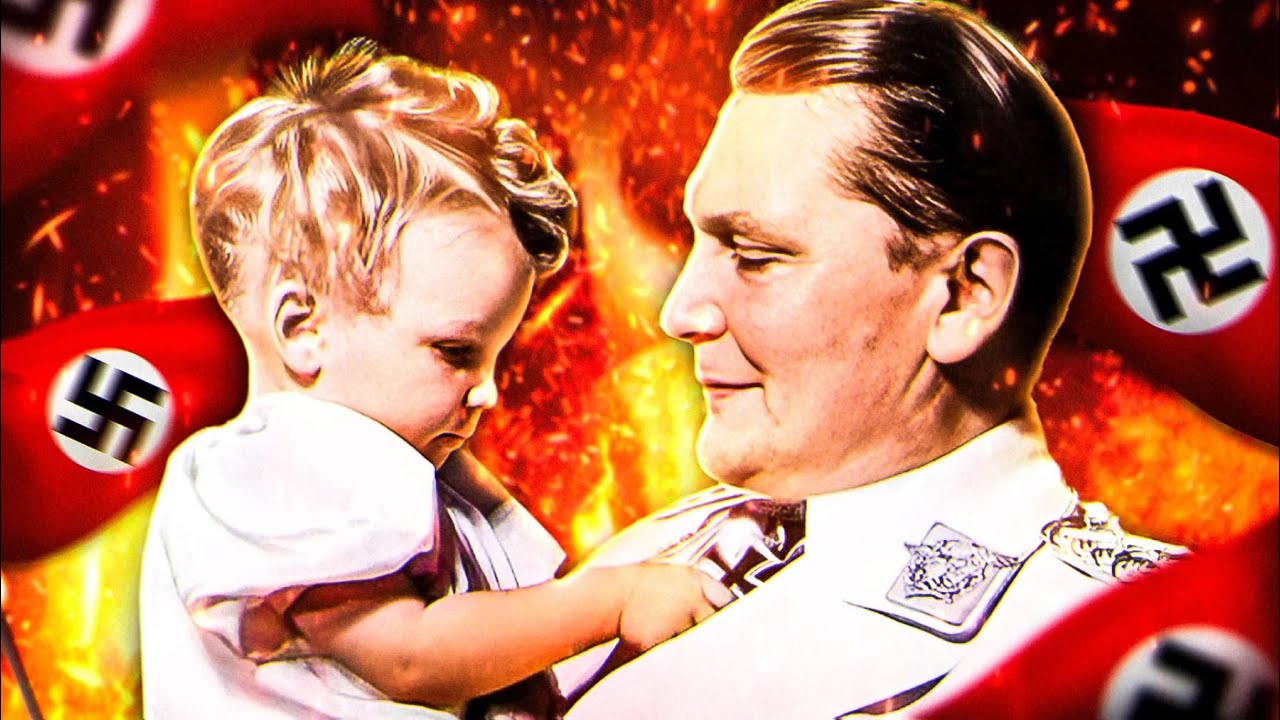
The children of Nazi leaders were raised in a world of privilege and adoration, only to see their fathers condemned as mass murderers after World War II. For Edda Göring, daughter of Reichsmarschall Hermann Göring, life on the vast estate of Karinhall was a fairy tale of luxury, complete with rare animals and a personal miniature railway. But after the Third Reich fell, she faced internment and poverty, yet she never stopped calling her father a hero, insisting in a 1991 interview, “I loved him very much, and it was evident how much he loved me.”
Gudrun Himmler, daughter of SS leader Heinrich Himmler, accompanied her father to the Dachau concentration camp at age 12, writing in her diary, “We saw everything we could. It was very nice.” After the war, she spent years in internment camps and later joined a clandestine network aiding former SS members, helping notorious war criminals like Klaus Barbie evade justice.
 She lived in Munich until her death in 2018, wearing a silver brooch her father gave her, a symbol of her unwavering loyalty to Nazi ideology.
Wolf Rüdiger Hess, son of Hitler’s deputy Rudolf Hess, dedicated his life to clearing his father’s name after Rudolf’s 1941 flight to Scotland and subsequent life imprisonment in Spandau. He wrote books claiming his father was a victim of Allied justice and organized annual memorial marches that attracted Neo-Nazis. Wolf Rüdiger died in 2001, still insisting that British intelligence had murdered his father, despite official reports of suicide.
The children of Reinhard Heydrich, the architect of the Holocaust, faced a different fate. After Heydrich was assassinated in 1942, his family fled Prague as the Reich crumbled. His son Klaus died in a car accident in 1943, and the surviving siblings—Heider, Silke, and Marte—chose deliberate obscurity.
Heider, now a retired engineer, refuses to discuss his father’s role, while Marte runs a fashion store on the island of Fehmarn, far from the power centers where their name once inspired fear.
Monika Hertwig, daughter of Amon Göth, the commandant of Plaszow concentration camp, spent decades believing her father was a good man. That shattered in 1993 when she watched Steven Spielberg’s “Schindler’s List,” which depicted Göth as a sadistic murderer. She later met a Holocaust survivor who had been forced to work in Göth’s household, saying, “For Helen, it was closure, but for me, it was the beginning of another life—a life in which I can live the truth.”
Niklas Frank, son of Hans Frank, the “Butcher of Poland,” took a radically different path. He became a journalist and wrote a scathing memoir titled “In the Shadow of the Reich,” in which he condemned his father as a monster. In a 2020 interview, he stated, “I am against the death penalty, but I am happy that my father experienced the fear of death he inflicted on so many innocent people.”
He also wrote a play imagining exhuming his father’s corpse to demand answers.
 Rolf Mengele, son of Josef Mengele, the “Angel of Death” of Auschwitz, grew up believing his father was a war hero. He discovered the truth as a teenager and later traveled to South America to confront him in 1977. He found an unrepentant Nazi who tried to justify his atrocities.
Rolf changed his last name to his mother’s and became a corporate lawyer, but he never betrayed his father’s hideout, saying, “What happened is contrary to all ethics and morality.”
Albert Speer Jr. , son of Hitler’s architect, pursued a career in architecture but deliberately distanced himself from his father’s legacy. He became a professor of urban planning and designed major projects like Shanghai’s International Automobile City.
He rarely spoke about his father, saying, “I have tried my whole life to distance myself from him.” He died in 2017 at age 83, leaving a legacy built on his own achievements.
Martin Bormann Jr. , son of Hitler’s private secretary, took an extraordinary journey from Nazi royalty to Catholic priesthood. Ordained in 1958, he worked as a missionary in the Congo and participated in Holocaust remembrance projects.
He said, “I love him as my father, but I cannot absolve him of any guilt.” However, allegations of physical mistreatment at a boarding school in the 1960s later cast a shadow over his atonement.
 The grandchildren of Nazi leaders have also grappled with this legacy. Katrin Himmler, granddaughter of Heinrich Himmler’s brother, published a family history titled “The Himmler Brothers,” shedding light on the broader implications of Nazi ideology. Jacqueline, granddaughter of Robert Gies, a lawyer who orchestrated the Lidice massacre, dedicated her life to uncovering his crimes, saying, “I cannot avenge these crimes, but I can keep the memory alive.”
Rainer Höss, grandson of Rudolf Höss, commandant of Auschwitz, discovered his family’s past during a school trip to Dachau. He broke ties with relatives who clung to Nazi ideologies and worked in Holocaust education, helping return stolen possessions to survivors’ descendants. But his path was marred by controversy: in 2016, he faced fraud allegations for misusing funds meant for a Holocaust film, leading to 18 convictions over 20 years.
Brigitte Höss, daughter of Rudolf Höss, chose a life of secrecy. She moved to Spain, worked as a model for Cristóbal Balenciaga, and hid her identity from her own children. Only at age 80, facing a terminal diagnosis, did she break her silence in a rare interview, painting Auschwitz as a “paradise” and calling her father a “sensitive man.”
This cognitive dissonance highlights the psychological toll of living with a hidden past.
Harald Quandt, stepson of Joseph Goebbels, survived the war while his six half-siblings were poisoned by their parents in Hitler’s bunker. He inherited a vast industrial empire, including a significant stake in BMW, and transformed it into a global powerhouse. He rarely spoke of his stepfather, preferring to focus on business and philanthropy.
His life ended in a 1967 plane crash, leaving a fortune that placed him among Germany’s wealthiest.
 Manfred Rommel, son of Field Marshal Erwin Rommel, forged a successful political career in postwar Germany. He became mayor of Stuttgart in 1974, known for liberal policies and efforts to integrate immigrants and support the Jewish community. He said, “We must learn to live together as brothers or perish together as fools.”
His journey from the son of a Nazi general to a respected public servant exemplifies personal transformation.
The Goebbels children—Helga, Hildegard, Helmut, Holde, Hedwig, and Heidrun—met the most tragic fate. On May 1, 1945, as Soviet troops closed in, their parents sedated them with morphine and crushed cyanide capsules in their mouths. Magda Goebbels left a letter to her eldest son, saying, “The world that comes after the Führer is no longer worth living in.”
Their bodies were discovered by Soviet troops, still dressed in pajamas, a grim testament to fanatical devotion.
These stories reveal the brutal fate of the children of Nazi leaders, from denial and defiance to confrontation and redemption. They serve as a powerful reminder of the enduring repercussions of the Third Reich, affecting generations removed from the original events. The legacy of these families continues to challenge our understanding of guilt, responsibility, and the possibility of redemption in the face of unspeakable crimes.