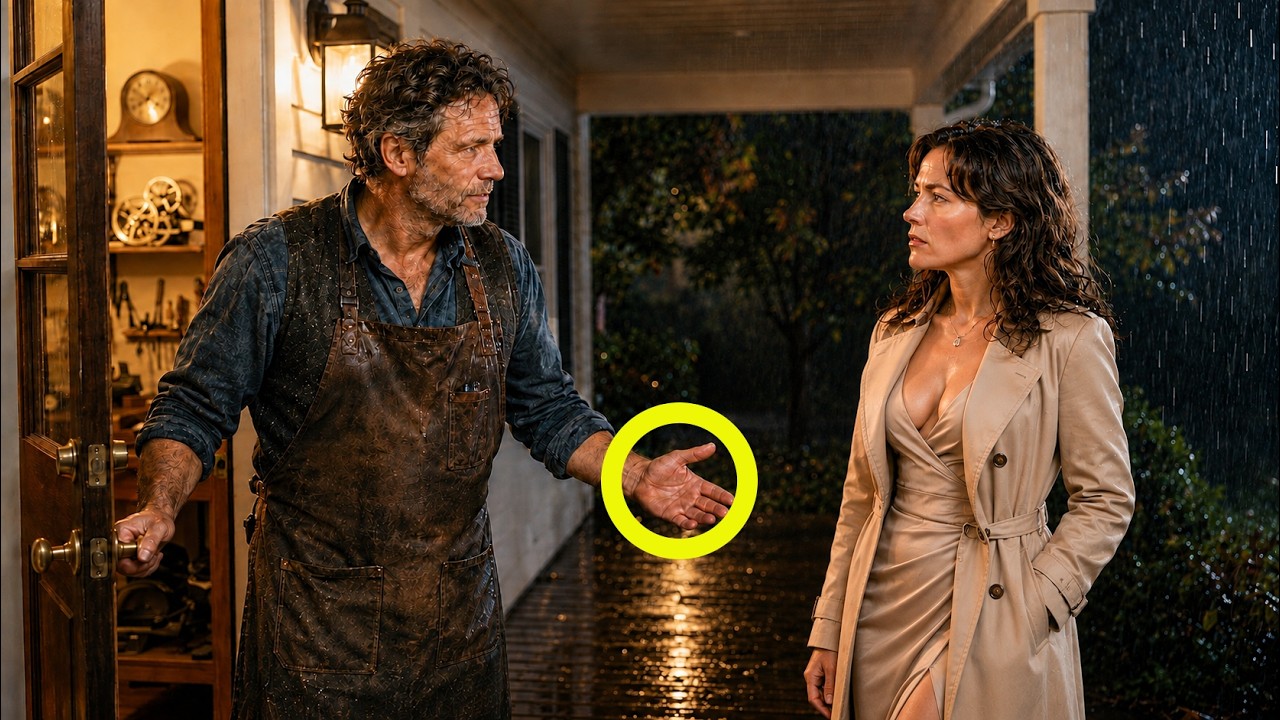
I stood in the rain, letting the water soak my hair and my face. Seattle felt cold that night, but I felt colder inside. My name is Cain. I was thirty-eight years old.

Nearly a decade earlier, my father died—broken, defeated, and labeled a criminal. People said he had done terrible things, but he was a good man. He lost everything when his business collapsed, and the weight of the accusations crushed him. I lost my father, my home, and any hope I had left.
Every day was a fight, and every night stretched on forever. I was exhausted in a way that sleep couldn’t fix. I just wanted to stop. Someone walked toward me through the rain.
A tall man stopped in front of me, holding a large black umbrella. He raised it over my head, blocking the downpour. “Cain,” he said softly. His name was Wade, and he came from one of the wealthiest families in the city.
His family owned half the buildings downtown, and he always looked like he stepped out of a magazine. “You’re soaked,” he said. “Come with me. ”
I followed him to a quiet restaurant with low lights and white tablecloths.
He ordered hot tea for me, and as I drank it, he talked about the weather, his work, his plans. I listened, but I felt nothing. Then he stopped mid-sentence, slid out of his chair, and dropped to one knee. The people around us turned to stare.
Some women gasped. Wade opened a small velvet box. Inside sat a diamond ring, huge and brilliant. “Cain,” he said, his voice steady.
“Will you marry me? ”
I stared at him. I didn’t feel joy or excitement. I just felt tired—bone-deep tired.
I thought about the ten years of struggling, the loneliness, the nights I wished I wouldn’t wake up. He looked kind. He looked safe. Maybe this was my chance to finally rest.
So I said yes. The restaurant erupted in applause, and someone cried happy tears. They thought this was romantic. I knew the truth.
This wasn’t about love. It was about survival. —
The wedding came fast. The church was full of white roses, and the dress Wade’s family chose cost more than I used to earn in a year.
I felt like I was wearing a costume. We said our vows, we kissed, and everyone smiled at the cameras. I wasn’t happy. I was just numb.
After the ceremony, I moved into the Sterling mansion—a sprawling three-story estate with marble floors, priceless furniture, and more empty rooms than I could count. It looked like a museum, and it felt just as lifeless. Then I met Mrs. Evelyn Sterling, Wade’s mother.
She glided into the room in a gray dress, her hair perfect, her jewelry gleaming. She looked at me the way someone inspects a piece of furniture they might buy. “We have rules in this house,” she said, her voice smooth as silk. “Dinner is at seven.
You will dress well. You will be polite to our guests. Always. ”
I nodded.
“Yes, Mrs. Evelyn. ”
She smiled, but the smile never reached her eyes. From that day on, she controlled everything—what I wore, what I ate, who I spoke to.
Wade was always kind to me, but he never said a word to stop her. I played the part she wanted: the quiet, obedient wife. She thought I was stupid. I let her believe it.
But I wasn’t stupid. I watched. I listened. I learned.
—
One night, I walked past Wade’s office and heard voices inside. I paused. The door was cracked open. “The settlement is ready,” Mrs.
Evelyn was saying. “What if she asks questions? ”
“She won’t,” Mrs. Evelyn replied coldly.
“She’s not smart enough. She just wants a comfortable life. She’ll sign anything. ”
“What about the tax records?
”
“Hidden. Nobody will find them if we’re careful. ”
My heart pounded, but I didn’t move. I waited, then walked away as quietly as I’d come.
So there was a secret—something about settlements and hidden records. Something worth hiding. I thought about my father, about how he’d lost everything because rich people buried the truth. I looked around my beautiful room.
The silk curtains, the expensive furniture, the soft carpet—it was a golden cage. I wasn’t a puppet. I was just waiting, watching, learning. —
Two weeks later, I got my chance.
Wade was at a business meeting, and Mrs. Evelyn had gone shopping. The mansion was quiet. I slipped into Wade’s study and found a locked drawer.
A small key was taped underneath the desk. Inside the drawer was a thick, worn folder. The first page read “Accident Report. ” The date was from five years ago.
There were photos of a crashed car, blood on the road, a dead man inside. The victim was my father’s business partner. I read on. The driver who caused the accident was never found.
But the report showed payments—money funneled to police officers, judges, and reporters. All of it came from the Sterling family account. My father’s partner had proof that my father was innocent, and he was going to testify. He died before he could speak.
The Sterlings made it disappear. I heard a car pull into the driveway. I quickly locked the drawer, replaced the key, and hurried back to my room. My mind raced.
Wade knew. Mrs. Evelyn knew. They had destroyed my father, and now I was living in their house.
—
That night, Wade came home with a gift: a diamond necklace. “For you,” he said, smiling. But his smile looked guilty. “It’s beautiful,” I said, letting him clasp it around my neck.
I knew exactly what it was. Hush money. Keep the wife happy, keep the wife quiet. Days passed.
Wade showered me with more gifts—earrings, bracelets, a new car. I took everything and smiled. But inside, I felt nothing but cold hatred. Then Mrs.
Evelyn called me into her office. She pushed a stack of legal documents across her desk. “Sign these,” she said. I read them carefully.
The contract transferred all Sterling assets—the mansion, the companies, the bank accounts—into my name. But there were restrictions. I couldn’t sell anything or change anything. Mrs.
Evelyn kept full control. I was just the name on the paper. I understood. I was a legal shield.
If the authorities ever came asking questions, the assets would be in my name. I would take the fall. Not them. Mrs.
Evelyn smiled. “Just sign here. It’s simple. ”
I smiled back, sweet and innocent.
“Of course. Can I read it first? I want to understand. ”
Her smile tightened.
“There’s nothing to understand. Just sign. ”
“Tomorrow,” I said. “I’ll sign tomorrow.
”
Her eyes went cold, but she nodded. I left her office, locked my door, and looked at myself in the mirror. The diamond necklace gleamed on my neck. They thought I was their puppet.
They thought I was their shield. They had no idea who they’d invited into their home. —
The charity gala came two weeks later. Rich people filled the ballroom, and reporters’ cameras flashed everywhere.
Mrs. Evelyn wanted everyone to see the perfect Sterling family. I wore a long red dress and the diamonds Wade gave me. We smiled for the cameras.
But I wasn’t there to smile. I was hunting. I stayed close to Wade, holding his arm, playing the perfect wife. But I listened.
I watched. A man in a suit approached Mrs. Evelyn—a lawyer, from the look of him. “The Hampton shares were easy to take,” Mrs.
Evelyn said. “The old man never saw it coming. ”
Hampton. My father’s name.
“You framed him perfectly,” the lawyer said. “He was weak,” Mrs. Evelyn replied. “Weak men don’t deserve power.
I took what should have been mine. ”
So it was her. She had destroyed my father—planned everything, stolen his company, silenced the one man who could have saved him. All for money.
All for power. I walked to the bathroom and locked the door. I looked at myself in the mirror, and for the first time, I saw the truth. I wasn’t a victim.
I had known Wade’s family was involved—that was why I came here. I had planned everything. I studied Wade for months. I went to his favorite coffee shop, dropped my book near him, let him charm me.
I made him fall in love. I was kind, sweet, attentive. He proposed, just like I knew he would. And I was prepared.
The necklace he gave me—I’d had a tiny recording device built into it. The earrings Mrs. Evelyn chose—I’d added devices there, too. For months, I’d recorded every conversation, every secret, every confession.
I finished my makeup and returned to the party. Mrs. Evelyn stood near the stage, talking to more important people, laughing her cold laugh. I walked straight up to her and stood very close.
“The party is wonderful, mother,” I said softly. Mrs. Evelyn looked at me—really looked at me. For the first time, something flickered in her eyes.
Confusion. Maybe fear. “Cain,” she said slowly. “Are you well?
”
“I’m perfect,” I said. I touched the necklace. “Everything is perfect. ”
I walked away, feeling her eyes on my back.
She was worried now. She didn’t know why, but she felt it—danger. The gala ended late. We returned to the mansion, and I went to my room.
I opened my laptop and took out the small memory card from my necklace. I put it in the computer and pulled up the recordings—Mrs. Evelyn’s voice, her confessions, her crimes. Then I opened my email and wrote to the federal police.
I attached everything: the recordings, the accident reports, the payment records, the cover-up. Then I wrote to the major newspapers and sent them everything, too. It was midnight when I pressed send. I closed my laptop and sat back.
I didn’t feel happy. I didn’t feel sad. I just felt calm—finally, truly calm. —
Morning came.
I dressed and went downstairs. Wade sat at the breakfast table, staring at his phone. His face was white. “Cain,” he said, his voice shaking.
“What did you do? ”
“I told the truth,” I said. I sat down and poured myself some coffee. “The police called me,” he said.
“The newspapers called me. They have recordings, documents—they know everything. ”
Mrs. Evelyn burst into the room.
Her hair was messy, her face red with fury. She’d never looked messy before. “You! ” she screamed at me.
“What did you do? ”
“I sent the truth to the right people,” I said calmly. “They know about the accident, about my father, about everything you did. ”
“You stupid girl,” she snarled.
“You’ve destroyed us. You’ve destroyed yourself. ”
“No,” I said. “I freed myself.
”
Wade stood up, desperate. “Cain, please. Tell them it was a mistake. Tell them the evidence is fake.
We can fix this. ”
“No, Wade,” I said. “We can’t fix this. ”
“My mother made mistakes, but I’m innocent,” he said.
“I did nothing wrong. ”
I almost felt sorry for him. Almost. I reached into my bag and pulled out more papers—emails between Wade and his mother.
“Read these,” I said. He took them, reading with shaking hands. His face drained of color. The emails were clear: if anyone ever discovered their crimes, Mrs.
Evelyn planned to blame Wade—to let him take the prison sentence. His own mother was ready to sacrifice him. Wade dropped the papers. His legs gave out, and he fell to the floor, sitting there broken.
“She was going to blame you,” I said. “She wrote it all down. ”
Mrs. Evelyn said nothing.
She just stared at the exposed papers. Wade looked up at his mother. “Your own son? ”
“I did what I needed to do to survive,” she said coldly.
“You’re a monster,” he whispered. Car engines rumbled outside. I walked to the window. Police cars and news vans filled the driveway.
“They’re here,” I said. The knock came hard and official. “Open up! Federal Police!
”
Officers flooded the mansion. “Mrs. Evelyn Sterling,” one said. “You’re under arrest.
”
She screamed, fought, threatened. “Do you know who I am? I have power! I have lawyers!
”
The officers didn’t care. They snapped handcuffs on her wrists and read her rights. I watched her being dragged away, still screaming. An officer approached me.
“Mrs. Sterling? We need to talk. ”
“Of course,” I said.
I poured myself some tea. “I’ll tell you everything. ”
—
The trial lasted six months. The evidence was overwhelming.
The recordings captured everything—Mrs. Evelyn’s confession at the gala, the plot to blame her own son, the cover-up of the accident that killed my father’s partner. Behind the scenes, the documents linked her directly to destroying my father. Mrs.
Evelyn went to prison. Wade went to prison too. The Sterling empire collapsed. The companies shut down, the mansion was sold, everything they owned was gone.
The court recovered my father’s old assets—money, shares, property that had been stolen from him. They gave it all back to me. But I didn’t keep it. I gave every dollar, every share to charity and created a foundation in my father’s name.
It helped people who’d lost everything because of lies—people like my father. That became his legacy: help, hope, and justice. Reporters called me brave. People said I was strong.
But I didn’t feel brave. I just felt free. —
After the trial, I packed one small bag. I took nothing from the mansion, nothing from that life.
I drove to my father’s grave in a quiet town nestled among green hills. The headstone was simple: his name, his dates. I placed white roses on the grass—his favorite. The sun felt warm on my face.
The sky was blue, no clouds, just light. I sat on the grass and talked to him. “I did it, Dad,” I said. “I made them pay.
Your name is clear now. Everyone knows the truth. ”
Tears fell, but they weren’t sad tears. They were relief, release.
I thought about all the times I’d wanted to rest—how I’d thought a man, a marriage, a safe place could give me peace. But rest didn’t come from a man. It didn’t come from marriage. It came from truth, from justice, from fighting back.
I stood up and looked at the grave one last time. “My heart is finally resting,” I said. “Not because of a man. Because of the truth.
”
I walked back to my car and looked at the open road ahead. I didn’t know where I’d go—maybe a new city, maybe a new life. But I had time. I had freedom.
I had peace. The storm inside me was gone. I started the car and drove away, the sun following me, warm and bright. My heart was at rest—finally, truly, completely.
And I was free.
:max_bytes(150000):strip_icc():focal(745x201:747x203):format(webp)/idaho-students-bryan-kohberger-murders-072826-415624556ba5411e8865235b81f12cae.jpg)