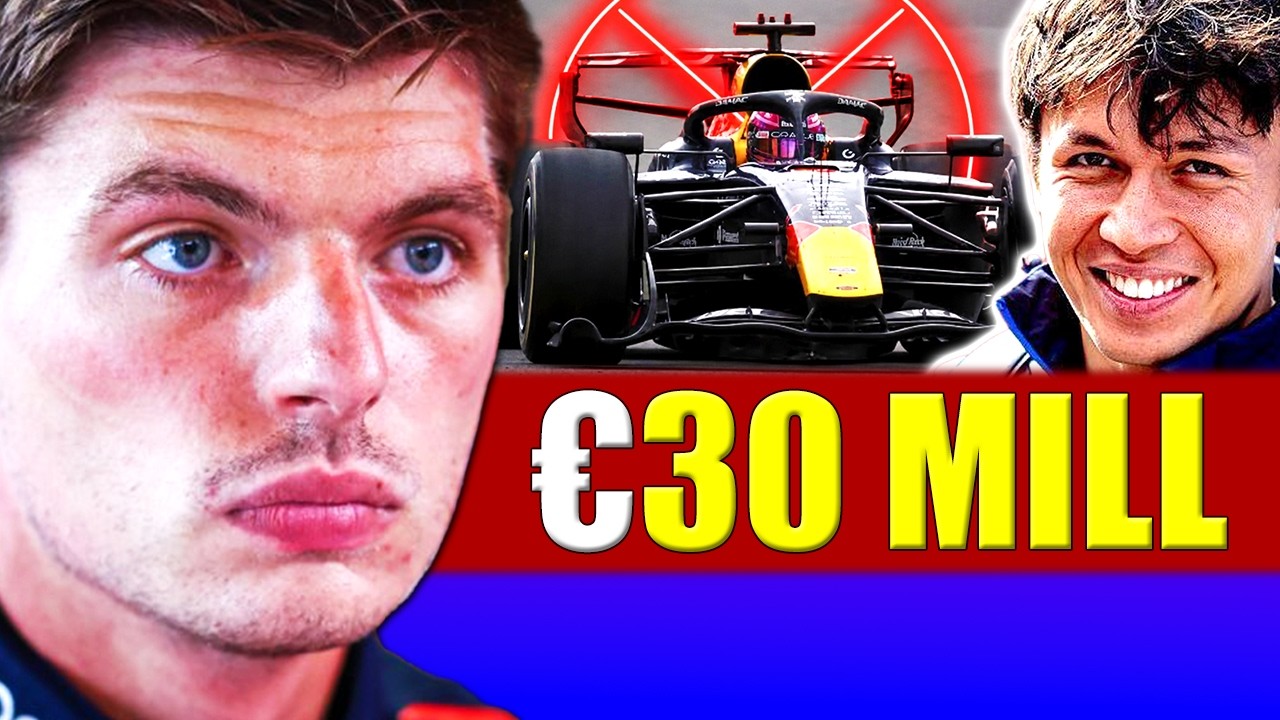
The summer break in Formula 1 has been shattered by a cascade of seismic driver market developments, with Alex Albon securing a shock long-term extension at Williams that includes unprecedented exit clauses, while Carlos Sainz is reportedly on the verge of signing a staggering 30 million euro per year deal that could reshape the entire grid. The confirmation of Albon’s stay through 2027, announced by team principal James Vowles, has sent ripples through the paddock, raising urgent questions about the future of Sergio Perez, the ambitions of Cadillac, and the stability of Red Bull’s entire driver program. This is not merely a routine contract renewal; it is a signal that the midfield is now a battleground for survival, with massive sums of money and career-defining decisions being made behind closed doors.
The Albon deal, while expected by many insiders, carries explosive implications. Vowles framed the renewal as a demonstration of mutual confidence in Williams’ long-term project, but the inclusion of performance-based exit clauses reveals a fragile truce between driver and team. Albon, who has now become the most tenured Williams driver in history with over 100 Grand Prix starts, will not be trapped if the team fails to deliver on its promises of a resurgence.
 The clauses allow him to leave if a top team comes calling, effectively making him a free agent in waiting. This is a high-stakes gamble for Williams, which is pouring resources into retaining Sainz while simultaneously trying to upgrade its facilities. The message to the factory floor is clear: keep the car competitive, or risk losing both drivers.
Sainz’s situation is even more volatile. Spanish publications Marca and SoyMotor are reporting that the two-time race winner has already signed a multi-year deal worth 30 million euros annually, a figure that dwarfs the salaries of most drivers outside the elite tier. RacingNews365 confirms the negotiations are at an advanced stage, with performance clauses that would allow Sainz to leave for a top team like Red Bull, Ferrari, McLaren, or Mercedes without penalty.
This is a massive financial commitment for a team that has struggled to score points consistently. If true, it signals that Williams believes Sainz is the cornerstone of their revival, but it also places immense pressure on the team to deliver a car capable of fighting at the front. The alternative is a public relations disaster: if Sainz leaves, it would confirm that Williams cannot retain top talent.
The domino effect of these deals is already being felt in the Red Bull camp. Sergio Perez, whose seat has been under threat due to inconsistent performances, has publicly stated that he is still one of the best drivers on the grid. However, his stock has fallen as Yuki Tsunoda has outperformed expectations at Racing Bulls.
The emergence of Sainz as a potential free agent, even with exit clauses, could tempt Red Bull to make a change if Perez fails to improve. Christian Horner faces a dilemma: stick with a driver who has delivered podiums but struggled against Max Verstappen, or gamble on a proven race winner like Sainz. The situation is further complicated by the fact that Sainz’s contract with Williams would likely include a buyout clause, making any move expensive.
 Meanwhile, Cadillac’s entry into Formula 1 is facing internal turmoil. The team has fired team principal Graham Loudon after just 11 rounds, replacing him with Marcin Budkowski, a former Alpine executive who was himself a victim of corporate upheaval. The decision, announced by TWG Motorsports chief Dan Towriss, has been met with skepticism.
Budkowski’s introduction video, filled with corporate platitudes about building and innovating, has drawn criticism from fans and pundits alike. The team is struggling with reliability issues and a lack of pace, and the sudden leadership change raises questions about whether the American ownership understands the complexities of F1. Comparisons are already being made to Alpine’s chaotic management under Luca de Meo, which saw constant changes and little progress.
The driver market chaos is not limited to the top teams. Yuki Tsunoda, who has been a reliable performer for Red Bull’s junior program, is reportedly running out of options for a full-time F1 seat. Negotiations are ongoing with Meyer Shank Racing in IndyCar, a move that would be a significant shift for the Japanese driver.
Haas, which has a technical partnership with Toyota, could be a potential landing spot, but the team may prefer Rio Hirakawa due to stronger financial backing. Tsunoda’s situation highlights the brutal reality of the driver market: even talented drivers can be left without a seat if the timing and money do not align.
 On the technical side, Honda’s return to F1 with Aston Martin is generating mixed opinions. Reports suggest the new power unit could deliver a 30-horsepower improvement, translating to a five-tenths of a second lap time gain. However, testing in Budapest revealed only a 20-horsepower increase, raising doubts about the engine’s readiness.
Aston Martin is reportedly hiring back engineers who worked with Red Bull during the Honda partnership, signaling a serious commitment to the project. The performance of this engine will be critical for Aston Martin’s ambitions to challenge the frontrunners in the coming seasons.
The FIA is also under scrutiny over the so-called Macarena rear wing design, which has been linked to crashes involving Red Bull. Ferrari’s version of the wing has been deemed safe, but Red Bull’s implementation has raised safety concerns. The FIA’s technical team, led by Nikolas Tombazis, has had discussions with Red Bull about potential changes, though no formal ban has been issued.
The controversy highlights the delicate balance between innovation and safety in F1, with teams pushing the boundaries of aerodynamics while regulators try to prevent dangerous failures.
 Mercedes, meanwhile, is preparing a major upgrade package for the upcoming Dutch Grand Prix. Technical director James Allison has revealed that the team has spent months developing new parts that could significantly improve performance. The upgrades come at a critical time, as Mercedes has fallen behind McLaren and Red Bull in the constructors’ championship.
Allison’s optimism is notable, given the team’s tendency to downplay expectations. If the upgrades deliver as promised, the championship battle could become even more intense.
The Dutch Grand Prix itself promises to be a pivotal weekend. McLaren’s dominant performance in Hungary, led by Lando Norris and Oscar Piastri, has raised questions about whether the team has the fastest car. Ferrari’s recent struggles have opened the door for Mercedes to close the gap.
Weather forecasts suggest possible rain, which could add an element of chaos reminiscent of the 2023 race. The sprint format will also test teams’ ability to adapt quickly.
As the summer break ends, the driver market is in a state of flux. Albon’s extension, Sainz’s impending mega-deal, and the uncertainty surrounding Perez and Tsunoda are just the beginning. The next few days could see more announcements that reshape the grid for years to come.
Teams are making calculated gambles, drivers are securing their futures, and the sport is bracing for a period of unprecedented change. The only certainty is that nothing is certain in Formula 1.