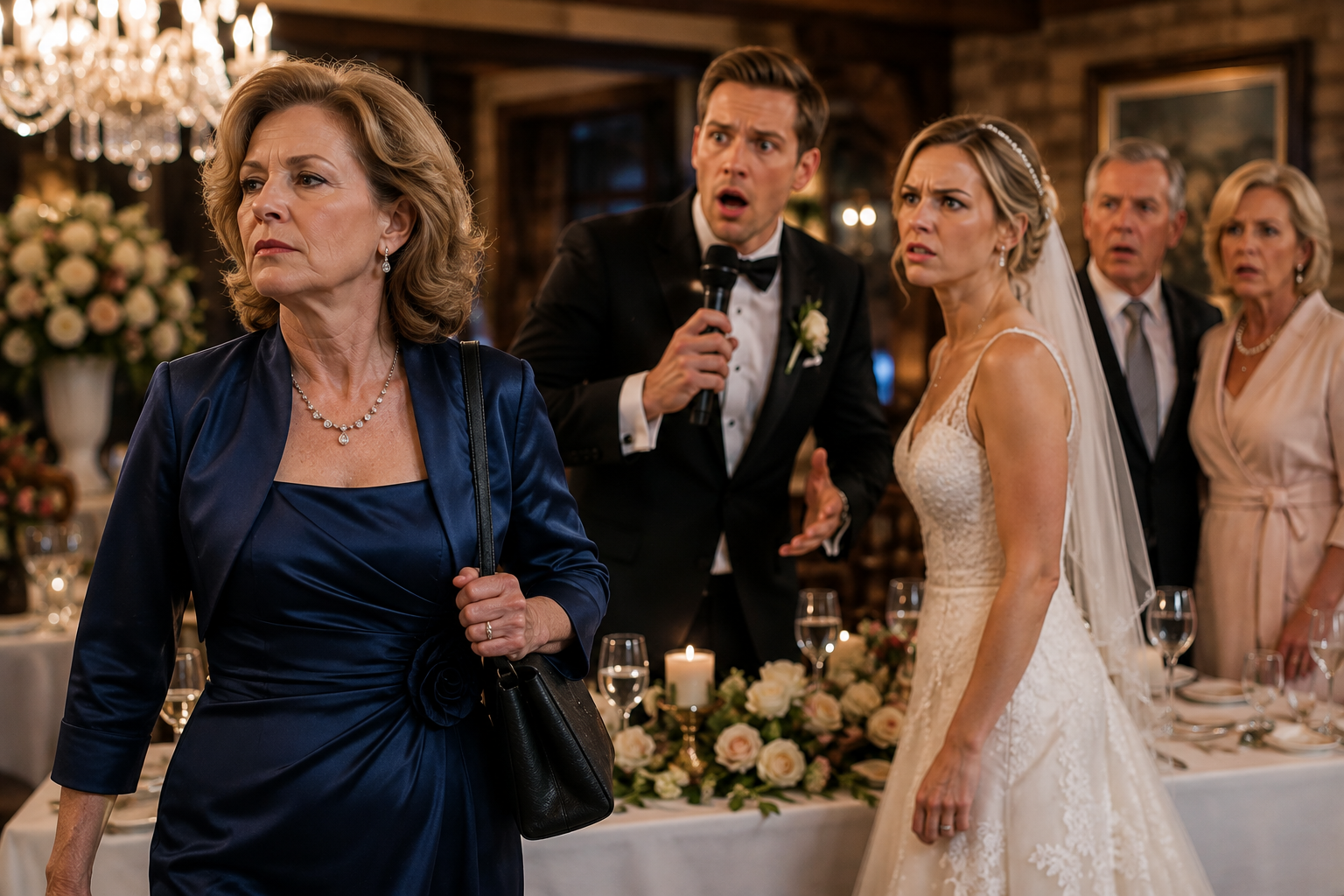
The clatter of a silver spoon against a crystal glass sliced through the festive chatter in the banquet hall. Guests turned expectantly as Bastian, the groom, took the microphone, his face pale beneath the carefully tailored suit. Beside him, his bride Saskia beamed with the confidence of someone accustomed to getting her way.
But when Bastian spoke, his words landed like a bombshell: “Mama, I have decided not to tell you beforehand, but my in-laws and my wife will be moving onto the farm with me.” The room erupted in applause, guests murmuring about the beauty of multigenerational living. Saskia shot a triumphant look toward the mother of the groom, Veronika, seated near the kitchen doors.
 She expected social pressure to force Veronika into silent acceptance as the family’s unpaid housekeeper. But Veronika did not panic. She did not cry.
Instead, a crystalline calm settled over her.
Slowly, Veronika rose, smoothing the fabric of her dark blue dress. As the applause faded and silence spread across the room, she stepped forward. Her voice carried clearly, without a tremor: “That is a very interesting plan, considering the farm does not belong to you.”
The silence that followed was deafening. Bastian’s face drained of all color. Saskia’s smile froze as if doused with ice water.
Veronika did not wait for excuses or chaos. She retrieved her handbag, turned on her heel, and walked out of the hall with her back straight. She knew exactly what had been plotted behind her back, and she had been preparing for this moment for weeks.
The scheme to take over her home did not begin at the wedding. It started three months earlier, when Saskia’s parents, Klaus and Renate, began accompanying the young couple on Sunday visits to the farm. At first, Veronika thought it was politeness.
But soon she noticed their eyes were not admiring the landscape—they were appraising it. They wandered through the hallways, knocking on wood-paneled walls, loudly calculating square footage. Renate stood in the middle of Veronika’s kitchen and openly criticized the layout.
“These massive oak cabinets take up too much space. If we put in something more modern, a kitchen island would fit perfectly,” she declared, as if Veronika were a ghost in her own home. Bastian, passive and eager to please his future wife, nodded and murmured that adjustments could be made.
One Sunday, Veronika caught Renate placing her own decorative plates in the glass cabinet, pushing aside the porcelain that Veronika’s late husband had given her. Veronika did not scream. She did not make a scene.
She waited until after lunch, when the family went for a walk in the orchard. In silence, she wrapped each of Renate’s plates in newspaper and packed them in a moving box. That same afternoon, before they drove back to the city, she opened the trunk of Bastian’s car and placed the box inside.
When Renate noticed her plates missing, she looked confused. Veronika simply handed her a cup of tea for the drive and smiled. She had no appetite for arguments.
Her boundaries were not negotiable, but blinded by entitlement, they mistook her silence for weakness.
There is a vast difference between trust and blindness, and Veronika had long stopped being blind. One month before the wedding, Bastian arrived at the farm on a Tuesday afternoon—an unusual day for his visits. He sat on the bench in front of the house, scratching the back of his neck, a nervous habit from childhood that always preceded a lie.
He asked for a spare key to the front door, claiming a plumber needed to check the pipes in the guest bathroom while she was at the market. Veronika knew the state of her pipes perfectly—nothing was broken. She looked into her son’s eyes and saw the dark shadow of Saskia’s influence dictating every word.
She went to the hallway chest, retrieved a brass key from the drawer. It was the key to an old rusty padlock from the shed, thrown away years ago, but it had the exact same shape and weight as the house key. She handed it to him with a peaceful smile.
He pocketed it hastily, relieved at the lack of resistance.
Two days later, Veronika was working in the greenhouse, hidden behind the large oaks, when she heard gravel crunch. Klaus’s car pulled up. He and Renate got out with three large moving boxes and marched straight to the front door.
For a full fifteen minutes, they struggled with the lock, cursing audibly as the key refused to turn. Finally, defeated, they carried the boxes into the old open barn, hid them behind some garden tools, and drove away. The silent invasion had begun, but Veronika was already steps ahead.
An empty room is an open invitation to opportunists. The farm had two large guest rooms upstairs, untouched since Bastian moved to the city. Veronika knew those were exactly the rooms Saskia and her parents had targeted for their covert move-in.
 Instead of confronting them and exhausting herself in a draining battle, she decided to solve the problem with her own hands. The next morning, she called two young men from the village who usually helped with the harvest. She paid them to completely dismantle the two massive double beds.
They loaded the mattresses and frames into her station wagon, and she donated them directly to a local charity. Within 48 hours, the rooms were unrecognizable. The first room became the painting studio she had always wanted but kept putting off.
She filled the bright space with easels, blank canvases, and worktables laden with oil paints and brushes. The second room became the main storage for her small homemade jam business. She had heavy metal shelves installed and filled them to the ceiling with jars, labels, and boxes.
Not a single inch remained to unroll even a sleeping bag.
The following weekend, Saskia and Bastian visited under the pretense of needing to use the bathroom. Veronika heard Saskia’s footsteps pause in the upstairs hallway, then stop abruptly in front of the rooms. When they came back down, their faces were frozen, lips pressed into thin, angry lines.
Saskia did not ask where the beds had gone—that would have revealed their true intentions. Veronika calmly kneaded her bread dough in the kitchen, humming an old tune, knowing her message had been delivered loud and clear.
The control another person can exert over you ends exactly where your bank account begins. During Bastian’s college years, Veronika had set up a joint savings account to support his expenses. Over time, she had transferred money there regularly, thinking it would serve as a small nest egg for his future marriage.
But a careful look at her monthly statements told a different story. She noticed small but steady withdrawals: 90 euros at a store for designer curtains, 180 euros at a boutique for expensive rugs. Saskia and Renate were using the cushion Veronika had painstakingly saved to finance the furnishings for the house they planned to take from her.
That nearly made her snap. But she did not call Bastian for explanations. She did not send angry texts to Saskia.
Words are like smoke, but numbers are final.
That same afternoon, Veronika put on a light jacket, drove to the local bank branch, and sat down with the branch manager. She withdrew every single cent that was hers from the joint account—virtually the entire balance—and transferred it to a new private account in her name alone. Then she signed the paperwork to remove herself as a co-owner of the old account, which was now effectively at zero.
As she walked out of the bank and breathed the fresh autumn air, a tremendous weight lifted from her shoulders. She did not inform them. She let them continue with their lavish wedding plans, firmly believing they had an endless financial cushion.
The true test of their audacity would come on the night of the celebration, and Veronika had already positioned her pieces on the chessboard so that everything she owned was protected.
The night wind in the countryside shows no mercy to festive evening wear. After leaving the banquet hall, her words still ringing in their ears, Veronika drove straight back to the farm. The night was pitch black, lit only by a waning moon.
As she approached the driveway, her headlights caught exactly what she expected: Klaus and Renate’s car parked directly in front of her veranda. They had left the celebration shortly after the toast to beat her home and take possession of the house before she returned. But now she found them shivering on the doorstep.
Renate had her arms wrapped around her thin silk shawl, while Klaus cursed softly as he desperately tried to turn the wrong key in the lock. The ground around them was cluttered with heavy suitcases.
Veronika parked and turned off the engine. The crunch of her boots on the gravel was the only sound breaking the rural night’s silence. Klaus spun around, his face red with frustration and anger.
“Veronika, your lock is broken. We’ve been freezing our butts off here for half an hour. Open the door immediately,” he demanded, without a hint of shame about trying to break into her home in the middle of the night.
 Veronika stopped at the foot of the small staircase and looked at them with absolute calm. She did not reach for her keys. She simply crossed her arms and breathed in the clear country air.
“The lock works perfectly,” she replied in a steady, matter-of-fact voice. “The problem is that you are trying to unlock a door that does not belong to you. You are at the wrong address.
This is my house.”
Before they could respond, the headlights of a second car illuminated the driveway. The newlyweds had just arrived. Bastian slammed on the brakes, kicking up a cloud of dust.
Saskia practically leaped out of the car. Her white designer wedding dress dragged through the dirty gravel, which she did not care about in that moment. Her face was a mask of pure outrage.
Bastian followed close behind, suddenly looking very small in his own suit. “Mama, this is the limit. You are ruining the most important day of my life!”
he shouted, positioning himself next to his in-laws. Saskia stepped forward, jutting her chin defiantly. “Enough games, Veronika.
Unlock the door. My parents are exhausted, and this is now our house.”
Veronika did not raise her voice. True authority does not need to shout. Without another word, she turned and walked over to the old barn.
She opened the side door and flicked on the yellowish light. One by one, she dragged out the three heavy moving boxes that Klaus and Renate had hidden there weeks earlier, dropping them with a dull thud onto the gravel path, right at their feet. “Here are the things you secretly deposited on my property,” she declared, looking her son directly in the eyes.
“There are no free rooms. There is no space for you here. The driveway gate closes automatically in exactly five minutes.”
With firm steps, she walked up the stairs. Saskia began hurling wild accusations into the night, calling her selfish and crazy, but her voice faded into meaningless background noise. Veronika inserted her real key into the lock, turned it gently, stepped into her warm hallway, and closed the heavy oak door behind her.
She heard the solid metallic click as the lock engaged. Outside, the bitter reality of the cold night began to creep into their bones.
She went upstairs and switched on only the small desk lamp in her study. From the dark window, she had a perfect view of the driveway. The scene below had rapidly shifted from demanding arrogance to naked desperation.
Renate was crying, leaning against the car, while Saskia gesticulated wildly at Bastian, demanding an immediate solution. Veronika watched her son pull out his phone. The screen light illuminated his tense face.
He made a few frantic calls, presumably trying to get rooms at the only decent country inn in the neighboring village. Then he took out his wallet. He pulled out the plastic card linked to their old joint account and dictated the numbers over the phone.
Even through the thick wooden window, Veronika knew the exact moment the payment failed. Bastian froze, stared at the card in disbelief, and read the numbers again frantically. He shook his head and argued with the person on the other end.
Then he tried to check via his banking app. When the screen showed a balance of zero euros, his shoulders slumped completely. The financial cushion he had planned to use to salvage the evening no longer existed.
 The facade of the perfect family crumbled in seconds. Saskia confronted him, demanding answers, and when she realized there was no money, she began screaming at him. Klaus and Renate loaded their suitcases into the car in icy, grievance-filled silence.
Bastian looked up at the dark window, knowing Veronika was watching. Without money, without a house, and without power, they climbed into their respective cars and disappeared down the field road. The farm returned to its natural stillness.
The next morning, the sun bathed the orchard in warm golden light. Veronika woke early as always, brewed fresh coffee, and stepped onto the veranda to check on her tomato plants. The air was fresh and clear, with no trace of the previous night’s drama.
Around ten in the morning, a modest rental car rolled slowly over the gravel. Bastian came alone. He got out with red eyes, still wearing the crumpled shirt from the wedding.
He walked to the veranda, sat down on the bottom wooden step, and rubbed his face with both hands. He seemed to expect Veronika to come out and deliver a long lecture or scream at him for his betrayal. Instead, she poured a second cup of black coffee and handed it to him in silence.
He took it with trembling hands. “Saskia is boiling with rage. Her parents had to sleep in a cheap motel by the highway,” he murmured with a breaking voice.
“I thought… I thought you would just adapt, Mama, like you always did with Dad, like you always did with me.” Veronika sat down in her rocking chair and drank her coffee calmly. “My love for you is boundless, Bastian,” she answered gently.
“But my patience has its limits, and my life is not a piece of furniture that can be rearranged at will just to make others comfortable.” He lowered his head and swallowed the bitter taste of the truth. He did not try to justify himself or argue.
She explained unequivocally that this house was her sanctuary, and that his life choices could not come at the expense of her resources. He needed to learn to be an adult man, not a mere tool for his wife’s demands. He finished his coffee, nodded slowly, and returned to his car.
That morning, he stopped being a spoiled child.
Six months have passed since that wedding night. The farm breathes in a quiet, happy rhythm. The two old guest rooms are now full of colors, finished paintings, and jars of jam ready for the farmers’ market.
Her mornings belong entirely to her, dictated only by sunlight and her own desire to garden. Saskia has never set foot on the property again. Through indirect channels, Veronika learned that Klaus and Renate had to rent a small apartment on the outskirts of town, forced to live on their own income instead of hers.
Bastian, however, visits a few times a month on Sundays. Their meetings have changed dramatically. There are no hidden demands or appraising looks at her furniture.
He sits on the veranda, helps her maintain the tractor, and they talk about his work. He is finally learning to respect the boundaries of her space. Veronika feels not a single spark of guilt.
She needed no lawyers, no public scandals, no cruel revenge to protect her life. She simply cut the strings with which they tried to bind her.
Every afternoon, she walks through her orchard, harvesting the season’s crop, feeling the firm earth under her boots. Loneliness is not a lesson; it is what you choose to fill it with. Her home is once again an inviolable sanctuary.
The hardest lessons in life are rarely taught through words. They are conveyed through clear actions, through solid locks, and through the courage to never bend. Veronika feels fulfilled, mistress of her own destiny, and for the first time in many years, completely sovereign.
On a deeply personal level, this experience has taught her that a mother’s love is not a blank check or an excuse for boundless self-sacrifice. For years, she thought giving in was the only way to keep her family close. But she has realized that true peace does not come from pleasing everyone else, but from respecting oneself.
Drawing a clear boundary and saying no does not mean she has stopped loving her son. It means she has finally learned to protect herself. Sometimes the healthiest measure requires no shouting or exhausting arguments, but firm, silent decisions.
At the end of the day, our dignity and our home are territories that no one defends for us—unless we have the courage to do it ourselves.