 The morning calm shattered with the screech of tires on gravel. For a 62-year-old woman who had spent decades building a quiet life by the Baltic Sea, the sound was an invasion. She had been tending her hydrangeas, the salt air mixing with the scent of damp earth, when her son’s car skidded to a halt in front of her home.
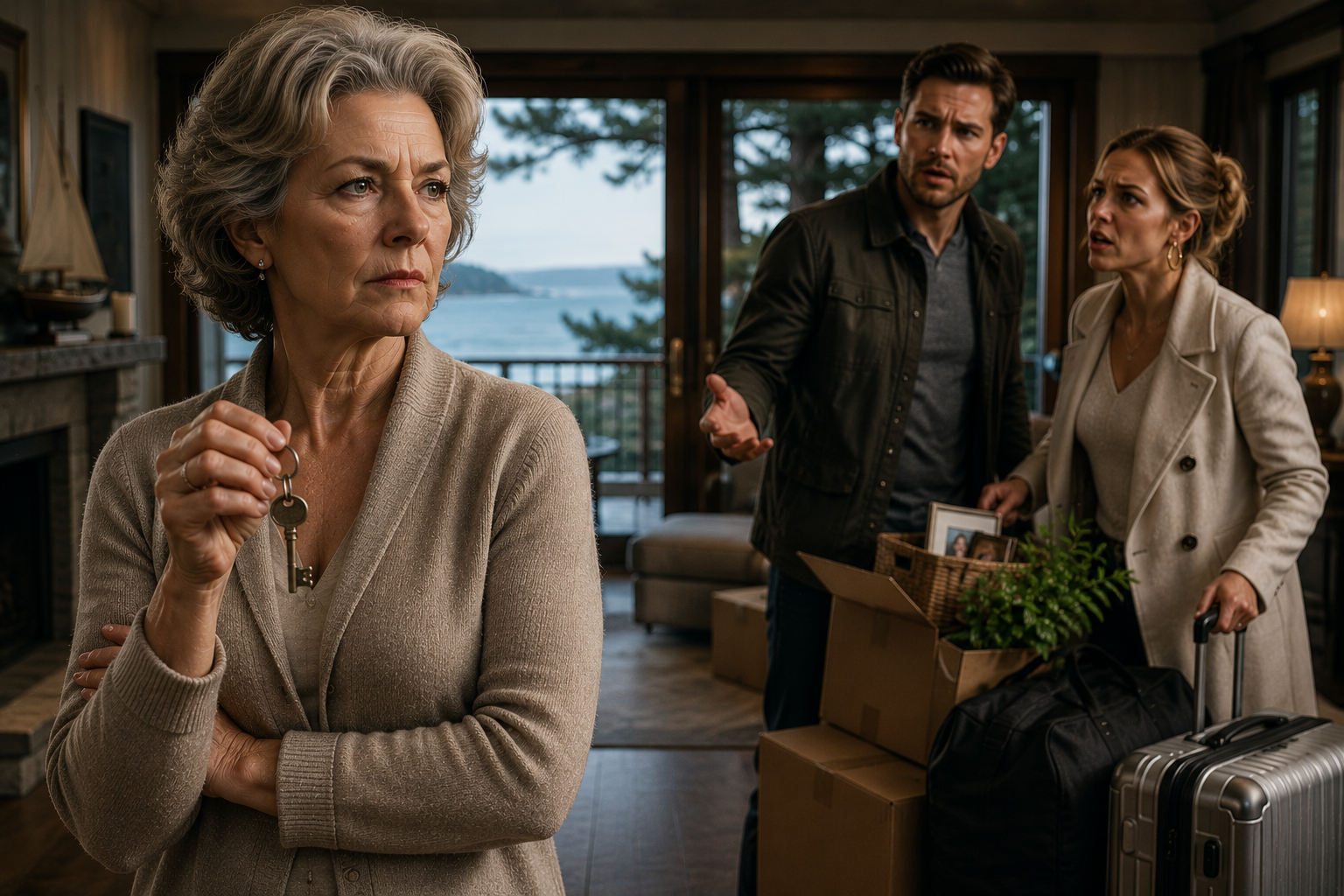
There was no phone call, no warning text. Just the sudden, jarring presence of Henrik and his new wife, Saskia, dragging three oversized suitcases up the path. The woman, Marlene, wiped her hands on her apron and braced herself for what she instinctively knew would be a battle for her very existence.
Henrik’s smile was tight, his eyes avoiding hers as he offered a perfunctory hug. Saskia didn’t bother with pleasantries. Her gaze was already sweeping the property, calculating the square footage of the facade, the value of the large windows, the potential of the wooden balcony.
“It’s bigger than you described,” she said to Henrik, her voice flat and appraising, as if Marlene were not standing right there. Without waiting for an invitation, Saskia marched past Marlene and into the house, her heels clicking with authority on the hardwood floors.
Marlene followed them inside, her heart a steady drum against her ribs. Henrik reached into his jacket and pulled out a key. It was the spare key to her house, the one she had given him years ago for emergencies.
He held it awkwardly, then pressed it into Saskia’s waiting hand. “From now on, she’ll take care of everything,” Henrik announced, his voice strained, as if reciting a rehearsed script. “The shopping, the maintenance, your daily routine.
You’ve worked hard enough, Mom. It’s time for you to rest.”
The words hung in the air, heavy with a presumption that stole Marlene’s breath. She watched as the small brass key disappeared into Saskia’s expensive handbag. There were no tears of betrayal, no outburst of anger.
Instead, a cold, crystalline clarity settled in Marlene’s chest. She smiled, a thin, controlled curve of her lips. “I’ll prepare the guest room for you,” she said, her voice eerily calm, and turned toward the kitchen.
Saskia’s response was immediate and dismissive. “Don’t bother, Marlene. We’ll take the master bedroom upstairs.
The light is better in the morning. You’ll be much more comfortable in the small room downstairs. No more stairs for you to climb.”
Henrik nodded eagerly, as if this were a brilliant medical recommendation rather than a hostile takeover. Marlene walked to the coffee machine, poured herself the last cup of hot coffee into her favorite mug, and said nothing. They had a meticulously crafted plan to seize her home, her savings, her life.
But they did not know that Marlene had a plan of her own.
By afternoon, the familiar silence of Marlene’s home was replaced by the grating sound of furniture being dragged across floors. Saskia wasted no time. From the kitchen island, Marlene watched as her daughter-in-law began boxing up her beloved gardening books and magazines.
“Minimalism brings inner peace, Marlene,” Saskia lectured, not bothering to look up as she dusted the now-bare coffee table. “Too many objects create stress. Henrik told me you’ve been forgetting where you put things lately.”
Marlene set down her coffee cup. “My memory is perfectly fine, Saskia,” she said, walking over and picking up the box with a firm grip. “These stay with me.”
She carried the box toward her sewing room. Saskia let out a theatrical sigh, the kind reserved for a difficult child. “Don’t be difficult, Marlene.
We’re only trying to help.”
That evening, as Marlene prepared dinner, she discovered Saskia had rearranged her kitchen cabinets. The plates were in a different cupboard. Her spices, many of which she had grown herself, were thrown in the trash.
“They were expired,” Saskia declared from the doorway. Marlene said nothing. She found a note taped to the refrigerator: a list of household rules.
Strict quiet hours. A salt-free diet plan. A mandate that the living room television could only be used for documentaries or financial news.
Later, after washing the pans, Marlene walked down the hall. The door to her master bedroom was open. Her good linen sheets had been replaced with dark gray synthetic fabric.
The framed photos of her late husband were face-down on the dresser. Marlene took a deep breath. She would not sleep in that drafty guest room.
She entered the bedroom, gathered her pillows, her photographs, and her small wooden jewelry box, and carried them to the tiny study at the end of the hall. It was small, yes, but it had a solid oak door with a heavy bolt on the inside.
Hours later, Henrik knocked on the study door. “It’s good that you’re adapting so well, Mom,” he said through the wood. “This really is for the best.”
Marlene did not answer. She simply slid the bolt into place. The first phase of their invasion was complete.
Tomorrow, her counter-invasion would begin.
Dinner that night was a power play. Saskia had prepared what she called a “detox salad,” a sad pile of bitter leaves with a flavorless dressing. They sat at Marlene’s dining table, the same table where she and her husband had shared countless bottles of wine and laughter.
Henrik ate in silence, shooting nervous glances at his mother. Saskia chewed with perfect posture, dominating the room. “Marlene,” she began, setting down her fork with elegant precision, “I’ve looked at your utility bills.
You’re spending a fortune for a single person. Also, the gardener is a waste of money. I’ve canceled his service.
Henrik can handle the garden on Sundays.”
Marlene looked at her son. Henrik, who had never held a trowel in his life and hated getting his hands dirty, nodded vigorously. “Yes, Mom.
We need to tighten the belt.” Saskia pulled out a small notebook. “To manage everything properly, I need access to your main bank account.
And that emergency credit card you gave Henrik? I’ll be taking that for our weekly groceries. It’s simply more efficient.”
The audacity hung in the air like a physical weight. This was not a suggestion. It was a command.
They wanted her money, her space, her independence, all wrapped in the deceitful ribbon of familial care. Henrik finally met her eyes. “It’s for your own good, Mom,” he pleaded.
“So you don’t have to stress about the bills anymore. At your age, it’s dangerous to get confused with the numbers.”
Marlene slowly chewed a piece of the bitter lettuce. She nodded. “I understand exactly what you’re saying,” she replied softly.
Saskia smiled triumphantly, tucking her notebook away. “I’m glad you’re being reasonable. So many elderly people become so difficult.”
Marlene finished her meal in silence, washed her plate, and retreated to her small study. She would not argue. She would not waste her energy on screaming matches.
The bank in the nearby town opened at 8 AM. She would be in the parking lot at 7:30. She set her alarm for 5 AM.
The habit of waking before the sun was one she could not break, nor did she want to. At 5 AM, she moved through the dark kitchen with the ease of someone who knew every creak in the floorboards. As she waited for the water to boil, she heard muffled voices from the terrace.
Saskia and Henrik were already awake. Marlene stepped to the slightly open window, hidden in the shadow of the heavy curtains.
“You have to get her to sign the property transfer before Christmas,” Saskia hissed, pacing with her phone pressed to her ear. “Once we renovate the ground floor, we can rent it out to tourists during peak season. That will clear your debts in six months.”
Henrik’s voice was a nervous mumble. “I know, I know. But we can’t push her too hard.”
“It’s her house,” Saskia corrected, her voice turning to ice. “It was her house. Now it’s just dead capital.
She needs to get used to that small room. We’ll handle her meals. What more does she need?
With her credit card, we can cover the renovation costs. The matter will be settled.”
The steam from the coffee machine rose into the air. Marlene stepped silently back from the window. There was no room for horror in her chest, only a sharp, crystalline certainty.
Cold as glass. They had planned this down to the last detail. Henrik had a mountain of debt.
Saskia saw her as a pliable, easily manipulated elderly widow. The perfect victim.
Marlene poured her coffee and sat at the kitchen table. She felt no grief. Motherly love does not mean allowing yourself to be financially abused.
Her husband had left her this house, completely debt-free. The result of thirty years of hard work at the harbor. No one, not even her own flesh and blood, would turn her home into their personal life raft.
She returned to her room, put on her dark blue pantsuit, gathered all her important documents, and slipped out the back door before the couple stirred for breakfast. The morning air was fresh and salty. She started the engine of her old station wagon and drove into town.
She had several very specific errands to run.
The bank branch was empty at this early hour. The branch manager, a kind man she had known for over a decade, saw her immediately. She sat at his glass desk and presented her ID.
“I need to make some immediate changes to my accounts,” she said in a perfectly businesslike tone. In less than fifteen minutes, she revoked Henrik’s power of attorney over her main account. She had the joint credit card, the one he had for emergencies, completely canceled.
Then, she transferred 80% of her savings into a brand new, separate account, one so secure that withdrawals required her personal signature at the branch.
“Is there a fraud issue, Mrs. Petersen?” the manager asked, noting the resolve in her requests.
“Just a small family restructuring,” she replied with a fleeting smile.
Leaving the bank, she crossed the street to the hardware store. She bought a heavy-duty security lock for the garden shed, where the emergency generator and water pump controls were housed. Her last stop was the post office, where she rented a PO box.
From today onward, all her bank statements, bills, and important documents would be sent there, far from Saskia’s prying fingers.
She returned home around noon. She found Saskia in the living room, standing with a measuring tape, calculating the space between the window and the fireplace. “You’re late,” Saskia snapped, not lowering the tape.
“Lunch isn’t ready. I left the ingredients on the counter for you.” Marlene looked at the sad pile of unsalted vegetables on the granite.
“I had a lot to do today,” she replied, walking down the hall toward her room. “The kitchen is all yours, Marlene,” Saskia called out, offended by her lack of subservience. “We agreed that I would handle the administration and you would cook.”
Marlene stopped in the hallway, turned her head, and fixed Saskia with a steady gaze. “You said you would take care of everything from now on, Saskia. That includes your own lunch.”
She closed her study door, leaving Saskia with her measuring tape and her rising frustration. The first move had been made.
The next morning, while Henrik and Saskia walked along the beach to assess the potential of her property, Marlene called a local locksmith she trusted. His van was parked in front of the house before the sun was fully up. She did not ask him to change the front door lock.
That would have caused unnecessary drama, an escalation they would use to paint her as incompetent. Instead, she had him install a solid oak door in the middle of the hallway, separating the west wing of the house, which contained her bedroom, the kitchen, and her study, from the guest room and the entrance area. “An electronic keypad lock, Mrs.
 Petersen?” the craftsman asked, visibly confused. “Exactly.
With a PIN code, please.”
After two hours, the work was done. Her half of the house was now an invisible fortress. They could enter through the front door and go to the master bedroom they had claimed, but they could not reach the kitchen, her study, or her documents without the four-digit code.
Next, she took her car keys from the hall table. Saskia had taken her car the previous evening without asking, returning it with an almost empty tank and sandy floor mats. Marlene went to the garage, opened the hood, and discreetly disconnected the car battery.
A simple, foolproof trick her husband had taught her. She pocketed the keys and went back inside.
At 2 PM, she heard the front door open. Heavy footsteps in the entryway. “Mom?”
Henrik called from the other side of the new hallway door. She heard him rattling the handle. “What’s this?
The door is stuck.” Marlene walked over, opened it from her side, and leaned casually against the doorframe. “Nothing is stuck.
It’s locked.” Saskia appeared behind him, her face dark with fury. “Did you seriously have a new lock installed in this house?
I need to get to the blender for my smoothie. Open it.” “I’m sorry, Saskia,” Marlene replied calmly.
“Since you two are busy redesigning the layout, I decided to clearly define my own area. Access to this wing is now private.” She closed the heavy oak door directly in Saskia’s face.
The electronic lock confirmed the seal with a bright beep.
Marlene settled into her rocking chair by the kitchen window and poured herself an iced tea. In the hallway, confusion quickly turned into hissing complaints. “She’s completely losing her mind,” Saskia whispered furiously.
“Just leave her. I’m going to the supermarket. I need my supplements and real food.
Give me your mother’s card.” Marlene heard Henrik’s footsteps, then the heavy slam of the front door. She smiled slightly.
She spent a wonderfully peaceful afternoon watering her plants and reading a crime novel Saskia had tried to throw in the recycling.
Three hours later, loud knocking shattered the silence. Henrik was pounding on the hallway door. This time, he sounded almost panicked.
“Mom, please open up.” Marlene rose slowly, smoothed her skirt, and opened the door. Henrik was red-faced and sweating.
Saskia stood behind him, arms crossed, with a murderous look. They had no shopping bags. “The cashier at the supermarket declined the card,” Henrik burst out.
“I called the bank. They said my access has been completely blocked. We were humiliated in a huge line.
What did you do?”
“I did exactly what Saskia suggested on the first day,” Marlene replied, leaning against the wall. “I’m letting you handle the finances. That means, from today, all expenses you two incur are entirely your responsibility.
My money is for my retirement, not for your lifestyle.” Saskia stepped forward. “You can’t do this.
Henrik has debts that need to be paid immediately. We’re a family. We should use that credit line to renovate the house.”
Marlene turned to Saskia, silencing her with a single look. There was no point in beating around the bush. “To renovate my house, rent it to tourists, and stave off my son’s bankruptcy.
Yes, I heard your conversation on the terrace yesterday morning very clearly.” Henrik turned pale. Saskia opened her mouth, but no sound came out.
“I am not a real estate project,” Marlene continued, lowering her voice to make the words heavier. “And I am certainly not your ATM.” She pulled the door closed again.
The click of the electronic lock sounded like a gunshot in the dead silent hallway.
The next morning was oppressive. The air in the house seemed to vibrate with tension. With no access to the kitchen, Henrik and Saskia had to walk into town for breakfast, paid for out of their own, apparently shrinking, pockets.
Marlene watched from the window as they trudged down the gravel path to the garage. Minutes later, she heard the futile cranking of her car engine. A choked, dry sound, repeating over and over.
She stepped into the garden with her coffee cup, pretending to inspect the rose bushes. Henrik came tearing around the corner of the house, utterly frustrated, with grease on his hands. “The car won’t start,” he hissed, barely containing his rage.
“Saskia has an extremely important video call at a café in town. We need to get there right now. Where did you put Dad’s toolbox?”
“The tools are locked inside my study,” Marlene answered without looking at him, snipping a withered leaf with her pruning shears. “And the car won’t start because I decided it wouldn’t. You do not have permission to use my vehicles.”
 “Mom, please,” Henrik begged, raising his voice for the first time. “Don’t do this to us. We’re just trying to get on our feet.
Saskia only wants to organize things so we can all have a better life. You can’t just lock yourself in half the house and cut us off.”
Marlene turned to face him. He was her son. She had raised him to the best of her ability.
But somewhere along the way, his soft character had been devoured by greed. “I haven’t taken anything from you that is yours, Henrik. I have simply returned the responsibility for your own life to you.
And as for Saskia, she didn’t come here to organize. She came here to rule. And that will not happen here.”
“We’re married,” he tried to defend himself weakly. “What’s mine is hers.” “That’s perfectly correct,” Marlene nodded firmly.
“But this house is mine. My money is mine. And I make the rules here.
If you’re in such a hurry to get to town, the bus stops at the corner every half hour.”
Henrik stared at her in disbelief. He opened his mouth to argue, but the fighting spirit had already left him. He turned and walked heavily toward the road.
That day, they walked to the bus stop in the blazing sun.
As the sun set, Saskia’s last thread of patience snapped. At 10 PM, Marlene entered her code, unlocked the hallway door, and stepped into the living room. They were sitting on her sofa, surrounded by dirty coffee cups and a mess that was not hers.
They fell silent the moment they saw her. She walked directly to the coffee table and placed two sealed envelopes on the glass surface. “What’s this?”
Henrik asked, picking up the first envelope suspiciously.
“That is the detailed bill for your week here,” Marlene answered in a firm, calm voice. “I have calculated the electricity and water usage, as well as the exact cost of the organic produce Saskia threw in the trash on the first day. 180 euros.
Since you are now managing the finances, I expect you to reimburse me in cash tomorrow.” Saskia ripped the second envelope off the table and tore it open. A stack of color-printed papers fell into her lap.
“The second envelope,” Marlene continued, without moving a muscle, “contains a list of affordable rental apartments in the next town. They don’t require a guarantor. You have until Friday noon to vacate my house.”
“You can’t just throw us out!” Saskia screamed, jumping off the sofa. “Henrik is your son!”
Marlene looked down at her son. He was pale. His gaze was fixed on the floor.
He was completely incapable of defending himself or her. “I’m not throwing you out,” Marlene said, turning to return to her secure hallway. “I’m showing you the exit.
You came here wanting control. Now you have a wonderful opportunity to exercise that control under your own roof.” She closed the door behind her.
The beep of the electronic lock was the only answer to their shouting.
On Thursday morning, the engine of a taxi broke the silence in front of the house. There was no big drama, no screaming. Only the rough, scraping sound of three heavy suitcases being dragged over the gravel path to the road.
Marlene opened the front door to watch the departure. Saskia got into the car with clenched teeth, ignoring her completely. Henrik paused for a second by the hydrangeas.
His shoulders were slumped. “Mom, I’m sorry,” he mumbled. It was an empty apology, born from defeat and discomfort, not from genuine remorse.
Marlene looked him directly in the eye. “Learn to take the reins of your own life, Henrik. When you are ready to be a son and not an opportunist, this door will be open for a visit.
But only for a visit.” He nodded awkwardly, got into the taxi, and closed the door. Marlene watched the car drive down the coastal road until it disappeared entirely.
She closed the front door and let out a deep sigh, releasing all the pent-up tension of the past days.
She went into her bedroom, ripped those terrible gray sheets off the bed, and put her own fresh linen back on. She placed her photos back in their spots, retrieved her gardening books from the box, and brewed herself a strong cup of black coffee. She stepped onto the wooden balcony and sat in her rocking chair.
The house was finally silent again. Below, the waves crashed against the rocks in their eternal rhythm.
At 62, she did not need anyone to manage her life. She had the control. She had the keys.
And no one would ever try to take them from her again. Sometimes we are led to believe that as a family, we must always give in, as if parenthood forces us to surrender the wheel of our own lives for the sake of peace. But she had learned that true peace is not begged for, and it is certainly not negotiated.
Protecting your home, the fruits of your labor, and your peace of mind is not an act of selfishness. It is a matter of pure dignity. You do not have to scream, fight, or seek revenge to draw a line.
Sometimes, the most powerful response is a clear, silent, and unshakable action. Our home and our independence belong to us until our last breath. And in the end, true love also means having the courage to show others where their convenience ends and where our own freedom begins.