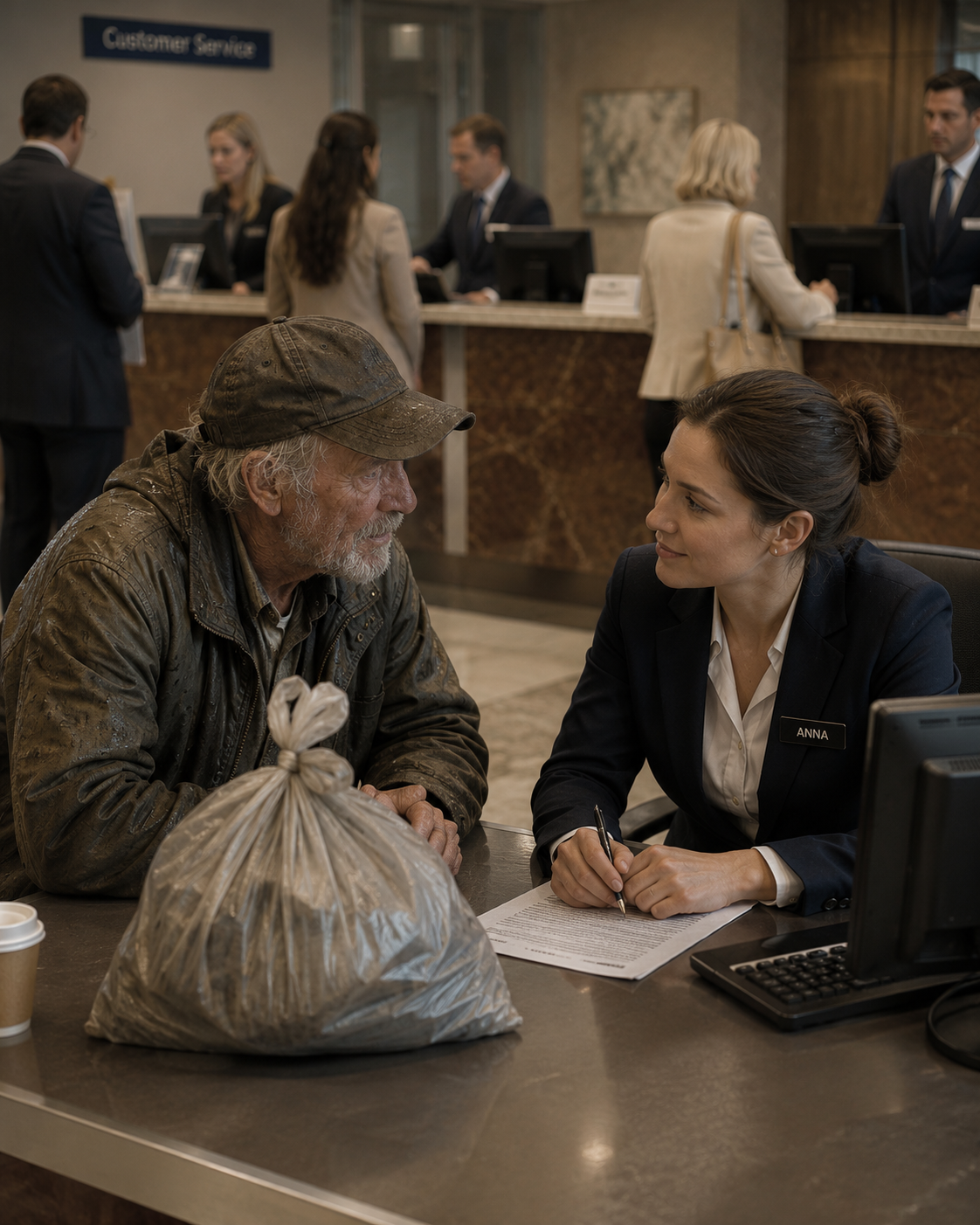
THE OLD MAN WHO WALKED INTO A BANK WITH A WORN PLASTIC BAG
On a rainy Monday morning, an elderly man walked into a large bank in downtown Boston carrying a faded plastic grocery bag.
His coat was old.
His shoes were wet.
Water dripped from the edge of his gray hat onto the polished marble floor.
Several customers glanced at him, then quickly looked away.
A security guard watched him closely as he approached the reception desk.
The old man smiled politely.
“I would like to speak with someone about my account.”
The receptionist looked at the plastic bag in his hand.
“What kind of account?”
“My savings account.”
She pointed toward a row of chairs.
“Please take a seat. Someone will assist you.”
The old man thanked her and sat down.
Ten minutes passed.
Then twenty.
Customers who arrived after him were called first.
A man in an expensive suit was immediately offered coffee.
A woman wearing designer clothes was escorted into a private office.
But the old man remained in the waiting area, holding the plastic bag carefully on his lap.
After nearly forty minutes, he returned to the reception desk.
“Excuse me,” he said. “I have been waiting for quite some time.”
The receptionist did not look up from her screen.
“We are very busy today.”
“I understand. But several people who came after me have already been helped.”
She sighed.
“Sir, small deposits and basic transactions can be handled at the counter.”
“I need to speak with a manager.”
The receptionist finally looked at him.
“The branch manager is not available for minor account questions.”
The old man remained calm.
“This is not a minor question.”
Before she could respond, a young employee named Anna approached.
She had heard the conversation from a nearby desk.
“I can help him,” she said.
The receptionist gave her a doubtful look.
“You have an appointment in fifteen minutes.”
“I have enough time.”
Anna turned toward the old man.
“Please come with me, sir.”
She led him to a small desk near the back of the bank.
Unlike the others, she did not stare at his clothes or the old plastic bag.
She offered him a towel for his wet coat and poured him a cup of hot coffee.
“My name is Anna. How can I help you today?”
The old man smiled.
“My name is Walter Bennett.”
He placed the plastic bag on the desk.
“I would like to review my accounts and possibly move some money.”
Anna opened the banking system.
“May I see your identification?”
Walter handed her an old leather wallet.
She entered his information.
Then she froze.
She checked the screen again.
The account balance was much larger than she expected.
Walter had several personal accounts, investment accounts, and business holdings connected to the bank.
The total amount was more than forty million dollars.
Anna looked up, but her expression did not change.
She did not suddenly become overly friendly.
She simply asked:
“What would you like to review first, Mr. Bennett?”
Walter noticed.
“You saw the balance.”
“Yes, sir.”
“And you are not going to call the manager?”
“I can call the manager if you need something outside my authority. But I am helping you right now.”
A faint smile appeared on Walter’s face.
He opened the plastic bag.
Inside were old folders, handwritten notes, tax documents, and several bank statements.
Anna carefully organized them.
For nearly half an hour, she answered his questions.
She explained the fees on one account.
She found an error in an old statement.
She showed him how his charitable foundation could transfer funds more efficiently.
She never rushed him.
She never spoke to him as if he were confused.
And she never asked why a wealthy man carried important papers in a plastic grocery bag.
Finally, Walter said:
“I am considering moving all my accounts to another bank.”
Anna paused.
“May I ask why?”
Walter looked toward the reception desk.
“I have been a customer here for thirty-two years.”
He nodded toward the employees who had ignored him.
“This morning, I wanted to see how people would treat me if they did not know how much money I had.”
Anna said nothing.
Walter continued:
“When I walked in wearing an old coat, no one saw a loyal client. They saw a poor old man who was wasting their time.”
Anna looked uncomfortable.
“I am sorry that happened.”
“You did not do it.”
“No, but it happened in the place where I work.”
Walter studied her face for a moment.
Then he asked:
“What would you do if this were your bank?”
Anna thought carefully.
“I would remind everyone that respect should come before account balances.”
Walter nodded.
“That is a good answer.”
At that moment, the branch manager walked past Anna’s desk.
He glanced at the computer screen and suddenly stopped.
“Mr. Bennett?”
Walter turned.
The manager’s face immediately changed.
He hurried over and extended both hands.
“Mr. Bennett, I wish someone had told me you were here.”
Walter did not shake his hand.
“I asked to speak with you almost an hour ago.”
The manager looked toward the receptionist.
“There must have been a misunderstanding.”
“No,” Walter said calmly. “There was an assumption.”
The manager pulled up a chair.
“Please come into my office. We can discuss anything you need.”
Walter looked at Anna.
“I am already being helped.”
The manager forced a smile.
“Of course. But given the size of your accounts—”
Walter interrupted him.
“You were not interested in the size of my accounts when you thought I had nothing.”
The room became quiet.
The receptionist lowered her eyes.
Several employees pretended not to listen.
Walter reached into the plastic bag and removed a sealed envelope.
He placed it on the desk.
Inside was a request to transfer nearly all of his money to another financial institution.
The manager’s face went pale.
“Mr. Bennett, please don’t make a decision based on one unfortunate morning.”
Walter looked around the bank.
“One unfortunate morning reveals what happens every ordinary day.”
The manager began apologizing.
He offered reduced fees.
Private banking services.
A personal account manager.
But Walter raised his hand.
“I do not need special treatment.”
He pointed gently toward the waiting area.
“I needed the same respect you give everyone who walks through that door.”
Then he turned to Anna.
“I will leave one account here.”
The manager looked relieved.
Walter continued:
“It will be managed only by her.”
Anna’s eyes widened.
“Sir, I am just a junior employee.”
“Today, you were the most senior person in this building.”
Within a year, Anna was promoted.
Not because Walter demanded it, but because the bank investigated the incident and discovered that many elderly and low-income customers had received similar treatment.
Training policies changed.
Complaints were reviewed.
Employees were reminded that wealth does not always wear a suit.
Walter continued visiting the branch.
He always carried the same worn plastic bag.
Some people assumed it contained groceries.
Others thought it held old newspapers.
Only Anna knew that inside were documents belonging to a man who could have purchased the entire building.
But Walter never cared whether people knew.
He had already learned something more valuable than money:
The quickest way to discover someone’s character is to let them believe you have nothing to offer.
Never judge a person by their clothes, their age, or the bag in their hand.
The person you ignore today may not be poor.
But even if they are, they still deserve your respect.