I found a wallet containing $3,200 in the parking lot behind the restaurant where I worked.
I returned every dollar.
Two weeks later, the owner walked into the restaurant with a police officer and asked to see the security footage from the night we met.
My manager looked at me and said:
“Rachel, you need to come with us.”
At that moment, I was certain I had made the biggest mistake of my life.
My name is Rachel Morgan.
At the time, I was thirty-six years old, recently separated, and working two jobs in Dayton, Ohio.
During the day, I cleaned rooms at a small hotel near the interstate.
At night, I waited tables at a family restaurant called Rosewood Grill.
Neither job paid much, but together they covered most of the bills.
Most.
My twelve-year-old son, Noah, and I lived in a small apartment above an auto-parts store. The building shook whenever delivery trucks stopped outside, and the heating system made a banging sound every morning at five.
But it was clean.
It was safe.
And after leaving my husband, safe was enough.
My husband, Eric, had never hit me.
Sometimes I wished he had, because then leaving would have been easier to explain.
Instead, he controlled everything quietly.
My paycheck went into his account.
He checked every grocery receipt.
If I spent four dollars on coffee, he wanted to know why I hadn’t made it at home.
When I finally left, I had forty-eight dollars, two suitcases, and a son who kept asking whether we were going back.
We weren’t.
But starting over cost more than I expected.
There was the security deposit.
The electricity connection fee.
Noah needed new shoes.
My car needed brakes.
Then, one afternoon, I received a letter from his school.
Noah had been selected for a science program in Washington, D.C.
He had built a small water-filtration system for the school fair, and one of his teachers had nominated him.
The trip cost $780.
The payment was due in three weeks.
“I don’t have to go,” Noah said when he saw my face.
“You want to go.”
He shrugged.
“It’s okay.”
Children shouldn’t become good at pretending disappointment doesn’t hurt.
I taped the payment notice to the refrigerator.
Then I began taking every extra shift I could get.
The night I found the wallet was a Friday.
The restaurant had been crowded from five until almost eleven.
A youth baseball team filled three tables.
A family celebrated a birthday near the window.
One customer sent his steak back twice, then left no tip because the third one had “too much flavor.”
By closing time, my feet were swollen and my lower back ached.
My tips for the entire night came to $86.
It wasn’t enough for Noah’s trip.
But it was something.
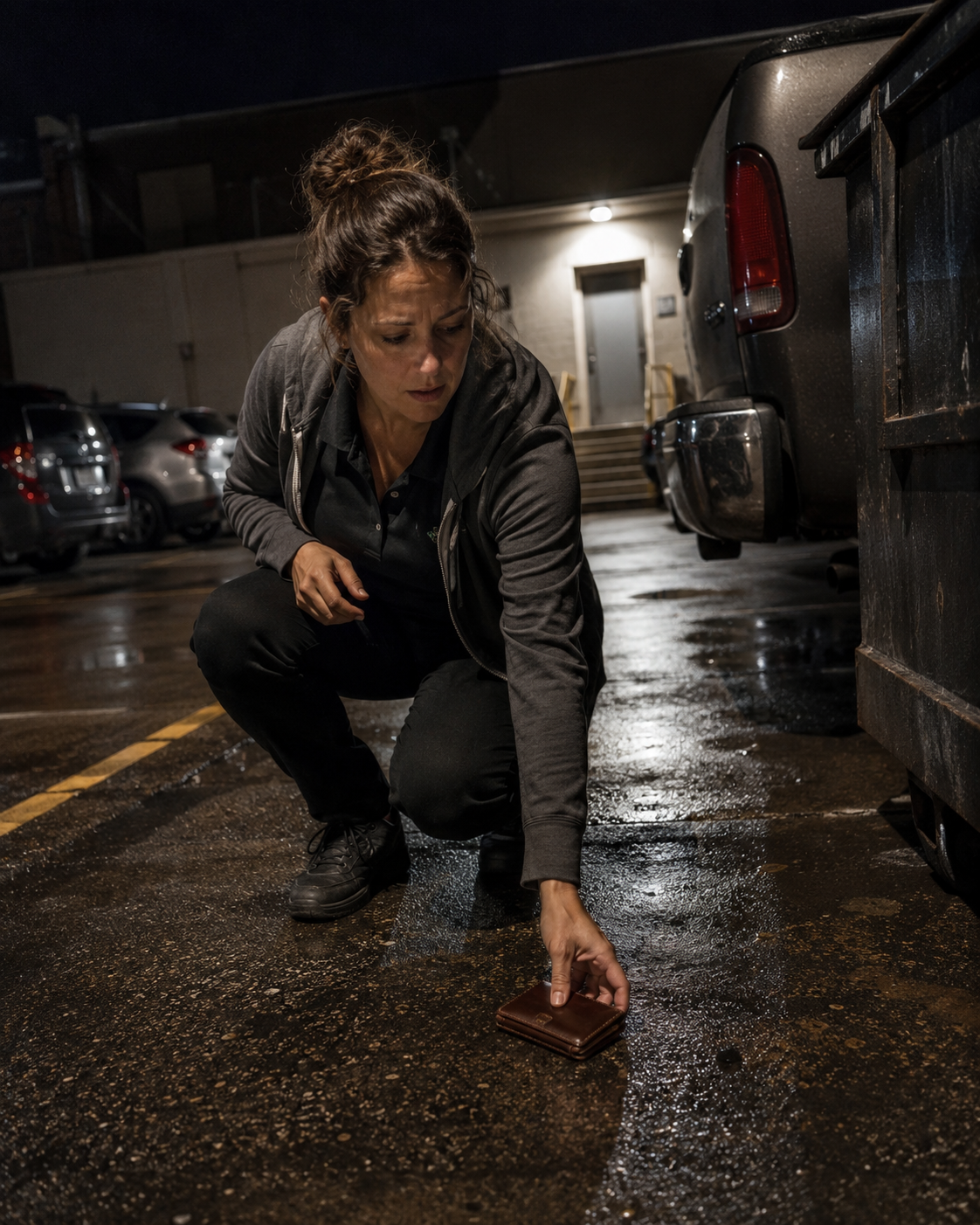
I helped wipe the tables, took two bags of trash outside, and walked toward my car.
That was when I saw the wallet.
It lay beneath a pickup truck parked near the dumpster.
Brown leather.
Thick.
At first, I assumed it belonged to one of the kitchen workers.
I picked it up and opened it, hoping to find an ID.
Instead, I found money.
A lot of it.
Hundred-dollar bills folded behind the credit cards.
I stood beneath the parking-lot light and counted them.
$3,200.
For a few seconds, I simply stared.
That money could pay for Noah’s trip.
It could fix my brakes.
It could cover rent for two months.
No one else was outside.
The parking lot camera above the back door had been broken since winter. My manager had complained about it, but the owner never replaced it.
I could take one bill.
The owner might never notice.
Two bills would still leave $3,000.
I hated myself for thinking about it.
But I did think about it.
When you are poor, temptation doesn’t always arrive as greed.
Sometimes it sounds like your child saying, “I don’t have to go.”
I opened the wallet again.
The driver’s license belonged to a man named Walter Gaines.
He was sixty-eight years old and lived less than four miles away.
Behind the license was a photograph of a young woman in graduation robes.
On the back, someone had written:
For Grandpa. We did it.
I closed the wallet.
Then I went inside and asked my manager, Steve, whether anyone had called about it.
“No,” he said.
When I showed him the money, his eyebrows lifted.
“Lucky night.”
“It isn’t mine.”
Steve looked at the wallet, then at me.
“You could leave it in the office.”
The office door didn’t lock properly.
Half the staff knew that.
“I’ll return it myself.”
He laughed.
“You’re going to a stranger’s house at midnight?”
“I’ll ask a police officer to come with me.”
“Or you could wait until morning.”
I thought about the amount of money inside.
If Walter had lost $3,200, he might already be panicking.
I called the non-emergency police number.
The dispatcher told me an officer could meet me at the address, but it might take thirty minutes.
I agreed.
Walter lived in a modest one-story house with a wheelchair ramp leading to the front porch.
A porch light was on.
A silver-haired man opened the door before I reached it.
“Mr. Gaines?”
“Yes?”
I held up the wallet.
His face changed.
He grabbed the doorframe.
“Where did you find that?”
“Behind Rosewood Grill.”
He opened the wallet immediately and counted the money.
I understood why.
If I had lost that amount, I would have counted it too.
When he finished, he looked up at me.
“All of it is here.”
“Yes.”
The police officer arrived just as Walter invited me inside.
His living room was filled with cardboard boxes.
On the couch were stacks of children’s books, notebooks and art supplies.
Walter explained that his granddaughter, Mia, had recently started teaching at a small elementary school.
The school had almost no budget for classroom supplies.
He had withdrawn money to help her buy what she needed.
“She was embarrassed to ask,” he said. “So I told her I had been saving it for something important.”
He reached into the wallet and removed two hundred-dollar bills.
“Please take this.”
I shook my head.
“I can’t.”
“You returned more than most people would.”
“It wasn’t mine.”
“That doesn’t stop everyone.”
“I don’t want a reward.”
Walter studied me for a moment.
Then he put the money away.
“What is your name?”
“Rachel.”
“And what made you drive all the way here after working a full shift?”
I thought about Noah.
“Because I know what it feels like to lose something you can’t afford to replace.”
He nodded slowly.
Before I left, he shook my hand.
“I won’t forget this.”
The next morning, my car made a grinding noise on the way to the hotel.
The mechanic said the brakes could not wait any longer.
The repair cost $540.
I used the money I had saved for Noah’s trip.
That evening, I removed the notice from the refrigerator.
Noah saw me fold it.
“You used the money for the car, didn’t you?”
“The car gets me to work.”
“It’s fine.”
There it was again.
That quiet little sentence.
It’s fine.
I wanted to tell him it wasn’t.
But promising money you don’t have only teaches a child not to trust promises.
“I’m sorry,” I said.
He looked down at his dinner.
“Maybe next year.”
The program was only for seventh graders.
There would be no next year.
Two weeks passed.
Walter didn’t return to the restaurant.
I didn’t expect him to.
That Friday, I arrived at Rosewood Grill ten minutes early.
Steve was waiting near the hostess stand.
He looked nervous.
“There’s someone here to see you.”
Walter sat in a booth near the front window.
Beside him was a police officer.
My stomach tightened.
I walked toward them.
Walter didn’t smile.
“Rachel,” he said, “we need to ask you something.”
The officer stood.
“Your manager says the restaurant keeps security recordings.”
“Some of them.”
“We need to see the footage from the night you found Mr. Gaines’s wallet.”
I looked at Walter.
“Why?”
He placed the wallet on the table.
“Because someone used one of my credit cards that night.”
The restaurant seemed to go silent around me.
“I didn’t use your card.”
“The charge was made at a gas station two blocks from here,” the officer said.
“I never even took the cards out.”
Steve approached us.
“Rachel, you need to come with us.”
Several customers turned to stare.
My face burned.
I had returned thousands of dollars.
Now I was being accused of stealing a credit card.
“I didn’t do anything.”
Walter looked at me carefully.
“I didn’t say you did.”
“Then why are the police here?”
“Because the card was used twenty minutes before you called.”
I stopped.
“Before?”
The officer nodded.
Walter opened the wallet and pointed to a blue credit card.
“The bank believes someone copied the card information or removed it, used it, then returned it to the wallet.”
“I found it behind a truck.”
“Do you remember which truck?” the officer asked.
“A red pickup. Near the dumpster.”
Steve’s expression changed.
One of the restaurant’s cooks, Travis, drove a red pickup.
He had left work early that night.
The security camera in the parking lot was broken, but the camera above the kitchen exit still worked.
We went into the manager’s office.
Steve pulled up the recording.
At 10:18 p.m., Walter appeared on screen leaving through the side door. He placed his wallet into his jacket pocket.
A few seconds later, he stopped to answer his phone.
The wallet slipped out.
He didn’t notice.
At 10:26, Travis exited carrying a trash bag.
He saw the wallet.
He looked around.
Then he picked it up and disappeared behind the dumpster.
Four minutes later, he came back and dropped the wallet near his truck.
At 10:41, I appeared on the recording.
I picked it up.
The room was silent.
Steve sat back in his chair.
The officer asked for Travis’s address.
Walter looked at me.
“I’m sorry.”
I wanted to say it was fine.
But it wasn’t.
For two weeks, he had suspected me.
Maybe not openly.
But enough to bring a police officer to my workplace.
“You thought I stole from you,” I said.
“I didn’t know what to think.”
“You knew I returned all the cash.”
“I did.”
“And you still thought I took the card.”
Walter lowered his eyes.
“Yes.”
That answer hurt more because it was honest.
I removed my apron.
Steve stepped closer.
“Rachel, where are you going?”
“Home.”
“You’re still scheduled.”
“I just got questioned by the police in front of half the restaurant.”
“We didn’t accuse you.”
“You asked me to come with you like I was being arrested.”
Steve glanced toward the dining room.
“We can discuss this after your shift.”
“No.”
I had spent years allowing men to embarrass me, then tell me when I was allowed to react.
I wasn’t doing it again.
I picked up my bag and left.
Walter came to my apartment the next afternoon.
I almost didn’t open the door.
He stood in the hallway holding an envelope.
“I owe you an apology.”
“You already apologized.”
“Not properly.”
I crossed my arms.
He continued.
“My wife died six years ago. After that, I became suspicious of everyone. Contractors overcharged me. A caregiver stole jewelry from my bedroom. My own nephew borrowed money and disappeared.”
“That wasn’t me.”
“I know.”
“But you still looked at me and saw someone who might steal.”
“Yes.”
There was no excuse in his voice.
Only regret.
He handed me the envelope.
I didn’t take it.
“If that’s money, I don’t want it.”
“It isn’t a reward.”
“What is it?”
“Information.”
Inside was a printed job listing.
An assisted-living center was hiring a dining-room supervisor.
Walter’s sister lived there.
He had spoken to the director about me.
“I’m a waitress,” I said.
“You’ve worked in hotels and restaurants. You manage difficult customers, schedules and money. The job includes health insurance.”
“I walked out of my shift yesterday.”
“Good.”
I stared at him.
He almost smiled.
“My sister says the dining room needs someone who knows when not to tolerate disrespect.”
At the bottom of the listing was the salary.
It was nearly seven dollars more per hour than I made at the restaurant.
“I didn’t finish college.”
“They don’t require a degree.”
“Why are you helping me?”
Walter looked toward the kitchen.
Noah’s science-trip notice was lying on the counter where I had left it.
“Because you gave me the benefit of your character before you knew anything about me.”
He paused.
“I failed to give you the same.”
I applied for the job.
The interview lasted forty minutes.
The director asked what I would do if a resident complained about the food.
I told her I would first determine whether the problem was the meal, the person’s health, or simply loneliness.
She stared at me.
Then she wrote something on her notepad.
I was hired the following Monday.
The job was harder than waiting tables, but it was different.
The residents learned my name.
I learned theirs.
Mrs. Keller wanted tea at exactly three.
Mr. Benton hid dinner rolls in his pockets.
Mrs. Alvarez complained about every meal, then asked for seconds.
The health insurance covered Noah.
The regular schedule meant I was home most evenings.
And the first paycheck included a hiring bonus.
It was $800.
One day before the deadline, I paid for Noah’s Washington trip.
When I gave him the receipt, he looked at it twice.
“Is this real?”
“It’s real.”
He threw his arms around me.
For the first time in months, I felt as if we were moving forward instead of simply avoiding disaster.
Walter visited the assisted-living center every Sunday.
At first, our conversations were awkward.
Then they became easier.
He never again offered me money.
Instead, he showed up at Noah’s school fundraiser.
He helped repair the broken shelf in our apartment.
On Noah’s birthday, he gave him a small tool kit and taught him how to change a tire.
Months later, Walter’s granddaughter Mia invited Noah to speak to her class about his water-filtration project.
The classroom supplies purchased with the returned money filled nearly every shelf.
Colored pencils.
Books.
Science kits.
Folders.
On the wall was a handwritten sign:
Honesty is doing the right thing when no one is watching.
I stood beneath it for a long time.
The truth was, I had thought about taking some of Walter’s money.
For several seconds beneath that parking-lot light, I had wanted to.
Being honest didn’t mean I had never been tempted.
It meant I chose what kind of person I wanted to be while no one was there to praise me.
Walter eventually learned that too.
Trust was not believing no one would disappoint you.
It was knowing when someone deserved the chance not to.
People sometimes say returning that wallet changed my life.
Maybe it did.
But not because there was money inside.
It changed my life because, for one difficult moment, I refused to let desperation make a decision for me.
Two weeks later, Walter nearly allowed fear to make his decision for him.
We both made mistakes.
The difference was that we were given the chance to correct them.
And sometimes, that is how an ordinary life changes.
Not through a miracle.
Not through a wealthy stranger handing someone a fortune.
But through one honest choice, one sincere apology, and one door opening just before you are ready to believe every door has closed.