The story of Colleen Stan is a harrowing tale of survival and resilience. Known as “The Girl in the Box,” Stan endured a horrific seven-year captivity at the hands of her kidnappers, Cameron and Janice Hooker, before finally escaping in 1984.

Her ordeal stands as one of the most 𝓈𝒽𝓸𝒸𝓀𝒾𝓃𝑔 cases of prolonged captivity in modern history.
On May 19, 1977, 20-year-old Colleen Stan was hitchhiking from her home in Eugene, Oregon, to a friend’s birthday party in Northern California.
She was an experienced hitchhiker and felt confident in her ability to judge character. When Cameron and Janice Hooker, a seemingly normal couple with a baby, offered her a ride, she accepted, believing she was safe.
However, shortly after she got into their van, Cameron Hooker pulled off the highway, threatening Stan with a knife and placing a homemade wooden box over her head, effectively blindfolding and silencing her.
They took her to their home in Red Bluff, California, where she was subjected to unimaginable torture and psychological manipulation.
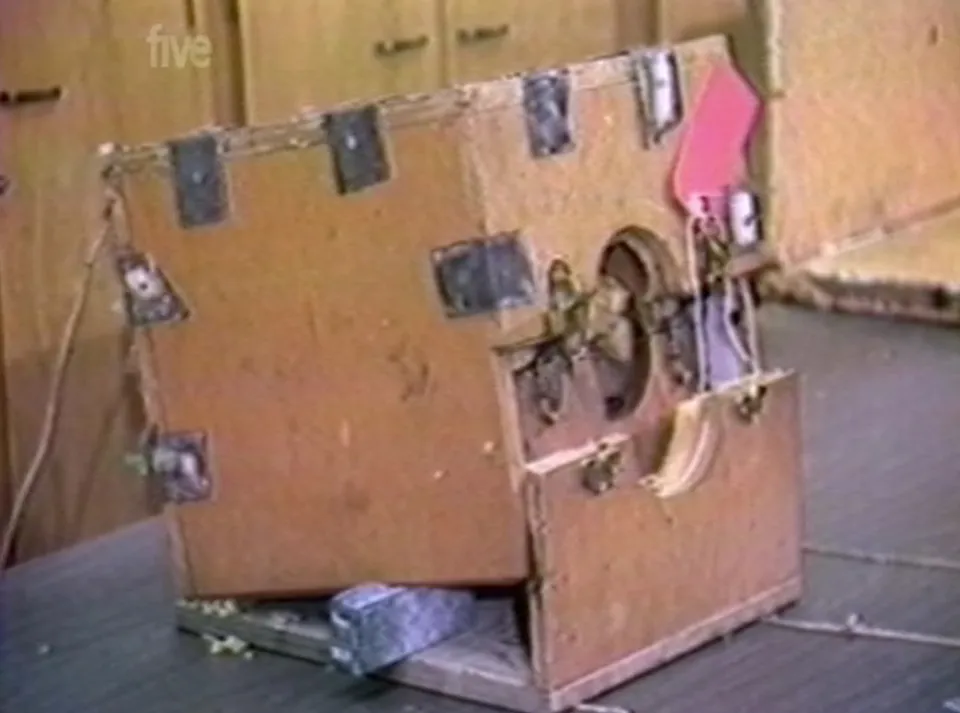 The box Colleen Stan was for forced to wear on her head by Cameron Hooker.
Cameron Hooker, a sadistic and controlling man, kept Stan in a coffin-like box underneath the couple’s bed for up to 23 hours a day.
The box was soundproof and designed to restrict movement, isolating her from the outside world and breaking her spirit.
Hooker manipulated Stan into believing he was part of a powerful and dangerous organization called “The Company” that would 𝓀𝒾𝓁𝓁 her and her family if she tried to escape.
For the first few months, Stan was regularly tortured, raped, and brainwashed. Cameron Hooker forced her to sign a “slavery contract” and renamed her “K,” further stripping her of her identity and autonomy.
Hooker’s wife, Janice, played a complex role in the captivity. She was both a participant in and a victim of her husband’s abusive behavior, initially agreeing to the kidnapping as a means to control his sadistic urges.
As the years went by, Stan’s life of terror continued. However, she was occasionally allowed some freedoms, such as visiting her family under the strict condition she would not reveal her true situation.
Remarkably, despite the presence of her captors, Stan adhered to these conditions due to the deep psychological control Hooker had over her.
The turning point in Stan’s captivity came in 1984, when Janice Hooker, struggling with her own sense of guilt and fear, confessed to Stan that “The Company” was a fabrication.

This revelation shattered the psychological chains that had kept Stan from escaping. With Janice’s help, Stan finally fled the Hooker household on August 10, 1984.
She contacted her family, and Janice went to the police, leading to Cameron Hooker’s arrest.
The trial of Cameron Hooker in 1985 brought the harrowing details of Stan’s ordeal to light. Janice testified against her husband in exchange for immunity.
Cameron Hooker was convicted of multiple charges, including kidnapping, rape, and sexual assault. He was sentenced to 104 years in prison.
Colleen Stan’s resilience and bravery in the face of unimaginable horror have been widely recognized. After her escape, she sought to rebuild her life, advocating for victims of 𝓪𝓫𝓾𝓼𝓮 and captivity.

Her story has been recounted in books, documentaries, and interviews, serving as a powerful testament to human endurance and the capacity to overcome even the darkest of circumstances.
Today, Colleen Stan is a symbol of survival and strength. Her experience underscores the importance of vigilance and support for victims of 𝓪𝓫𝓾𝓼𝓮, highlighting the psychological complexities involved in prolonged captivity.
The legacy of her ordeal continues to resonate, reminding us of the profound impact of trauma and the incredible resilience of the human spirit.