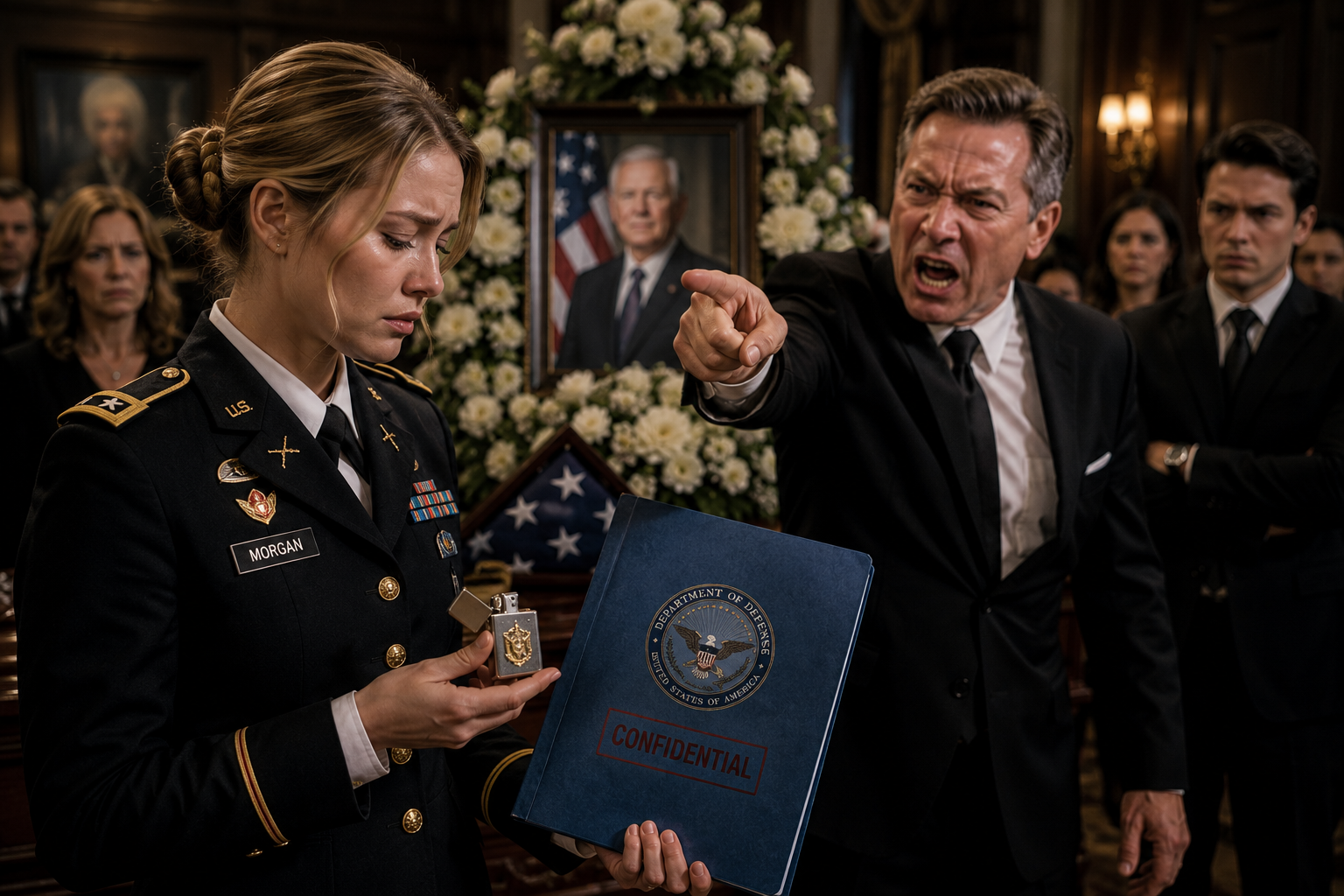
The first thing my father said to me at my grandfather’s funeral was, “Still pretending the Army needs another doctor?”
He did not whisper it.
Arthur Vance never whispered when humiliation could be useful. He said it in the reception room of the Army Navy Country Club, loud enough for retired generals, lobbyists, and defense contractors to hear. My grandfather, General Marcus Vance, had been buried less than an hour earlier.
I stood before him in my dress uniform, gloves tucked under one arm, rain drying on my shoulders.
“Hello, Dad,” I said.
He looked over my ribbons and medical corps insignia with the same smile I remembered from childhood.
“The family doctor finally came home,” he said. “Should we all line up for aspirin?”
One contractor chuckled. My younger brother, Julian, laughed openly, as he always did when Dad gave him permission.
Julian lifted his whiskey. “Clari, I didn’t know they let Army doctors leave base for family events.”
“They do for funerals,” I said.
His smile twitched.
Small victories are small, but I had learned not to waste them.
The room looked like every Vance family performance: expensive grief, polished glass, defense money, and people networking beneath chandeliers. My stepmother, Victoria, floated past with appetizers and refused to look at me.
I told myself to leave.
I had come for my grandfather, not for Arthur, Julian, Victoria, or the family machine that turned grief into influence.
Then the room changed.
Conversations softened. Men adjusted jackets. A senator near the bar straightened. Power had entered the room, and everyone who chased it felt the charge.
I turned.
Harrison Reed, Deputy Assistant Secretary of Defense, stood at the entrance with three federal security agents behind him.
My father saw him too.
For the first time all afternoon, Arthur Vance stopped stopped smiling.
Reed scanned the room, passed over my father, my brother, and the contractors, then stopped on me.
He walked straight toward me.
Not toward my father.
Toward me.
When he reached me, he gave a formal salute.
My body returned it before my mind caught up.
“Colonel Vance,” he said. “It’s an honor to see you again.”
Behind me, Julian’s glass froze halfway to his mouth.
Reed lowered his voice, but not enough.
“The men from Kandahar still ask about you.”
The room forgot how to breathe.
My father looked at my uniform again, differently this time, as if the fabric had changed while he was not watching.
Reed shook my hand.
“I came to pay respects to your grandfather,” he said. “He spoke of you near the end.”
That hurt more than any insult, because my grandfather and I had barely spoken in years.
Two minutes later, my father found me near the hallway.
“How do you know Harrison Reed?”
I looked at him, and for once, I did not feel sixteen.
“You meet certain people,” I said, “on the worst day of somebody’s life.”
Then I walked outside into the cold.
I had barely reached the wet stone steps when Reed appeared behind me carrying two paper cups of coffee. He handed me one, then opened his other hand.
In his palm lay my grandfather’s old silver lighter.
“He wanted you to have this,” Reed said.
My fingers went cold before I touched it.
Taped to the bottom was a folded strip of paper with my name on it.
And I understood the funeral had not ended.
It had just begun.
Part 2: The Lighter and the Warning
The lighter was heavier than I remembered.
My grandfather used to flip it open and shut when thinking. Click, pause, click. That sound lived deep in my childhood, beside leather chairs, old books, black coffee, and my father’s voice telling me to stop asking questions at dinner.
“Did he give this to you personally?” I asked.
Reed watched the parking lot.
“Two weeks before he died. He made me promise to put it in your hand, not your father’s.”
My name was written on the folded paper in my grandfather’s handwriting.
Clarissa.
“Why didn’t he mail it?”
“Because he trusted the mail less than people,” Reed said. “And he trusted people very little.”
That sounded like him.
Through the glass, I saw my father speaking too calmly beside Julian. Victoria sat stiffly on a cream sofa, twisting her wedding ring.
My family had always looked best from a distance.
From outside, we were legacy, politics, contracts, charity boards, and Georgetown dinners. Inside, everything had rules.
Do not embarrass the family.
Do not question your father in public.
Do not cry where guests can see.
Do not choose a life that cannot be turned into influence
I learned those rules before cursive.
When I was twelve, a senator asked what I wanted to be. I said surgeon. My father smiled and pressed a hand to my shoulder.
“She means health policy,” he said. “She’s very bright.”
I decided under that chandelier that one day I would become something he could not translate for his friends.
Years later, when I accepted an Army medical scholarship, my father looked at me like I had tracked mud across a white carpet.
“We have connections at Johns Hopkins,” he said.
“I don’t want easy.”
That was the wrong thing to say in Arthur Vance’s house.
My trust access disappeared a week later. He called it a lesson in adult choices.
I called it the beginning of my real life.
Medical school was fluorescent lights, frozen dinners, panic, debt, and exhaustion. Residency was worse. The Army was worse than that.
But it was mine.
I became good because people needed me to be good. Steady hands. Clear orders. No drama in the trauma bay. No flinching when helicopters landed at two in the morning.
Reed’s voice pulled me back.
“Open the note somewhere private,” he said.
“Is this about my grandfather?”
His eyes shifted.
“Yes. And no.”
Before leaving, he looked back at me.
“Your grandfather made mistakes. Near the end, he tried to correct one.”
Then he left me in the cold with the lighter in my hand.
I peeled the paper loose enough to see the first line.
Do not let Arthur touch the blue folder.
My pulse slowed.
Because fear in a hospital runs fast, but real danger often arrives quietly wearing your father’s name.
And I had no idea what blue folder my grandfather meant.
Part 3: The Blue Folder
I stepped back into the warmth of the country club, my dress uniform coat heavy on my shoulders. I slipped the lighter into my breast pocket, right behind my ribbons.
My father was waiting near the grand staircase, a fresh glass of bourbon in his hand. Julian stood beside him, trying to look imposing, but his eyes darted nervously toward the front doors where Deputy Assistant Secretary Reed’s security detail had vanished into the rain.
“Clarissa,” my father called out, his voice smooth and commanding. “Come here for a second.”
I walked over slowly, keeping my expression entirely neutral.
“I didn’t realize you were on a first-name basis with Harrison Reed,” Arthur said, taking a slow sip of his drink. “When did you treat him?”
“Two years ago,” I replied. “Field hospital outside Kandahar. A shrapnel wound from an improvised explosive device. I did the vascular repair on his leg.”
Julian blinked, swallowing hard. “You… you operated on a Deputy Assistant Secretary?”
“He was a lieutenant colonel at the time,” I said evenly. “On my table, everyone wears the same blood.”
My father’s jaw tightened slightly at my refusal to play into his social ladder, but he brushed it off with a dismissive wave. “Well, it’s fortunate. He’s heading the new defense logistics procurement board. Your brother’s firm is pitching a major contract to them next week.” He leaned in closer, his voice dropping into that familiar, suffocating intimacy he used when he wanted something. “I want you to call Reed tomorrow. Arrange a private dinner for us.”
I looked at Arthur Vance—the man who had cut my trust fund, mocked my uniform, and ignored my existence for a decade, now expecting me to leverage my military service to line my brother’s pockets.
“No,” I said.
Julian’s face flushed. “Clarissa, don’t be a stubborn idiot! This contract is worth forty million dollars!”
“I don’t trade my patients for contract referrals, Julian,” I said. “And the Secretary doesn’t either.”
Arthur set his glass down on a nearby mahogany table with a sharp, heavy click. “You’re still as foolish as you were at eighteen. You think that uniform makes you righteous? You’re standing in a building paid for by defense money, eating food paid for by your grandfather’s legacy.”
“Speaking of Grandfather’s legacy,” I said quietly, watching his eyes, “he left me something before he died.”
Arthur’s posture went rigid. The polished composure he had maintained all afternoon cracked for a fraction of a second. “What did he leave you?”
“His lighter.”
Julian let out a sharp laugh. “A lighter? The old silver one? That’s it?”
But Arthur didn’t laugh. His eyes narrowed, searching my face with cold, calculating intensity. “Did he leave anything else, Clarissa? Any… documents? Books?”
“He left me a memory of how he lived,” I lied smoothly. “Why? Were you expecting something else?”
“No,” my father said, though his hand twitched against his trousers. “Of course not. But your grandfather was confused near the end. Unstable. If he… gave you any papers or folders before he passed, they belong to the estate’s legal team. Do not open them.”
Do not let Arthur touch the blue folder.
The warning in my pocket felt like a burning ember against my ribs.
“I should get back to my base,” I said, offering a crisp, professional nod. “Good evening, Dad. Julian.”
I turned and walked toward the exit, ignoring my brother’s muttered curses and my father’s silence. As I pushed open the heavy glass doors into the cold rain, I knew Arthur wasn’t going to let this rest. The funeral was over, but the war for my grandfather’s final secret had just begun.
Part 4: The Vault
That night, I sat in the small, sterile study of my quarters at Fort Meade.
The silver lighter sat on the desk beneath the bright desk lamp. I used a pair of medical tweezers to carefully unfold the thin strip of paper taped beneath the base.
Beneath the warning line, my grandfather had written a set of coordinates, a key number, and a single instruction:
Fairfax Safe Deposit & Trust. Box #408. Use the lighter to open the bottom plate.
I picked up the lighter, turning it over in my hands. I slid my thumb along the worn silver casing, feeling for a seam. Near the bottom hinge, a tiny, concealed pinhole clicked when pressed with the tip of a scalpel blade. The bottom plate slid open, revealing a small, brass-cut safety deposit key hidden inside the hollow fuel chamber.
At 09:00 the following morning, I walked into the secure basement of the Fairfax Safe Deposit vault wearing my operational utilities.
The vault officer verified my military ID and my grandfather’s notarized trust authorization. He led me down a long, quiet corridor lined with polished steel boxes, unlocked the outer mechanism of Box #408, and stepped back to give me privacy.
I inserted the brass key, turned it, and pulled out the heavy metal drawer.
Inside lay a single, thick, navy-blue expansion folder.
I opened it on the viewing table.
Inside were hundreds of pages of financial audits, shipping manifests, and classified procurement logs spanning fifteen years. At the top of the pile was a handwritten letter from General Marcus Vance, dated three weeks before his death.
Clarissa,
If you are reading this, I am dead, and Harrison Reed fulfilled his final duty to me. I spent forty years serving this nation, but in my final decade, I turned a blind eye to my own house.
Your father and brother did not build their wealth on business acumen. They built it on systematic procurement fraud. For six years, Vance Defense Logistics has been falsifying safety certifications on medical supplies, surgical kits, and field trauma gear delivered to deployed units overseas. They charged the military top-dollar for combat-grade equipment while shipping cheap, sub-standard gray-market substitutes.
I discovered the paper trail two months ago. When I confronted Arthur, he told me I was too old to understand modern business. He threatened to have me committed if I went to the Inspector General.
I was a coward for twenty years, Clarissa. I let your father dictate this family. I let him drive you away because you were the only one with the courage to break his rules. You became a surgeon to save lives; I am asking you now to save the soldiers who are carrying defective gear into combat because of my son’s greed.
Do what I should have done a long time ago. Finish it.
My breath caught in my chest.
I flipped through the pages. The evidence was staggering. Invoice after invoice, signed by Julian Vance and approved by Arthur Vance, showing sub-standard tourniquets, compromised sterile dressings, and defective field anesthesia machines shipped directly to combat hospitals in Afghanistan and Iraq—the very trauma bays where I had worked.
My father hadn’t just built a fortune on defense money. He had built it by risking the lives of the soldiers I had spent ten years stitching back together.
Part 5: The Final Briefing
Two days later, an emergency executive briefing was convened in a private, soundproof conference room at the Pentagon.
At the head of the long oak table sat Harrison Reed, flanked by four senior officials from the Defense Criminal Investigative Service (DCIS) and two federal prosecutors from the Department of Justice.
I stood at the end of the table in my full dress uniform, my hands resting flat on the mahogany surface, the blue folder lying open before them.
“The audit is complete, Mr. Secretary,” I stated, my voice echoing with absolute military precision. “Every document in this folder has been cross-referenced with combat hospital procurement logs from 2018 to the present. The defect rate on the trauma kits supplied by Vance Defense Logistics is thirty-four percent.”
One of the DoJ prosecutors scanned a stack of certified shipping receipts. “This isn’t just civil fraud or breach of contract. This is criminal conspiracy, reckless endangerment, and major fraud against the United States government.”
Reed looked up at me, his face grim. “Colonel Vance… if we execute these warrants, it will destroy your family’s firm. Your father and brother are looking at twenty to thirty years in federal prison. Your family name will be ruined.”
I looked at the Secretary, then down at my grandfather’s silver lighter resting beside the blue folder.
“My family name was ruined the moment my father put a price tag on a soldier’s life,” I said. “Issue the warrants.”
Final
Three days later, a fleet of black federal SUVs pulled up to the gated entrance of the Vance estate in Georgetown.
It was 11:00 a.m. on a bright, clear Thursday. Arthur Vance was hosting a private luncheon on the marble terrace for twelve high-ranking defense executives and lobbyists—the very group he had tried to impress at my grandfather’s funeral.
Julian was standing near the outdoor bar, pouring champagne, when four armed DCIS agents and six federal marshals stepped through the French doors onto the patio.
“Arthur Vance? Julian Vance?” the lead federal agent announced, pulling a heavy warrant from his jacket. “We have warrants for your arrest issued by the United States District Court for the Eastern District of Virginia.”
The patio exploded into shocked murmurs. Guests dropped their glasses; lobbyists backed away as if my father were radioactive.
Arthur’s face turned gray. He tried to maintain his aristocratic composure, holding up a trembling hand. “This is an outrageous mistake! Do you know who I am? Call my attorney immediately!”
“Your attorney is already being interviewed at his office, sir,” the agent replied coldly. “Turn around and put your hands behind your back.”
Julian panicked, dropping his glass and taking a step toward the lawn, but two marshals intercepted him instantly, forcing his arms behind his back and snapping steel handcuffs around his wrists.
“Dad! Do something!” Julian shrieked, his voice cracking into a desperate, pathetic whine. “Dad, tell them!”
As the agents led my father and brother down the front driveway in handcuffs, a dark green military sedan idled at the curb.
I stepped out of the rear seat, wearing my dress uniform, my posture straight, my chin held high.
Arthur stopped dead in his tracks on the cobblestone walkway, staring at me through bloodshot, terrified eyes. The arrogance that had defined his life for sixty years was completely gone, replaced by the hollow, broken realization of a man who had lost everything.
“You…” Arthur whispered, his voice trembling with bitter, helpless rage. “You did this… you destroyed your own brother… your own father…”
I walked up to him, stopping just outside the property line. I looked him dead in the eye—no longer the intimidated sixteen-year-old girl, no longer the daughter seeking his approval, but an officer of the United States Army who had answered a higher call.
“I didn’t destroy you, Dad,” I said, my voice steady, cold, and quiet as mountain ice. “You built a house out of lies and defected gear. I just let the truth inside.”
Julian sobbed as he was loaded into the rear of the first SUV. My father was guided into the second, his eyes fixed on the pavement, unable to meet my gaze as the doors slammed shut.
Six months later, Vance Defense Logistics was liquidated by federal court order, its stolen profits seized and redirected into a permanent medical trust fund for injured veterans. Arthur and Julian Vance both entered guilty pleas to federal fraud and conspiracy, receiving fifteen-year and eight-year prison sentences respectively.
On a warm autumn morning, I stood beside my grandfather’s grave at Arlington National Cemetery.
The rain had cleared, leaving bright golden sunlight filtering through the oak trees. I pulled the silver lighter from my pocket, flipped the top open, and let the flame burn bright for a brief, quiet moment against the breeze.
Click. Pause. Click.
I closed the lid, set the lighter gently against the top of his marble headstone, and raised a crisp, flawless salute to the General.
I had broken my father’s rules. I had destroyed his legacy. But as I walked back toward my car, feeling the quiet strength in my stride, I knew I had finally honored the only thing that truly mattered:
I had saved lives.