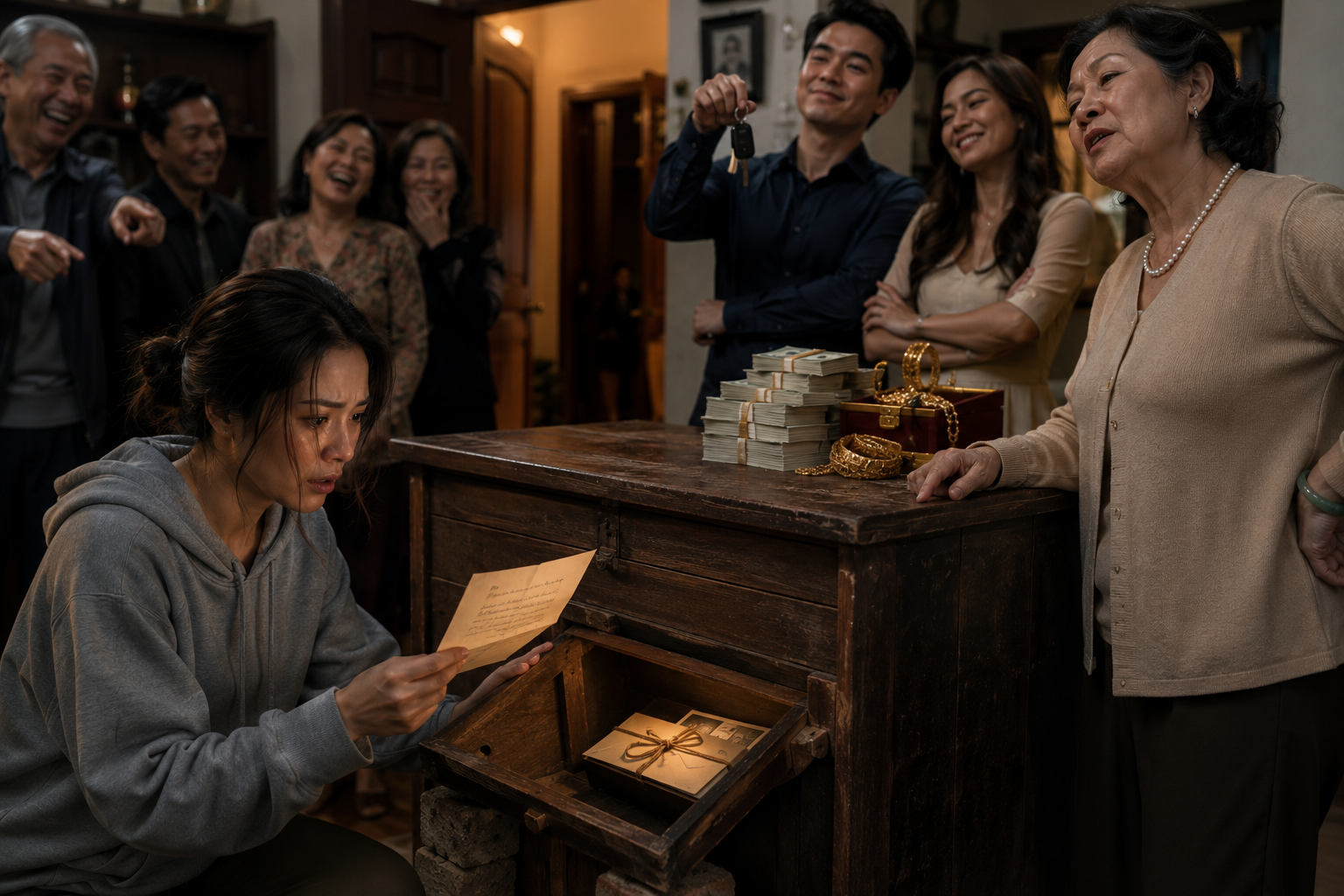
My father had been gone exactly forty days.
Before that, he spent seventy-three days in the regional hospital. During those seventy-three days, I called my brother, Brandon, more times than I could count. He always claimed he was buried under some massive project at his corporate job. I called my sister, Ashley, as well, but she insisted every single time that she could not find anyone to watch her kids.
Not once did either of them stay with him overnight.
I did.
I slept in that cold hospital hallway for seventy-three nights, my back pressed against the wall, my jacket folded under my head, listening through the door just to make sure he was still breathing.
Near the end, Dad could no longer speak. He only held my hand tightly and kept looking toward the door.
I knew who he was hoping to see.
They never came.
When he passed away, my mother called Brandon first. He did not ask what time the funeral would be, nor did he say he was coming right away. His very first question was about who was going to cover the funeral costs.
Ashley did not contribute a single dollar to the arrangements.
I paid for the casket, the memorial service, the food, and the burial plot entirely from my own personal savings. It came to $4,500, which swallowed almost everything I had put away.
I wrote every expense down in a small black notebook.
I did not write it down because I planned to demand repayment from them. I wrote it down because I knew that someday they would act like it never happened at all.
When the family gathered to divide Dad’s estate, that was exactly what they did.
No one mentioned the funeral bill.
No one mentioned the exhausting hospital nights.
No one mentioned who had actually stayed by his side.
My mother sat in the center of the living room with a heavy metal lockbox resting on the coffee table. Inside were the deed to the family home in the suburbs of Columbus, the title to Dad’s Ford Expedition, two bank passbooks, and my grandmother’s thick gold bracelets.
Brandon sat on one side with his wife, Jessica.
Ashley sat on the other side, leaning comfortably beside her husband, Greg.
I sat near the edge of the room, occupying the exact spot where I had always seemed to belong in that family.
My mother unlocked the metal box and began distributing the items.
“Your brother has the biggest mortgage burden right now,” she said calmly. “So the house should naturally go to Brandon.”
Just like that, the house was gone.
It was a three-bedroom home with a large living room, a sprawling backyard, and a two-car garage that my father had worked decades to pay off.
Brandon did not even pretend to hesitate or offer a polite gesture.
“That makes the most practical sense,” Brandon said, nodding smoothly.
Then my mother pulled out the SUV title and pushed it across the table toward Ashley.
“You need more space for the children when you drive around town,” she said.
“Thank you so much, Mom,” Ashley said, smiling quickly and trying to hide her delight.
After that came the passbooks containing the liquid savings.
Fifteen hundred dollars went to Brandon.
Twenty-five hundred dollars went to Ashley.
Then my mother placed the gold bracelets directly into Ashley’s hands, as if family memories only belonged to certain favorites.
I stayed completely quiet throughout the whole process.
I sat there and watched more than $350,000 worth of family assets get passed around the room while my name was not spoken once. It was not forgotten by accident, nor left out of guilt, nor even mentioned as a simple courtesy.
Finally, my mother turned her head toward my corner of the room.
“Well,” she said, pointing toward the far wall, “that is what is left.”
In the corner stood my father’s old wooden wardrobe.
It was painted a deep cherry red, though most of the paint had peeled away over the long years. One front leg was broken, and an old landscaping brick had been shoved underneath to keep the whole thing from leaning sideways.
Jessica let out a soft laugh under her breath.
“That thing probably isn’t even worth using as firewood,” Jessica whispered loudly.
“It would completely ruin the decor in my place,” Ashley said, wrinkling her nose.
My mother gave me the exact same look she had used my entire life whenever she expected me to accept less and call it gratitude.
“You’re the youngest,” she said quietly. “Don’t be greedy about this.”
Greedy was a word that almost made me laugh out loud.
Growing up, Brandon was always called the man of the house whenever Dad was away. Ashley was treated like a princess who could do no wrong. I was always the one expected to understand, to adjust, to give in, and to need less than everyone else.
My parents paid for Brandon’s expensive tutors back in high school. They bought Ashley’s formal dresses and helped fund every party she ever wanted to throw. I studied with worn secondhand books, worked my way through state college, and once went deep into credit card debt just to help Brandon with a down payment for his first apartment.
Eight years later, Brandon had not paid back a single cent of that money.
Whenever I brought up fairness in the past, my mother would always shake her head.
“In a family, we don’t keep score,” she used to tell me.
But on that day, sitting in that room, I finally did.
A full house went to Brandon.
An SUV, bank savings, and gold went to Ashley.
For me, there was only a broken wardrobe held up by a brick.
I stood up slowly and walked across the room toward the corner.
My fingers brushed over the peeling red paint, and something tightened in my chest. I would have recognized that wardrobe anywhere because it had stood in that corner for as long as I could remember.
That was where my father kept his old flannel shirts, his garage tools, stacks of old newspapers, and small boxes of items no one else cared about. It held the forgotten pieces of a quiet man’s life.
I bent down and pulled the landscaping brick from beneath the base.
The wardrobe groaned loudly and tilted sideways toward the floor.
My uncle, Uncle Raymond, who had been sitting silently near the back, suddenly frowned as he watched me.
Jessica laughed again from her spot on the couch.
Ashley did not even bother looking up from her phone screen.
My mother stared straight at me as I held the brick in my hand.
For one quick second, I could have sworn her expression completely changed. It was not anger or mild annoyance that crossed her face. It was a sudden, creeping nervousness.
That was the exact moment I realized something important.
There was something specific about that wardrobe that she did not want me to notice.
I straightened my back and looked around the quiet room.
“Fine,” I said calmly. “I will take this.”
No one offered to help me move the heavy piece of furniture. Brandon kept sipping his coffee without looking up, and Ashley kept scrolling on her phone.
My mother stood out on the front porch with her arms crossed tightly while Uncle Raymond and I dragged the heavy wardrobe out toward the rented moving truck. The whole time, she watched my every move like she was waiting for me to change my mind.
I did not change my mind.
Sometimes the item everyone laughs at is the only thing truly worth taking.
Sometimes the smallest inheritance is the one that exposes the biggest secret.
PART 2
Uncle Raymond and I lugged the furniture out toward the back of the truck.
It felt surprisingly heavy for an old piece of wooden furniture. An empty wardrobe with loose doors, a broken leg, and years of rot should not feel like it was loaded with cement.
Uncle Raymond grunted loudly as we settled it onto moving blankets.
“Does this thing have concrete blocks hidden inside it?” Uncle Raymond muttered, wiping sweat from his forehead with his forearm.
“I really don’t know,” I replied, staring back up at the house.
My mother was still standing on the porch, gripping the wooden railing with white knuckles. She did not look sad or exhausted like a widow who had just finished dividing her husband’s life. She had an ugly, creeping nervousness on her face.
“If you don’t want that trash later, just dump it out by the alley,” Jessica called out from the living room doorway. “Just don’t try to bring it back here.”
Ashley let out a quiet, mocking laugh from behind her. Brandon did not even bother to lift his head from his mug.
I slammed the tailgate shut without saying a single word.
Uncle Raymond climbed into the passenger seat beside me. For several minutes on the road, he did not ask a single question. He just stared out the window at the passing suburban streets, looking like he was debating whether to speak.
As we merged onto the main highway, he finally turned his head toward me.
“Your father thought a lot of that wardrobe,” Uncle Raymond said softly.
“Yeah, he really did,” I answered.
“He never let anyone move it around,” Uncle Raymond added.
I gripped the steering wheel tighter as the memory returned to me.
“I remember now,” I said, feeling a strange chill.
When I was a child, I once tried to take out a hammer he kept inside it, and he gave my hand a light swat.
“Don’t go grabbing things from this piece of furniture without telling me first,” my dad had scolded me back then.
I had felt hurt and walked away at the time. But later that night, he had come into my bedroom with a sweet pastry wrapped in a paper towel. It was his subtle way of apologizing when he did not know how to use words.
He had ruffled my hair and said something I did not fully grasp as a kid.
“There are things you keep not because they are worth a lot of money, but because you don’t want the wrong hands touching them,” my dad had explained.
At the time, I thought he was talking about his garage tools. Now, with the wardrobe thudding in the back of the truck every time we hit a bump, I started to suspect something else entirely.
We arrived at my apartment complex around dusk. I lived in a rented ground-floor unit on the south side of town with two modest rooms and a cramped kitchen.
Uncle Raymond helped me unload the wardrobe, and we shoved it against the wall in the spare room. When we finally let go, the old wood creaked deeply as if settling into its new space.
Uncle Raymond stood staring at it for a long moment.
“Your mother definitely did not want you to take that,” Uncle Raymond said.
“You noticed that too?” I asked, turning to him.
“I knew that woman before you were even born,” Uncle Raymond said with a heavy sigh. “When she is scared of something, she pinches her lips on the left side. Today, she was practically biting right through them.”
His words left a bitter taste in my mouth. Uncle Raymond reached out and patted my shoulder warmly.
“Don’t go picking a fight with them right now,” Uncle Raymond advised. “First, check out what you actually brought home. I don’t think your father was the kind of man to leave loose ends where he knew there were vultures.”
He left shortly after, leaving me completely alone with the wardrobe.
I stood up and opened the left door. Inside hung two crooked wire hangers and a small bag of old mothballs.
The right door was much stiffer. I yanked it twice until the frame gave way with a loud creak.
Inside were small wooden drawers where he kept nails, store receipts, a tape measure, and old pocketknives. I took them out one by one, finding nothing extraordinary until I reached the very bottom drawer.
It caught halfway out and refused to slide further.
I reached inside and felt the back panel, noticing it felt much shallower than the others. I knelt down, switched on my phone’s flashlight, and spotted a thin seam hidden in the wood.
I pulled the entire drawer off its tracks. Hidden behind it was a narrow compartment.
I reached inside and pulled out three distinct items: a thick yellowish envelope, a small brass key wrapped in black tape, and a thin black ledger notebook with frayed edges.
The envelope did not say it was for the family. It clearly read: For Eric.
I sat down hard on the floor. Seeing my father’s thick handwriting with my real name hit me harder than the entire inheritance meeting.
I opened the envelope and pulled out a single sheet of paper.
“If you are reading this, it is because I am gone. I am not leaving you this furniture out of pity. I am leaving it to you because you are the only one who knows how to tell the difference between something old and something useless. Out of the three of you, you were the only one who stayed when nobody wanted to smell the hospital anymore. In the black notebook are things your mother does not fully know and that your siblings have conveniently forgotten. It is so you don’t let yourself be pushed aside with a twisted story.”
I opened the black notebook right away. The pages were filled with dates, exact dollar amounts, and specific names.
Loan to Brandon for house down payment: $10,000. (Repaid: $0)
Graduation expenses for Ashley: $3,500.
Money taken from shop cash for Ashley’s SUV tires: $800.
Payment for Brandon’s lawyer after traffic violation: $1,200.
Eric paid for the new home refrigerator: $600. (He didn’t want it noted. I am noting it.)
It was all recorded right there. My dad had kept an exact record of everything to make sure the truth remained preserved.
I found a page marked with blue tape containing another instruction: If you get this far, read the envelope at the bottom.
I reached back into the hidden compartment and pulled out a second, thicker envelope. Inside was a certified copy of a legal document and a larger key. It was a signed statement regarding the parcel of land behind the main house.
Behind my parents’ house was a long strip of land that everyone called the back lot. Real estate developers were currently buying up land in that exact area for commercial expansion.
In the document, my dad explicitly stated that the back lot had been purchased separately with his own personal injury settlement. He explicitly willed that specific land to me to balance out the unfair financial burdens I had carried for the family.
It made it completely clear that the back lot belonged to me, even if Brandon had been given the main house.
Inside was one final note from my dad:
“Don’t fight for affection where they only talk about convenience. But don’t walk away empty-handed just to avoid making noise.”
At seven o’clock the next morning, my phone rang loudly. It was Ashley.
“Hey, if you haven’t taken your junk out of that wardrobe yet, you should bring it back,” Ashley said without greeting me. “Mom says she made a mistake and left some old insurance papers inside it.”
“Oh, really?” I asked, leaning against the wall.
“Yeah, she says you don’t even want that eyesore anyway,” Ashley replied quickly. “Brandon can come pick it up in his truck later today.”
“Tell Mom the wardrobe is already inside my apartment,” I said firmly.
There was a long silence on the line.
“And what about the papers inside?” Ashley asked, her voice dropping its easy tone. “Don’t be difficult about this, Eric.”
“I will look through everything very carefully,” I told her quietly. “We can talk later.”
I hung up the phone before she could argue.
By noon, I had nine missed calls from my mother and a sharp text message from Brandon: Don’t start drama over an old piece of furniture. If you found documents, we handle it as a family.
At four in the afternoon, I took the documents to see Mr. Gable, a retired lawyer who was a long-time friend of my father.
He read through the papers slowly on his porch while drinking coffee.
“Your father was very thorough,” Mr. Gable said, looking at me over his glasses.
“Does the document hold up legally?” I asked.
“It holds up enough to stop any potential sale of that entire property,” Mr. Gable explained. “If your mother is sweating over this, she knows exactly what you are holding.”
I drove back to my apartment complex as the sun was setting.
Brandon was standing right by my front door with his arms crossed tightly over his chest.
“You took your sweet time answering calls,” Brandon snapped as I approached.
“I live here, Brandon,” I replied, taking out my keys. “You don’t need to stand there like a debt collector.”
“Mom is extremely upset right now,” Brandon said, stepping closer.
“I would be upset too if I gave away land that wasn’t mine to give,” I said calmly.
His eyes shifted nervously. He clearly knew about the lot.
“What exactly did you find in that wardrobe?” Brandon demanded, his jaw tightening.
“It’s funny how fast we went from calling it firewood to asking what I found,” I said, staring him dead in the eye.
“Look, Eric,” Brandon said sharply. “If there are legal papers, we settle it as a family. No digging up history.”
“It isn’t family harmony when the support only flows in one direction, Brandon,” I replied firmly.
We stood in absolute silence, sizing each other up in the dim light. The old dynamic where my older brother could easily intimidate me was completely dead.
I inserted my key into the lock without inviting him inside.
Before I shut the door, I glanced toward the parking lot. My mother was stepping out of Brandon’s parked SUV, clutching her purse tightly against her chest with a pale, nervous face.
She was not coming to make peace. She was coming to demand the papers back.
Taking that old red wardrobe was not the conclusion of our family’s inheritance dispute; it was only the beginning of the fight to come.
THE END.