The FBI has officially taken over the investigation into the death of 19-year-old Nolan Wells, plunging the case into a maelstrom of controversy after two separate autopsies failed to explain the deep red subcutaneous markings on the back of his head and revealed that critical structures—including his throat and neck organs—are missing from the body sent for independent examination.

Good evening. This is a developing story that has exploded into a national firestorm after the family’s independent pathologist, Dr. Roger Mitchell, a former chief medical examiner for Washington, D.
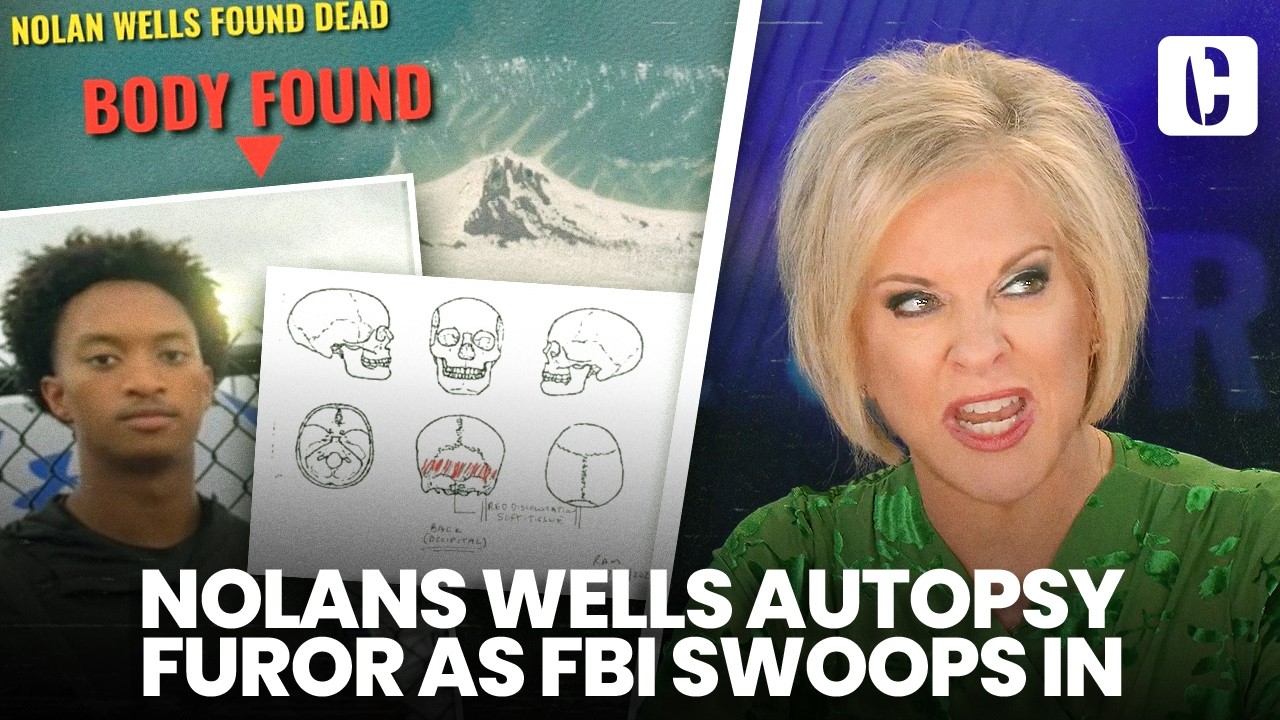 C. , released a bombshell report indicating that the anterior internal neck structures—the trachea, laryngeal cartilage, thyroid horn, and hyoid bone—were not received with Nolan Wells’s body when it arrived for the second autopsy. The absence of these tissues, which are essential for determining whether strangulation or throttling occurred, has ignited fury among the family and their legal team, led by civil rights attorney Ben Crump.
According to the transcript of Nancy Grace’s “Crime Stories” program, the second autopsy also found a focal area of red discoloration in the soft tissue of the back of the head, the occipital region, described as twelve by eight centimeters in size. The cause of this mark remains unknown. The first autopsy, conducted by the Mississippi State Medical Examiner’s Office, had initially labeled the death as a drowning with no foul play suspected, but the family has vigorously contested that conclusion.
The family of Nolan Wells, speaking through their attorney and directly to the public, have expressed devastation and confusion. In the transcript, Wells’s mother is heard saying, “The only question we have is what happened to our son. We have been consistently degraded by the public.
Questioned about our parenting, our GoFundMe, called a racist. I am a health care provider. I love everyone.
It’s been difficult, but we are leaning into our faith.”
The family’s attorney, Ben Crump, is known for representing families in high-profile cases involving potential civil rights violations. In the show, Crump is quoted saying, “If this were your child, wouldn’t you want to know what happened? He goes out with friends.
They all come back. He’s dead. I don’t understand the hate directed toward Nolan’s family.
At this hour, I don’t think anyone is guilty, but there is a conflict in the stories, and we are not stopping until we know what happened to Nolan Wells.”
The FBI’s involvement marks a significant escalation. Local law enforcement in Jackson County, Mississippi, initially said no foul play was suspected, but now the district attorney’s office is handling all information, and the FBI has swooped in. According to the transcript, the sheriff’s office confirmed that the FBI is working with them on the case, and the district attorney is overseeing the investigation.
This typically indicates either a resource issue in a small jurisdiction or a potential federal civil rights angle, as the family has raised concerns about the initial handling of the case.
The circumstances of Nolan’s death are deeply troubling. He was last seen alive on July 4th during a group outing to Horn Island, a remote barrier island in the Gulf of Mexico off the Mississippi coast. According to testimony from acquaintances like Warren Hudson, who spoke on the Officer Tatum Show, the group involved twenty to thirty people spread across three boats.
Nolan’s friends left the island without him, reportedly believing he had gone with another boat.
Wells’s body was discovered early Monday morning, July 7th, face down on the beach at the water’s edge. Aerial video obtained by the United Cajun Navy shows the body lying prone. Brian Trasher, vice president of the United Cajun Navy, told Nancy Grace in the transcript, “He was face down on the beach right at the water’s edge.
As we flew over the island, he appeared face down, almost as if asleep, with one leg slightly out to the side.”
The cause of death remains officially undetermined. The second autopsy report notes significant decomposition, which limited the pathologist’s ability to assess certain marks. However, the presence of that well-defined red mark on the back of the head has led to intense speculation.
 Death investigator Joe Scott Morgan, a professor of forensics at Jacksonville State University who has investigated over 10,000 death scenes, explained on the show that while decomposition is typically diffuse—spreading randomly—the mark drawn by the pathologist on an anatomical diagram shows distinct borders, almost a rectangular shape. This suggests a pattern, not simple postmortem blood pooling.
Morgan pointed out that if Nolan was found face down, gravity would have caused blood to pool in the front of his body, not the back. “The mark on the back of the head, with margins, does not look like lividity or decomposition,” Morgan stated. “It looks like direct pressure was applied to that area.”
The missing neck structures are the most explosive element. Morgan explained that the state Medical Examiner’s Office in Mississippi retained the neck organs and tissue samples. This is highly unusual.
“They don’t just arbitrarily hold things like this,” Morgan said. “This is something that would commonly go with the body when released. I deduce they have seen something there of evidentiary value.
They are preserving the neck structures for a reason. The hyoid bone is delicate and is generally only traumatized by direct pressure from manual strangulation or a throttling event.”
The absence of the neck in the second autopsy means the independent pathologist could not examine the hyoid, strap muscles, or laryngeal cartilage for fractures or hemorrhages that would indicate strangulation. Dr. Mitchell, the independent pathologist, also noted that he did not receive the lungs intact.
Although he did take tissue samples for histology, the lungs had already been dissected in Mississippi, and he had to work with what remained.
The family has been frustrated by conflicting stories from witnesses. Nolan’s mother used Life360 to track his phone, which led her to the home of a friend who had been on the island. The phone was on the boat, but the friends initially did not know where Nolan was.
When the mother asked, they retrieved the phone from a truck after a fifteen-minute delay. This has raised questions about what, if anything, was being done to the phone during that time.
Caitlyn Becker, senior national correspondent for the New York Post, noted in the transcript that the friends said they left Nolan with a girl named Katie, but Katie reportedly said Nolan left with his friends. This contradiction, along with the fact that no one among twenty to thirty people checked on Nolan before his mother’s call, has fueled suspicion.
The family’s legal team has declined an offer from the United Cajun Navy to use cadaver dogs to search the boat that authorities suspect Nolan may have been on. Brian Trasher revealed on the show that he offered top canine teams to inspect the boat for any trace of decomposition, but the family’s attorney declined. Trasher speculated that if the boat had been cleaned with a specific chemical, the dogs could still detect residual scent.
The refusal has led to renewed online speculation.
The FBI’s decision to take over the investigation suggests a major expansion of the probe. Josh Coal, a veteran criminal defense attorney and former assistant U. S.
attorney, explained that the FBI typically enters cases either because resource constraints require federal assistance or because there may be a civil rights component. Given that the family has hired Ben Crump, who often handles civil rights and police brutality cases, the federal civil rights angle is plausible.
 Cellular data and forensic phone analysis will be critical. Investigators will need to acquire all phones of the friends who were on the island. Digital forensic examiner Dave Mack explained on the show that even if a phone has been tampered with, deleted data can be recovered if the forensic acquisition is done quickly.
Activity timestamps can show who accessed the phone, when, and whether attempts were made to delete data.
The timeline is crucial. Nolan Wells left for Horn Island around midday on July 4th. The last known sighting was around 4:30 p.
m. His body was found Monday morning at about 8 a. m.
The gap from 4:30 p. m. to Monday morning remains a black hole, according to Brian Trasher.
No witnesses have come forward with clear accounts of what happened during that period.
The deep red mark on the back of the head remains unexplained by marine life. Morgan dismissed the theory that crabs or fish caused the mark, noting that if marine animals had fed on the body, there would be evidence of chewing and irregular damage, not a defined rectangular mark. The mark appears more consistent with pressure against a flat surface, possibly while Nolan was still alive or immediately after death.
The investigation is now being directed by the district attorney’s office. The Jackson County sheriff’s department referred all questions to the DA. The grand jury process will likely be used to determine whether charges should be filed.
The family has demanded transparency, but law enforcement has said little.
Attendees at the island gathering are believed to be primarily young people aged 18 to 25. Some were drinking alcohol, but there is no indication of drugs. The weather on July 4th was typical summer conditions with calm seas.
Nolan was described as an athletic young man and a strong swimmer, making a simple drowning unlikely in the minds of his parents and many observers.
The family has faced an onslaught of online criticism, including accusations of racism and mismanagement of GoFundMe funds. Nolan’s mother, a family nurse practitioner, addressed those attacks in the transcript: “I am a health care provider. I take my job very seriously.
I love everyone. It’s been difficult, but we are leaning into our faith.”
But behind the scenes, the forensic evidence is mounting. The second autopsy report, which is publicly available, says that the body was received in a bag, already dissected, with multiple organs removed. The pathologist notes that the absence of the anterior neck structures precluded full assessment of potential trauma to the neck.
 He also states that the deep red discoloration on the occiput is “of unknown etiology” pending further investigation.
Dr. Bethany Marshall, a psychoanalyst commenting on the case, highlighted behavioral evidence that she believes investigators should prioritize: “In a forensic interview, the number one thing we look for is empathy for the victim. Are the kids communicating like, ‘Oh my god, where did he go?
He was my best friend. I can’t sleep.’ That would indicate innocence.
Lack of empathy, attempts to form a cohesive story, rationalization—that’s what we see in guilt.”
The friends have reportedly been interviewed, but their accounts remain contradictory. Some say Nolan wanted to stay on the island, others say he was left behind accidentally. The phone activity will help establish whether any digital evidence of a cover-up exists.
The involvement of the FBI also raises the possibility of a hate crime investigation, though no evidence of racially motivated violence has emerged publicly. Ben Crump’s presence often amplifies the civil rights angle, but in this case, the focus remains on the physical evidence.
Nancy Grace, during her show, summed up the situation: “I don’t know if it was a lynching, but I know I need to see the neck. The main things I want to see are the lungs and the neck, and they’re both missing. I have a problem.”
The case has gripped public attention, with online communities demanding justice and answers. The family’s GoFundMe has raised hundreds of thousands of dollars to fund the independent autopsy and private investigation.
The next steps are uncertain. The district attorney will likely present evidence to a grand jury within weeks. The FBI will continue to coordinate with local authorities.
The family is expected to hold another press conference soon, accompanied by Ben Crump.
For now, the question remains: what happened to Nolan Wells? Was it a tragic accident, or something far darker? The missing throat and the red mark on his head suggest that investigators have only begun to scratch the surface.
This is a breaking story. We will continue to follow it closely. If you have any information, please contact the Jackson County Sheriff’s Office at 228-769-3063.
As Nancy Grace said tonight, “If this were your child, wouldn’t you want to know what happened? I would.”
Tonight, we also remember an American hero, Sergeant Jeremy Brown of the Clark County Sheriff’s Office in Washington, who was shot and killed in the line of duty, leaving behind his wife Jill and five children. We honor his service.
This article is published as part of ongoing coverage. Stay with us for updates as they break.


