
Michael Jackson lived with titles almost no artist could imagine.
The King of Pop.
The greatest entertainer of his generation.
The man behind Thriller, the Moonwalk and some of the most recognizable music videos ever made.
He broke records, sold hundreds of millions of albums and changed the language of popular culture. But when Michael spoke about the future he wanted most, it was not another hit song, another world tour or another award that seemed to matter most.
It was something far quieter.
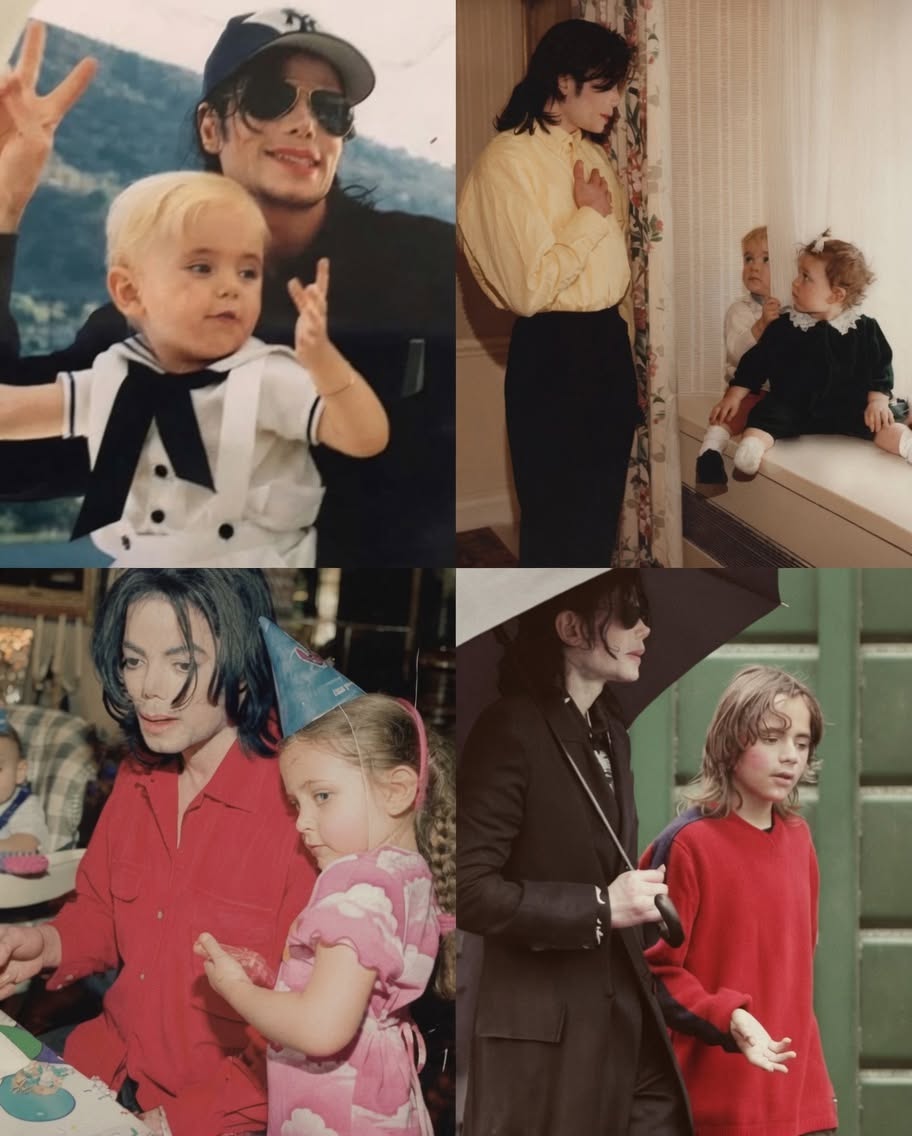
He wanted his children to grow up and remember him as a good father.
In a 2001 speech at Oxford University, Jackson spoke movingly about his children, Prince and Paris, and said he hoped they would remember how he always wanted them with him and how he tried to put them before everything else. In that same speech, he reflected on his own childhood, saying that while music gave him joy, he had wanted more than anything to be a typical little boy — to build tree houses, have water balloon fights and play hide-and-seek with friends.
That contrast explains so much about the way Michael Jackson approached fatherhood.
The world gained a superstar when he was still a child. But the little boy behind that superstar lost many ordinary things that most children take for granted. He spent his youth rehearsing, recording, traveling and performing. While other children were playing outside, Michael was becoming a professional entertainer under pressure that would have overwhelmed many adults.
Years later, when he spoke about those memories, there was often a sadness beneath the words. It was not that he rejected his gift. It was that the gift had come with a cost.
That may be why becoming a father mattered so deeply to him.
For Jackson, fatherhood was not simply a new chapter. It seemed to be a chance to protect something he felt he had lost in himself: childhood.
Away from the stage, home footage and family accounts often showed a very different Michael from the one the public debated endlessly. In personal videos, he appeared playful, soft-spoken and deeply focused on creating moments of wonder for his children. The 2003 television special Michael Jackson’s Private Home Movies offered fans a rare look into his personal world through footage from his own collection, including family scenes and behind-the-scenes moments far removed from the spectacle of the stage.
That private image mattered because the public version of Michael Jackson was often too large to feel human.
He was followed by cameras, studied by tabloids and judged through headlines. His appearance, his choices, his friendships and his parenting were all turned into public debate. But inside his own home, he wanted to be something much simpler to Prince, Paris and Bigi: present.
A father who played.
A father who listened.
A father who tried to create magic where pressure might otherwise have entered.
Neverland itself was often discussed as a symbol of Jackson’s complicated relationship with childhood. The California estate included amusement rides, a zoo, a movie theater and spaces designed around fantasy and play. Entertainment Weekly recently described the property as a 2,700-acre estate in Los Olivos that became both Jackson’s residence and a private amusement park, reflecting how central imagination was to the world he built around himself.
For critics, Neverland became a subject of controversy. For fans, it represented Jackson’s longing for innocence. For his children, it was part of the environment their father tried to create — a place where childhood could feel protected, magical and separate from the machinery of fame.
Of course, Michael Jackson’s life was never simple. His legacy remains one of the most discussed and contested in modern entertainment. But when people speak about him as a father, the conversation often becomes more intimate and less abstract.
Prince, Paris and Bigi were still children when Jackson died on June 25, 2009. His death shocked the world, but for them it was not the loss of an icon. It was the loss of their dad.
That truth became impossible to ignore at his public memorial service on July 7, 2009, at the Staples Center in Los Angeles. Before millions watching around the world, Paris Jackson stepped to the microphone, surrounded by family, and delivered one of the most emotional moments of the day. Through tears, she said that ever since she was born, her father had been the best father anyone could imagine.
The words lasted only a few seconds.
But they changed the atmosphere of the entire memorial.
For days, the world had been discussing Michael Jackson as a cultural figure: the records, the scandals, the debt, the comeback concerts that would never happen, the questions surrounding his death. Paris’ voice cut through all of that. In one sentence, she reminded everyone that behind the global spectacle was a family grieving in real time.
To fans who remembered Jackson’s Oxford speech, the moment felt almost unbearably poignant.
He had once hoped his children would remember that he tried to put them first.
After he was gone, his daughter stood before the world and said exactly what he had longed to hear.
The tragedy was that he was not there to hear it himself.
That is why the story of Michael Jackson as a father still moves so many people. It is not separate from the story of Michael Jackson the artist. It is tied to it. The same lost childhood that shaped his music, his imagination and his obsession with wonder also shaped the way he tried to raise his children.
He knew what fame could take.
He knew what pressure could do.
He knew what it felt like to be watched too early and too intensely.
So he tried, in whatever ways he could, to give Prince, Paris and Bigi something softer than what he had known.
History will always remember Michael Jackson through many titles. Some will call him a genius. Some will call him a mystery. Some will remember the controversies, while others will remember only the music. His life will continue to be argued over because few artists have ever occupied such a complicated place in public memory.
But to his children, the most important title was never King of Pop.
It was Dad.
And judging by the words Paris Jackson spoke through tears in 2009, that may have been the title Michael Jackson valued most — and the one he earned in the place where it mattered most.