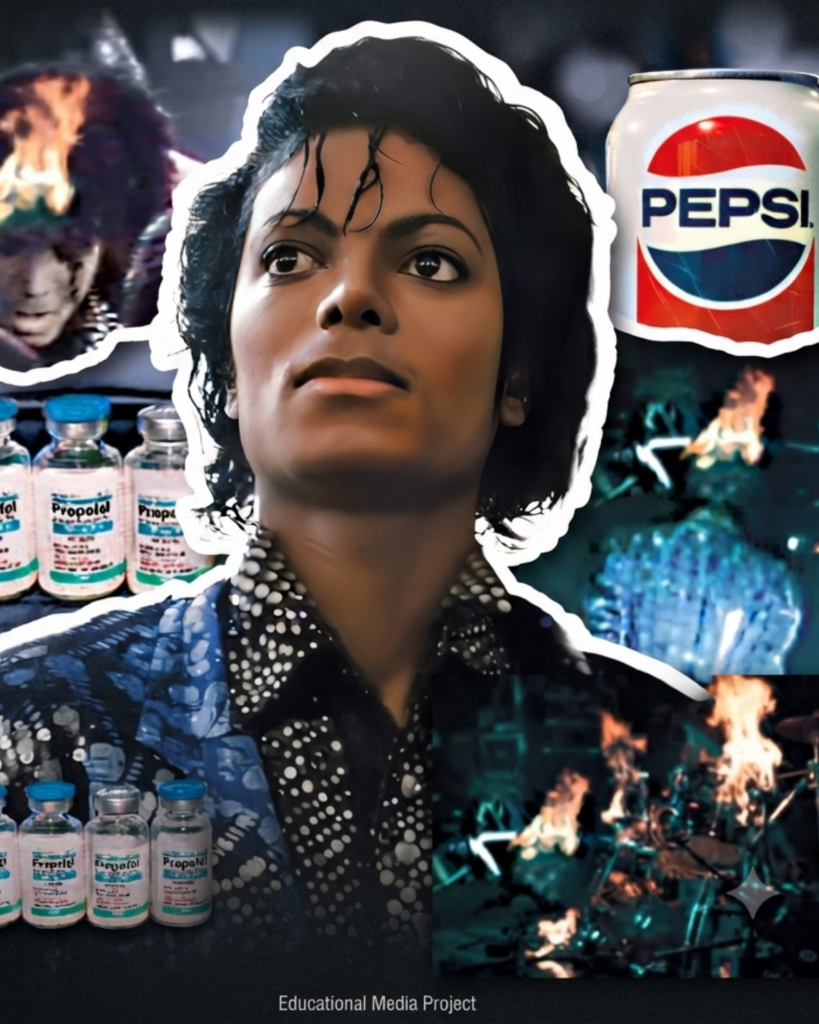

“Burned in an accident while filming a television commercial in Los Angeles, Jackson—one of the world’s most successful recording stars, whose latest album Thriller has sold over 20 million copies—was rushed to hospital after his hair caught fire. Doctors treated him for second-degree burns to his scalp but said he was in no danger.”
That was the sanitized news report. The reality was far more brutal.
The date was January 27, 1984. Michael Jackson, the King of Pop at the peak of his powers, walked onto a stage at the Shrine Auditorium in Los Angeles. Thousands of fans had been assembled to simulate a Jackson 5 concert for a Pepsi commercial. It was supposed to be a routine shoot. Five successful takes had already been filmed. But the director wanted one more.
That sixth take would change everything.
Michael had insisted on creative control. He had fought hard to limit his face on screen to just four seconds—focusing instead on his iconic glove, his shoes, his silhouette. He wanted mystery. He wanted myth. He didn’t want to be just another celebrity shilling soda. But Pepsi had paid $5 million for this campaign, the most expensive marketing deal in history at the time. They wanted a spectacle.
So when director Bob Giraldi told Michael to stay at the top of the stairs a few seconds longer to make the shot more “majestic,” the singer obliged. He struck his iconic pose. The fireworks exploded. And then, disaster.
A spark from the pyrotechnics landed on Michael’s hair—drenched in flammable hairspray, despite his later claims that he used only natural products. Flames erupted on his scalp. The heat was intense. Michael felt it immediately, but he kept dancing for several seconds, not fully comprehending what was happening. Then the pain hit. He spun around, trying to extinguish the fire. He screamed his brother Tito’s name. “Help me!”
The footage captured it all. Michael spinning in panic. The flames engulfing his head. The crew rushing the stage. The audience—3,000 people—thought it was an assassination attempt. Chaos erupted.
The burns were severe. Second and third-degree burns across the top of his scalp. The wound was so deep that a quarter-sized hole exposed his skull. The pain was unimaginable.
But Michael Jackson, ever the performer, made an extraordinary decision. Instead of being whisked out the back door, he insisted on being taken through the front entrance—past the media, past the cameras, past the screaming fans. “I want to show them I’m okay,” he said.
He was wheeled out on a stretcher, his sequined glove still on, waving weakly at the crowd as if to reassure them. The image went around the world. It was a masterstroke of public relations. But behind the gesture, Michael was in agony.
He was rushed to the Brotman Memorial Hospital, where he did the unthinkable. Despite his condition, he gave autographs. He took photos with staff. He visited other patients to cheer them up. He even refused to let his pain show. “Michael couldn’t pass unnoticed,” one witness recalled. “He got up to visit other patients. He showed such empathy, even though he wasn’t well himself.”
The diagnosis was grim. Doctors warned him he would likely suffer partial baldness. He would need reconstructive surgery. In April 1984, surgeons made incisions in his scalp, inserted two balloons to expand healthy skin, and covered the wound. The procedure was brutal. The pain was constant. And for the first time in his life, Michael Jackson began relying on painkillers to cope.
He had always resisted narcotics. He abhorred them. But the headaches were relentless. The migraines were unbearable. And so, reluctantly, he started taking medication. It was a decision that would haunt him for the rest of his life.
“He went from being someone who hated drugs to someone who couldn’t function without them,” one biographer noted. “The Pepsi accident opened the door. It was the beginning of the end.”
Michael was furious when he reviewed the footage. He saw the negligence clearly. The pyrotechnics had misfired. The safety protocols had been ignored. And the director, Bob Giraldi, was trying to blame Michael’s hairspray instead of taking responsibility.
Miko Brando, Marlon Brando’s son and a close friend of Michael, later testified that Giraldi had deliberately asked Michael to stay on the stairs longer. Donald Deskey, a fireman on set, confirmed that Giraldi’s instructions caused the accident. Steve Howell, Michael’s personal cameraman, revealed that Michael was so enraged he wanted to sue Pepsi and release the footage publicly.
His father, Joseph Jackson, had to intervene. “If you show those images, people will only remember you as the guy who burned,” he told his son. “Like John F. Kennedy’s assassination footage. It will define you.” Michael eventually relented. He didn’t release the footage. But he did take the settlement: $1.5 million, which he immediately donated to Brotman Hospital—the very hospital that saved his life.
The commercials still aired. Pepsi won its first victory over Coca-Cola in history. The “Victory” tour went ahead. Michael Jackson continued his partnership with Pepsi for years. But the damage was done.
Michael wore fedoras and wigs for the rest of his life, not as a fashion statement, but to hide the scars. He became dependent on painkillers and sedatives. His addiction grew worse over time. It contributed to his insomnia. It made him erratic. It changed his behavior. And eventually, it killed him.
“People forget that the Pepsi accident wasn’t just a small incident,” one commentator reflected. “It was the pivot point. The moment that changed everything. Before that, Michael was invincible. After that, he was vulnerable. He was in pain. He was dependent. And the people around him exploited that.”
In 2009, Dr. Conrad Murray administered propofol to Michael Jackson to help him sleep. The dosage was reckless. The negligence was criminal. Michael died of acute intoxication. But the path to that death began in 1984—the day a spark set fire to his hair and set him on a collision course with tragedy.
“There is a dark irony,” one analyst said. “The Pepsi commercial made Michael Jackson the most famous man on the planet. And it also destroyed him.”
Michael himself knew it. In his journal, he wrote about his fears. He understood that the pain, the drugs, the dependency—it all started with the fire. He never fully recovered. Not physically. Not emotionally. He kept dancing, kept performing, kept smiling for the cameras. But the pain was always there.
One of the most haunting details about the Pepsi accident is this: the exact day of the accident—January 27, 1984—marked the halfway point of Michael Jackson’s life. Count the days from his birth to that date, and then from that date to his death. They are almost identical. The accident literally divided his life in half.
“Before Pepsi, Michael Jackson was invincible,” the analysis concludes. “After Pepsi, he was mortal. And ultimately, he was lost.”
His mother, Katherine, had convinced him to do the commercial to support his family. His brothers had pressured him. His father had pushed. The record label had exploited him. The director had ignored safety. The pyrotechnicians had been reckless. Everyone had a hand in the tragedy.
“Michael was always giving,” one close friend said. “Always giving to others. He gave everything to his family. He gave everything to his fans. He gave everything to his art. And in the end, he gave his life.”
The Pepsi accident is not just a story about a commercial gone wrong. It is the story of how the King of Pop was slowly, silently, systematically destroyed by the very industry he helped create.


