There are some photographs of Michael Jackson that do not feel like celebrity history. They feel like a private pause.
In a series of images taken during the Jacksons’ visit to Trinidad and Tobago, Michael is seen meeting Janelle “Penny” Commissiong, the Trinidadian beauty queen who made history as Miss Universe 1977. The meeting has long fascinated fans, partly because of who both of them were at that moment — and partly because of how unguarded Michael looks in the pictures.
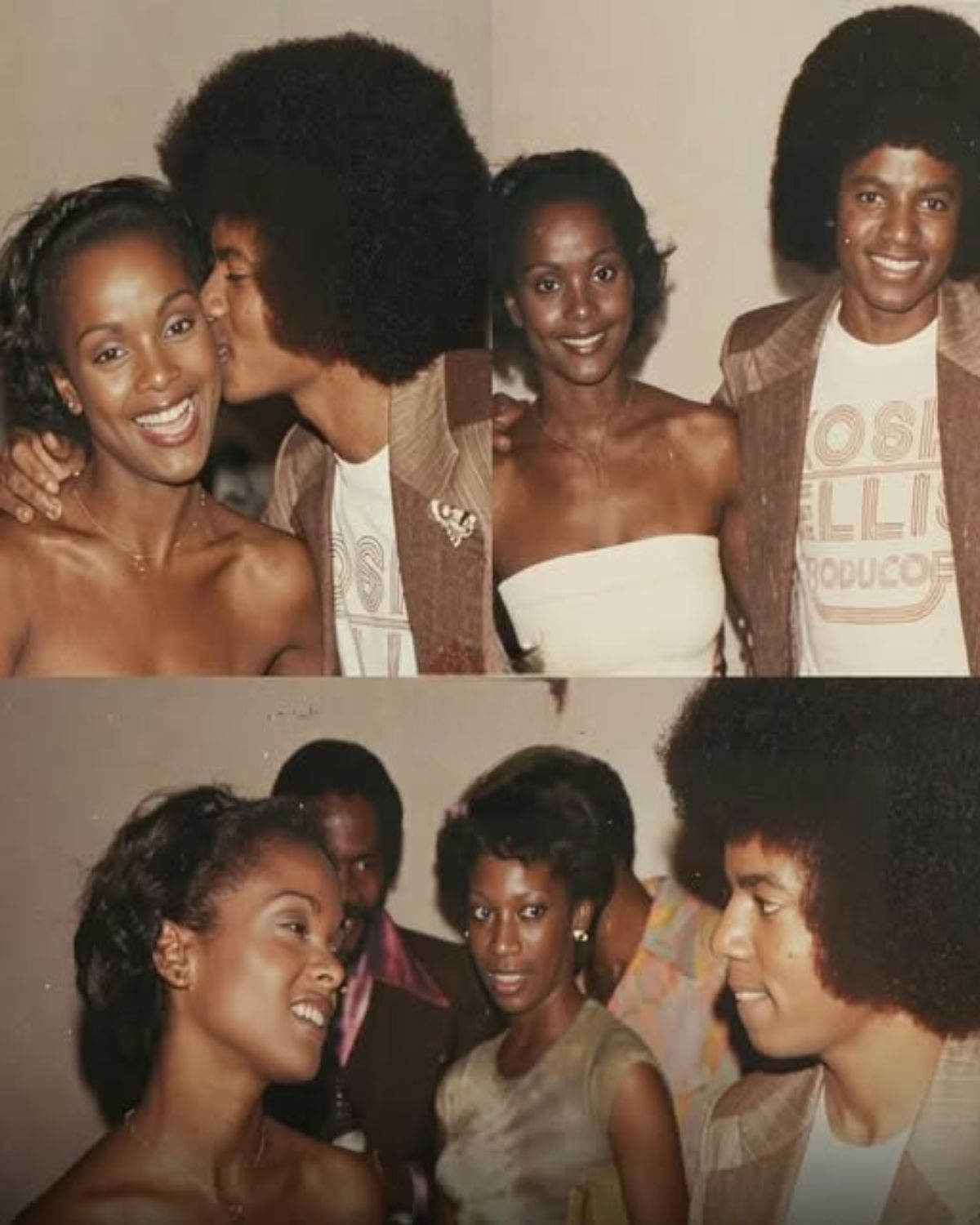
According to photographer Mark Lyndersay, the photographs were taken at the Trinidad Hilton during the Jacksons’ visit to the country. Lyndersay later identified the moment as taking place in February 1978, when Tito, Jackie, Marlon, Michael and Randy Jackson met Commissiong, the first Black woman to win Miss Universe.
For decades, fans have returned to those images: Michael smiling, talking with Commissiong, leaning close, and at one point giving her a gentle kiss on the cheek.
What makes the photographs so striking is not scandal. It is not even romance.
It is how normal Michael looks.
Not the King of Pop. Not the record-breaking icon he would later become. Not the mysterious figure the world would endlessly analyze.
Just Michael.
A young man, still only 19, caught in a moment of admiration.
By the late 1970s, Michael was already famous. He had grown up in front of cameras as the magnetic young star of the Jackson 5, and by the time he arrived in Trinidad with his brothers, he had already lived more public life than most entertainers experience in a lifetime. Lyndersay later wrote that even then, Michael had already logged an extraordinary career as both a group performer and solo artist.
Yet in the photos with Commissiong, his attention does not seem fixed on the camera.
It seems fixed on her.
That is part of the lasting fascination. Commissiong was not just a beauty queen. She had become a national icon for Trinidad and Tobago after being crowned Miss Universe in Santo Domingo in July 1977. Her win made her the first Black woman to hold the title, a landmark moment in pageant history.
So when Michael met her, he was not simply meeting another public figure. He was meeting someone who, in her own way, had also become a symbol of global pride, beauty and representation.
The photographs capture that unusual balance: two young stars from different worlds, both already carrying the weight of public attention, sharing a brief human moment inside a hotel room.
Over time, a famous fan story grew around the meeting. According to the long-running rumor, Michael was so taken with Commissiong that after earning money from The Wiz, he bought an expensive Rolls-Royce and learned to drive because he wanted to take her to a movie premiere himself.
It is a charming story. It is also difficult to prove.
Most serious fans and researchers treat it as more of a legend than a confirmed fact. There is no solid public evidence that the Rolls-Royce story happened exactly as repeated. But the reason the rumor survived may be more interesting than whether it is true.
People believed it because the photographs made it feel possible.
There is something almost painfully human about seeing Michael Jackson — a performer who would later become one of the most mythologized people on earth — look like any other young man caught off guard by admiration. He does not appear calculating. He does not appear staged. He appears curious, slightly nervous, and deeply present.
That is rare in Michael Jackson’s visual history.
So much of his life was photographed as spectacle. The glove. The jacket. The moonwalk. The stadium. The mask. The motorcade. The crowd.
Everything became enormous.
But these images pull the story back down to earth.
They remind viewers that before the mythology hardened around him, Michael Jackson was still a young man capable of being impressed. He could still be shy. He could still be fascinated. He could still forget, for a few seconds, that the world was always watching.
That may be why the photos continue to matter nearly half a century later.
They do not show the biggest performance of his life. They do not show a record-breaking concert or a historic award moment. They do not show the invincible King of Pop.
They show something smaller, softer and harder to manufacture.
Michael Jackson, not performing.
Michael Jackson, not posing.
Michael Jackson, simply being caught in a moment that felt real.
And for a man whose life would later be buried under fame, mystery, headlines and legend, that may be the rarest image of all.