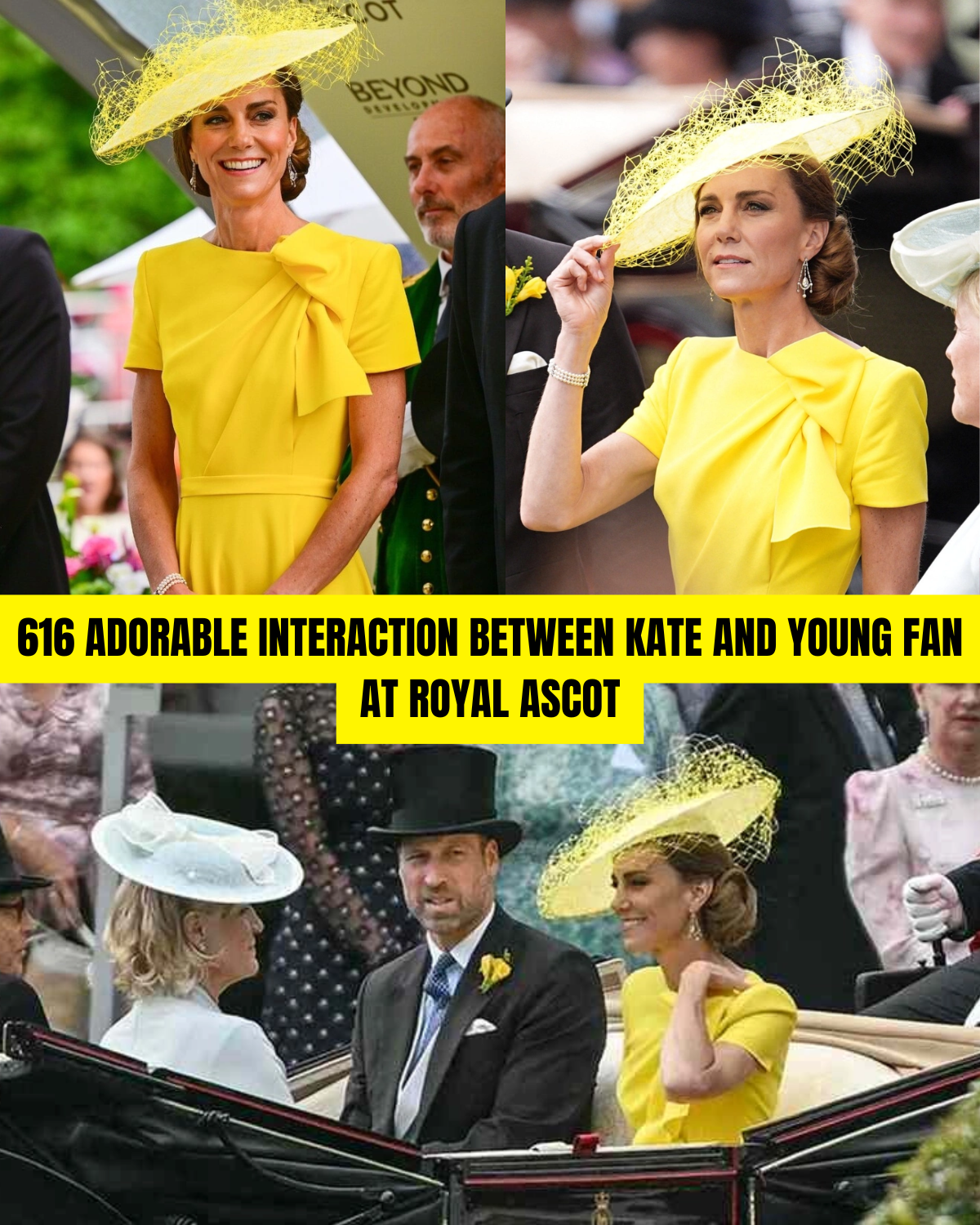
At Royal Ascot, what should have been a strictly ceremonial royal appearance instead turned into a moment of pure humanity—soft, unscripted, and unexpectedly emotional—centered on Catherine, Princess of Wales.

Seated beside Prince William in a horse-drawn carriage during the royal procession, Catherine looked every inch the future queen: composed, radiant, wrapped in a daffodil-yellow gown that shimmered like sunlight over tradition itself. Yet it was not the dress, nor the jewels, that people would remember.
It was a child’s voice.
“Princess Kate!” a young girl called out from the crowd. For a brief second, everything seemed to pause—like the entire racecourse was holding its breath. Catherine immediately turned, smiling and waving gently, acknowledging the innocent excitement.
Then came the moment that changed the atmosphere entirely.
As the little girl shyly turned away, Catherine leaned into humor, softly saying: “I can still see you.”

Laughter rippled through the crowd. Not the distant, polite laughter of formality—but the warm, surprised laughter of people suddenly reminded that royalty can also be playful, human, alive.
Witnesses described the moment as “unexpectedly intimate” and “strangely emotional in its simplicity,” a rare break from the rigid choreography of royal tradition.
But behind that smile, there was something deeper still. Catherine’s return to Ascot marked a significant step back into public life after her health recovery—a return watched closely, almost anxiously, by the public.

Even her jewelry carried weight beyond beauty: diamond earrings once worn by Queen Elizabeth II, and a pearl necklace linked to Princess Diana—quiet echoes of legacy resting gently on her presence.
And yet, in a world of crowns, titles, and centuries of tradition, it was not heritage that defined the moment.
It was a child’s call. A princess’s smile. And a single sentence—“I can still see you”—that turned Royal Ascot into something unexpectedly unforgettable.
Because sometimes, the most powerful royal moments are not spoken from balconies… but whispered in laughter from a moving carriage.