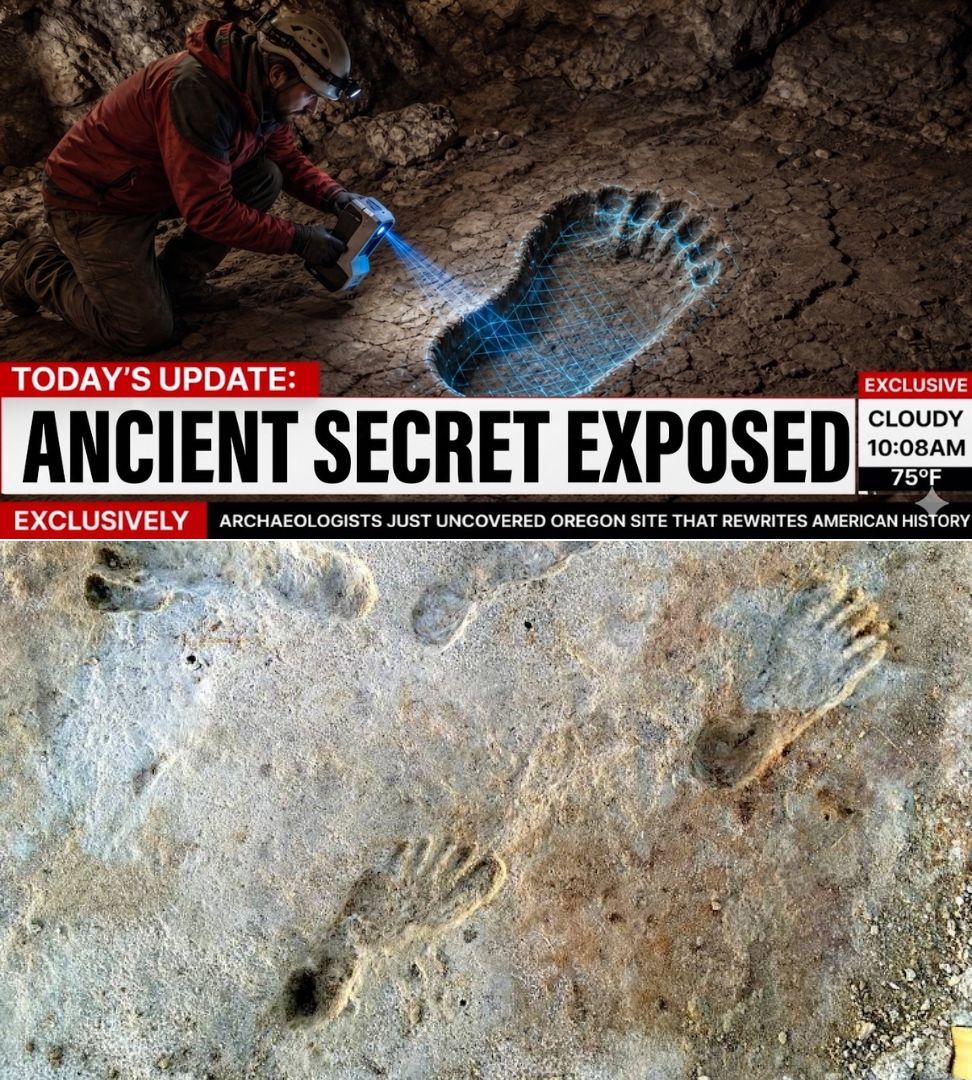
A groundbreaking discovery in Oregon is rewriting the narrative of human history in the Americas. For decades, textbooks have taught that the first humans arrived around 13,000 years ago, but new evidence suggests that our understanding of this timeline is far too simplistic and may be fundamentally flawed.
 The Clovis culture, named after the distinctive stone tools first identified in New Mexico during the 1930s, has long been considered the first group of people to inhabit North America. These skilled hunters, known for their beautifully crafted spear points, were thought to have migrated across a land bridge from Siberia to Alaska during the last ice age. This narrative, so neatly packaged, has dominated American archaeology for nearly a century, leaving little room for alternative theories.
However, recent archaeological findings in Oregon and other parts of the continent are challenging this established story. Evidence now indicates that humans may have arrived in the Americas thousands, if not tens of thousands, of years earlier than previously believed, using routes and methods that were not considered by the old model.
At the heart of this revelation are the Paisley Caves in south-central Oregon. These unassuming rock shelters, which overlook a once-water-filled lake basin, have yielded remarkable finds. Archaeologists excavating the caves discovered coprolites—ancient human waste that has been preserved for over 14,000 years. This unglamorous evidence has proven to be invaluable, as it contains DNA that matches the genetic lineages of modern Native Americans, indicating that people were living in Oregon long before the Clovis culture was thought to have arrived.

But the discoveries don’t stop there. Other sites, like Meadowcroft Rockshelter in Pennsylvania, have revealed human artifacts dating back as far as 19,000 years, further complicating the Clovis-first narrative. Despite rigorous methodologies and thorough documentation, the findings faced skepticism and rejection from the scientific community, which had built careers around the established timeline.
In Oregon’s Rimrock Draw, excavations have uncovered stone tools and animal remains dated to between 21,000 and 22,000 years ago, suggesting that humans were present in the region during a time when glaciers blocked the previously assumed migration routes. The tools found at this site belong to a different cultural tradition, known as the Western Stemmed Tradition, which raises questions about the diversity of early human populations in the Americas.

Even more astonishing are the fossilized human footprints discovered at White Sands National Park in New Mexico, dating back 21,000 to 23,000 years. These prints, preserved alongside tracks from Ice Age animals, indicate that humans coexisted with megafauna during a period when the Clovis culture was believed to be the first. The implications of these findings are profound, suggesting that humans were navigating the continent long before the ice-free corridor opened.
The Cerutti Mastodon site in California adds another layer of complexity to this evolving narrative. Here, researchers found mastodon bones with signs of human interaction, dating back approximately 130,000 years. This discovery, while controversial, hints at the possibility of human presence in North America during a time when modern humans had yet to leave Africa.

As the evidence mounts, it becomes increasingly clear that the story of the first Americans is not a simple tale of a single migration. Instead, it paints a picture of multiple waves of migration, diverse cultures, and complex histories that span tens of thousands of years.
For Indigenous peoples, this new understanding affirms what their oral traditions have long maintained: that their ancestors have been on this land for far longer than previously acknowledged. The narrative of the Americas is being rewritten, revealing a deeper, richer history that challenges everything we thought we knew.
As researchers continue to unearth new evidence, one can’t help but wonder: what other secrets lie buried beneath the surface, waiting to reshape our understanding of the first Americans?