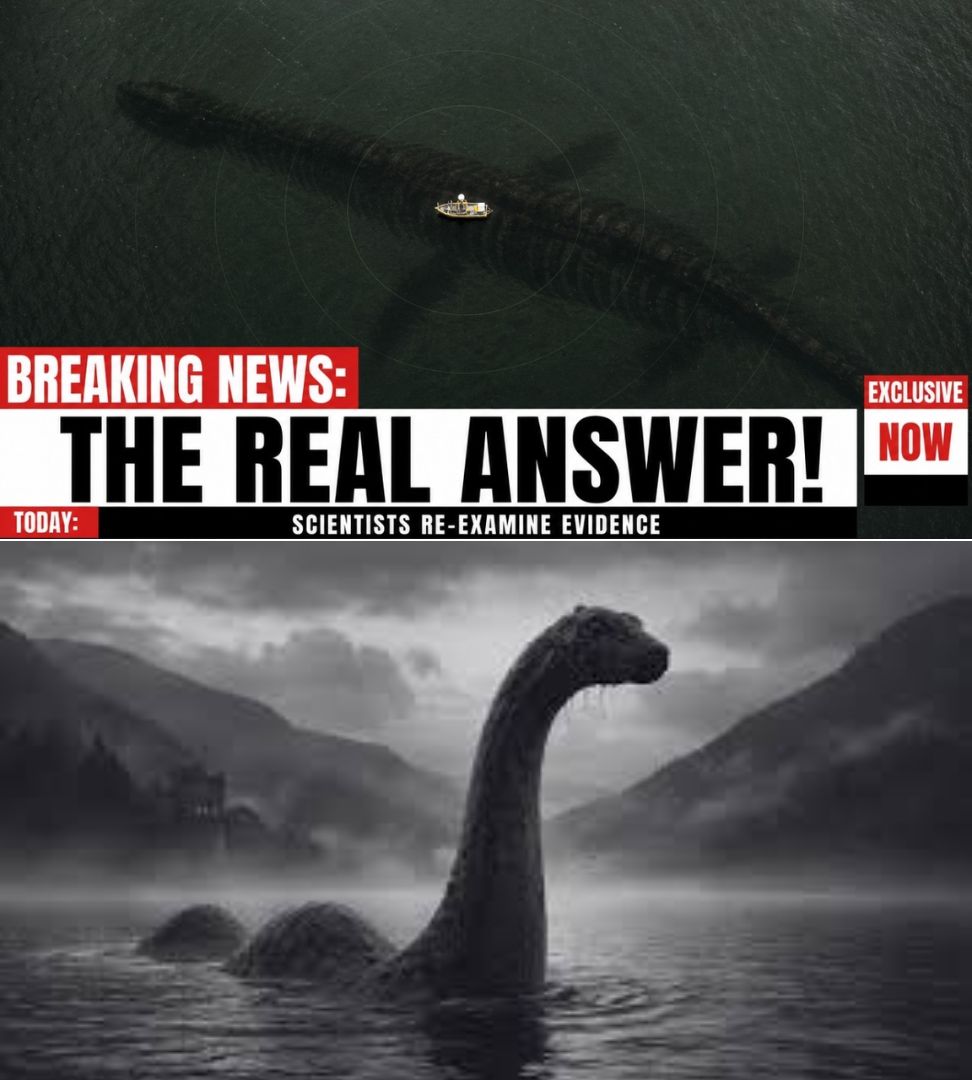
The sonar screens flickered in the darkness of the control room, and the operators knew immediately that what they were seeing was not a school of fish. The contact was solid, massive, moving at a depth of nearly five hundred feet in waters where sunlight has never reached. This was not the first time such a reading had been recorded in Loch Ness, but it was among the most compelling in a growing body of evidence that has forced researchers to reconsider everything they thought they knew about the most famous cryptid in the world.
 For ninety-one years, the Loch Ness monster has been dismissed as a combination of misidentification, hoax, and wishful thinking. The surgeon’s photograph, revealed as a hoax in 1994, was treated as the death blow to the legend. But the serious investigators who have spent decades studying the loch never considered that photograph central to their work. The real evidence was always elsewhere, buried in sonar data, acoustic recordings, environmental DNA studies, and systematic observations that have been compiled over generations.
The loch itself is an environment unlike any other in the British Isles. Carved by glaciers that retreated ten thousand years ago, Loch Ness stretches twenty-three miles in length and plunges to depths of seven hundred and fifty-five feet. It contains more fresh water than all the lakes in England and Wales combined. The water is stained dark brown by peat sediment, reducing visibility below the surface to near zero within feet. The temperature hovers just above freezing year-round, so cold that the bacteria responsible for decomposition cannot survive, meaning bodies sunk in its depths do not decompose normally.
The first major sonar contact came in 1954. The fishing boat Rival 3 was using echo sounding equipment when it detected something large moving at a depth of approximately four hundred and eighty feet. The contact was solid, not the scattered return expected from a school of fish, but a single large mass that tracked on the sonar for nearly half a mile before disappearing into the depths. The crew had been fishing Loch Ness for years. They knew what fish looked like on sonar. They knew what the bottom looked like. This was none of those things.
In 1960, aeronautical engineer Tim Dinsdale filmed what he believed to be the Loch Ness monster from the shore. The film showed a large dark object moving across the surface, leaving a substantial wake. Skeptics initially dismissed the footage as showing a boat, but Dinsdale had filmed a boat in the same location for comparison, and the two objects looked nothing alike. The film was submitted to the Joint Air Reconnaissance Intelligence Center, the British military organization responsible for analyzing surveillance imagery.
The military analysts applied the same techniques they used to identify Soviet submarines and aircraft. Their conclusion was that the object in the Dinsdale film was probably an animate object approximately twelve to sixteen feet long. This finding was not widely publicized. It did not fit the narrative that the Loch Ness monster was a joke. It was quietly filed away, but the analysis exists, and the conclusion stands. The British military’s own experts determined that something large and alive was filmed in Loch Ness in 1960.
The 1970s brought underwater photography to the investigation. Robert Rines, a patent attorney and inventor with a background in physics, led expeditions that combined sonar tracking with synchronized underwater cameras. In 1972, one of these camera systems captured an image that remains controversial to this day. The photograph shows what appears to be a large diamond-shaped flipper attached to a rough textured body, estimated at four to six feet in length based on known camera parameters.
The photographs were published in Nature, one of the world’s most prestigious scientific journals. This was not a tabloid. This was not a monster hunting magazine. Nature, the journal that has published discoveries from DNA to black holes, published photographs of what appeared to be an unknown animal in Loch Ness. Peer reviewers at one of the most rigorous scientific journals in the world looked at the evidence and decided it was worth publishing. That decision has never been retracted.
 The largest coordinated search in Loch Ness history occurred in 1987. Operation Deepscan deployed twenty-four boats in a line across the width of the loch, equipped with sonar systems that created a curtain of sound sweeping through the water. The boats moved down the length of the loch together, scanning the entire volume of water from surface to bottom. The operation was designed to settle the question definitively. If something large was in the loch, the sonar curtain would find it.
Operation Deepscan found three contacts. Three large moving objects were detected at depths below six hundred feet, deeper than any known fish population in the loch. The contacts were solid returns, not schools of fish. They moved in ways inconsistent with debris or thermal layers. Darryl Lorance, the sonar manufacturer whose equipment was used in the operation, examined the contacts personally. His conclusion was that the returns were larger than a shark but smaller than a whale.
The skeptics have always insisted that a large unknown animal in Loch Ness is biologically impossible. The argument is straightforward. A breeding population of large animals would require a substantial food supply. Loch Ness, with its cold, dark, nutrient-poor waters, simply cannot support enough prey to feed a population of large predators. But these arguments assume we know what the creature eats. If the Loch Ness animal is a fish, cold-blooded and slow metabolizing, the caloric requirements would be far lower than for a warm-blooded mammal.
The arguments also assume the population is large. But Loch Ness is connected to the sea. The River Ness flows from the northern end of the loch to the Moray Firth, an inlet of the North Sea. Marine animals can and do enter the loch from the ocean. Seals have been documented in Loch Ness. Atlantic salmon run through it. A solitary animal or a very small population could potentially survive in the loch while spending much of its time in the marine environment.
Then came the environmental DNA study in 2019. Professor Neil Gemmell of the University of Otago led a comprehensive survey of Loch Ness, collecting water samples from throughout the loch at various depths. The technique is elegant. Every organism sheds DNA into its environment through skin cells, mucus, and waste. By sequencing the DNA, researchers can identify what species are present without ever seeing them directly.
The results were presented as a debunking of the monster legend. Gemmell found no evidence of large unknown animals, no plesiosaur DNA, no unknown reptile. But the headlines missed something important. Gemmell’s study found enormous quantities of eel DNA in Loch Ness, far more than would be expected from a normal eel population. Gemmell himself acknowledged the finding. He suggested cautiously that the Loch Ness monster sightings might be explained by unusually large eels, far larger than any currently documented.
European eels can grow to substantial sizes. The largest recorded specimens have exceeded five feet in length, but the species is poorly understood. Eels are mysterious creatures that spawn in the Sargasso Sea and migrate across the Atlantic. Their maximum potential size in optimal conditions is unknown. An eel that lived in Loch Ness for fifty years, seventy years, a century, how large might it become? No one knows. The maximum size of a European eel has never been established because no one has ever studied eels that have lived their entire lives in optimal conditions without migrating.

A fifteen-foot eel moving through dark water, its elongated body creating humps as it undulates, its head rising briefly to the surface before submerging again. What would witnesses describe? They would describe exactly what they have been describing for ninety-one years. The eel hypothesis does not explain everything. It does not explain sonar contacts at six hundred feet where eels typically do not swim. It does not explain the military analysis of the Dinsdale film which estimated the object at twelve to sixteen feet in a body shape inconsistent with an eel.
But it opens a door. If the Loch Ness monster is not a single creature but a phenomenon, if the sightings represent giant eels at the surface, large fish at middle depths, and something else entirely in the abyss, then the mystery becomes more plausible, not less. We may not be looking for one monster. We may be looking at an entire ecosystem that has never been properly documented.
The investigation continues today. The Loch Ness Project has maintained monitoring equipment in the loch for decades. Sonar systems, cameras, and environmental sensors collect data continuously. The contacts continue. In 2020, a sonar contact described as the most compelling ever recorded was captured by a tour boat equipped with modern fish-finding equipment. The contact showed a large elongated object at a depth of approximately five hundred feet moving parallel to the boat before descending further into the darkness.
In 2023, the largest surface search in Loch Ness history was conducted. Hundreds of volunteers with binoculars and cameras were coordinated with drone surveillance and thermal imaging. The search captured footage of an unusual disturbance in the water that investigators could not explain. The searches continue because the evidence continues. Not every sighting, not every photograph, but a core of anomalous observations that resist conventional explanation.
The question that skeptics have never adequately answered is why here. If the Loch Ness monster is purely a product of misidentification and hoax, why has Loch Ness produced so many more reports than comparable lakes? Why not Loch Lomond, which is larger by surface area? Why not Loch Morar, which is deeper? Why not any of the hundreds of other Scottish lochs with similar characteristics? The answer may be that something is genuinely different about Loch Ness, something in the environment, the food web, the specific combination of conditions that exists nowhere else.
The skeptics demand a body. They demand definitive footage. They demand proof that would satisfy a courtroom. But the skeptics are not applying their standards consistently. New species are documented every year based on evidence far less comprehensive than what exists for Loch Ness. Animals are added to the scientific record based on a few specimens, a handful of observations, limited photographic evidence. The bar for Loch Ness has been set impossibly high, not because the evidence is weak, but because the implications are uncomfortable.
 Mainstream science has committed itself to the position that large unknown animals cannot exist in well-studied areas. Admitting that something large has been living in a Scottish lake for decades, studied by multiple expeditions, photographed, tracked on sonar, and still not identified would be embarrassing. And so the evidence is dismissed. The sonar contacts are waved away as equipment error. The photographs are rejected as ambiguous. The consistent eyewitness descriptions are attributed to expectation bias.
The real answer to the Loch Ness monster is stranger than the legend. Because the legend has always been too simple. The legend says there is a monster, a single specific creature, a plesiosaur survivor or something equally dramatic. The reality appears to be more complex. Loch Ness harbors something, possibly multiple somethings, that we have not been able to identify. The combination of depth, darkness, volume, and cold creates an environment uniquely resistant to investigation.
The sonar contacts, the photographic evidence, the environmental DNA findings, and the eyewitness reports all point to biological activity that has never been adequately explained. It might be giant eels reaching unprecedented sizes in optimal conditions. It might be a species of large fish that has never been formally described. It might be something that emerges from the sea through the River Ness, spending part of its life cycle in the loch and part in the ocean. It might be something we have not yet imagined.
What it is not is nothing. The evidence accumulated over ninety-one years does not point to misidentification and hoax. It points to an unknown, a gap in our understanding that we have been unwilling to acknowledge. Loch Ness is not a solved mystery. It is an unsolved one that science has chosen to ignore. The re-examination of the evidence has not debunked the monster. It has revealed that the case for something unknown in the loch is stronger than the mainstream narrative acknowledges.
The Dinsdale film analysis stands. The Operation Deepscan contacts were never explained. The environmental DNA survey found biological anomalies that researchers themselves could not account for. The sonar contacts continue to this day. Something is in Loch Ness. We have been looking for ninety-one years. We have deployed submarines, sonar, cameras, DNA sampling, drones, and thermal imaging. We have conducted the most thorough investigation of any body of water on Earth. And we still cannot say definitively what is down there.
That is not failure. That is data. The inability to identify what is in the loch despite nearly a century of effort tells us something important. Whatever lives in those depths is adapted to evade detection. It inhabits an environment that protects it from observation. It has survived because the loch itself makes finding it nearly impossible. The legend says there is a monster in Loch Ness. The evidence says there is something, something large, something elusive, something that has defied identification despite the most intensive investigation ever conducted on an alleged cryptid.
The monster hunters were right. They were just looking for the wrong monster. The real creature, whatever it is, is stranger than the plesiosaur of legend. It is an animal that has adapted to one of the most hostile environments in the British Isles. An animal that surfaces rarely and unpredictably. An animal that moves through darkness so complete that even modern technology cannot penetrate it. It is real. And after ninety-one years, we are only beginning to understand what it might be.
The investigation continues. The sonar scans continue. The DNA studies continue. Somewhere in the cold, dark depths of Loch Ness, something is moving. Something that has been there longer than anyone knows. Something that will still be there when we finally develop the technology to find it. The Loch Ness monster is real. The only question left is what kind of real. And that question is stranger than any legend could capture.
https://www.youtube.com/embed/ENSDYr8i2pU